
Bint e Aisha
-
Posts
1,761 -
Joined
-
Last visited
-
Days Won
106
Content Type
Profiles
Forums
Events
Everything posted by Bint e Aisha
-
🌷آپ دنیا کی خوبصورت عورت بن سکتی ہیں 🌷 وکلُّ الحادثاتِ و اِن تناھتْ۔۔۔۔ فموصولُٗ بھا فرجُٗ قریبُ شعر کا مفہوم ہے کہ "دنیا کی ہر مشکل خواہ وہ جس قدر بھی کو اس کے ساتھ نصرت بھی بندھی ہوئی ہے۔" آپ اپنی خوبصورتی کے سبب دھوپ کی روشنی سے بھی زیادہ چمکدار ہیں۔ اپنے اخلاق کی وجہ سے مُشک سے بھی زیادہ قیمتی ہیں۔ اپنی تواضع کی وجہ سے چاند سے بھی زیادہ بلند ہیں، لہٰذا آپ اپنے ایمان کی خوبصورتی کی حفاظت کیجیے اور قناعت و پردہ کی بھی حفاظت کیجیے۔ خوب جان لیجیے کہ آپ کے زیور سونا چاندی اور ہیرے نہیں بلکہ تہجد کے وقت کی دو رکعتیں، روزہ کی شدید پیاس اور وہ خفیہ صدقہ ہے جس کا علم صرف اللہ تعالی کو ہے۔ وہ آنسو ہیں جن سے گناہ دھلتے ہیں اور وہ لمبا سجدہ ہے جو اللہ تعالیٰ کی تعظیم کے لیے کیا جاتا ہے۔ اور اللہ تعالی سے وہ حیا ہے جو شیطانی وساوس سے بچاتی ہے۔ لہٰذا آپ تقویٰ کا لباس زیب تن کیجیے، کیونکہ آپ پوری دنیا میں خوبصورت عورت ہیں، چاہے آپ کے کپڑے بوسیدہ ہی کیوں نہ ہوں۔ آپ حیا کا برقع پہن لیں، کیونکہ آپ دنیا کی اچھی عورت ہیں، چاہے آپ کے پاس پہننے کے لیے عمدہ جوتی نہ ہو۔ آپ ہمیشہ غیر مسلم اور گناہگار عورتوں سے دھیان رکھیے کہ یہ جہنم کے انگارے ہیں۔ (ماخوذ از: دنیا کی سعادت مند عورت) (اللہ تعالیٰ ہم سب کو اپنے ایمان کی حفاظت کرنے اور اس کی خوبصورت صفات کو اپنانے کی توفیق عطا فرمائے۔ اور ایمان کی حالت میں اس دنیا سے اٹھائے۔ آمین!) تحریر: راشد محمود عُفِیٙ عٙنْہ (سکونِ دل)
-
🌷 آپ کا گھر عزت و محبت کی مملکت ہے 🌷 قُل ھو الرحمٰن آمنّا بہٖ۔۔۔۔۔ واتبعنا ھادیاً من یثربٖ شعر کا مفہوم ہے کہ "کہہ دیجیے ہم اس رحمٰن ذات پر ایمان لائے ہیں اور مدینہ میں ہدایت دینے والے کے تابعدار ہوگئے ہیں۔ اے میری عزیز بہن! اپنے گھر کی چار دیواری سے سوائے شدید ضرورت کے باہر نہ نکلیں کہ آپ کا گھر سعادت کا ایک راز ہے۔ اللہ تعالیٰ فرماتے ہیں: "وَقَرْنَ فِي بُيُوتِكُنَّ" کہ آپ عورتیں اپنے گھروں میں ٹھہری رہیے۔" آپ کے گھر میں ہی کھانے پینے کا سامان ہے اور آپ گھر میں ہی اپنے شرف اور وقار و حیاء کی حفاظت کر سکتی ہیں۔ ہمیشہ گری ہوئی عورت ہی کسی ضرورت کے بغیر بازار کی طرف نکلتی ہے، جس کا عزم یہ ہوتا ہے کہ ہر نئے فیشن اور زمانہ کے ساتھ چلے، بڑی مارکیٹوں میں گھومے اور ہر نئی چیز کے بارے میں معلومات حاصل کرے۔ ایسی عورت کے پاس دین کا کوئی شوق نہیں ہے، نہ علم و معرفت ہے اور نہ ثقافت۔ ایسی ہی عورتوں کی زندگی فضول ہے، جن کی نظر صرف اچھے کھانے پینے اور اچھا پہننے پر رہتی ہے۔ آپ خیال کیجیے کہ اپنے گھر کو مت چھوڑیں، کیونکہ یہی خوشیوں کا گھر ہے، امن و راحت کا محل اور انس و سلامتی کی منزل ہے۔ لہٰذا آپ اپنے گھر کی اچھائی کے لیے بنیاد بن جائیے۔ (ماخوذ از: دنیا کی سعادت مند عورت) (اپنے گھر کی چار دیواری کو لازم پکڑیں، بغیر کسی ضروت کے باہر نہ جائیں۔ اپنے راز اور گھریلو معاملات ایسے لوگوں کو مت بتائیں جو آپ کو ایسی رائے دیں جس سے کبھی سعادت حاصل نہیں ہو سکتی۔) تحریر: راشد محمود عُفِیٙ عٙنْہ (سکونِ دل)
-
🌷 پریشانیاں اور تکلیفیں ہمیشہ نہیں رہتیں 🌷 أتحسب أنّ البؤس للمرء دائم۔۔۔۔ ولو دام شیئٌ عدّہ الناس فی العجب شعر کا مفہوم ہے کہ "کیا آپ یہ سمجھتی ہیں کہ انسان پر آئی ہوئی پریشانی ہمیشہ رہتی ہے؟ اگر وہ ہمیشہ رہتی تو لوگ اسے عجیب سمجھتے۔" زندگی کو محبت اور امید کی نظر سے دیکھیے، کیونکہ زندگی خدائی ہدیہ ہے۔ آپ اس خدائی ہدیہ کو قبول کیجیے اور خوشی سے رہیے۔ صبح صادق کو اس کی خوبصورتی کے ساتھ قبول کیجیے، رات کو اس کے سکون و وقار کے ساتھ قبول کیجیے، سانس کے ذریعے ہوا کی خوشی اور خوبصورتی حاصل کیجیے۔ اس زندگی کو عبرت کی نظر سے دیکھیے، اللہ تعالی کی اس وسیع زمین پر پھیلی ہوئی نعمتوں سے فائدہ اٹھائیے۔ خوشبودار پھول، شبنم، سرسبز باغات، دھوپ کی تپش، چاند کی روشنی، یہ سب خدائی عطیات ہیں، انہیں اللہ تعالی کی اطاعت اور اس کا شکر ادا کرنے اور اسی کی حمد و ثناء میں معاون بنائیے۔ خیال کیجیے! غم اور پریشانی آپ کو نہ جکڑ لیں، ورنہ آپ خدائی نعمتوں کو نہ دیکھ سکیں گی۔ اللہ تعالی نے ان نعمتوں کو اسی لیے دیا ہے کہ انہیں اللہ کی اطاعت میں مددگار بنایا جائے۔ اللہ تعالی فرماتے ہیں: *یٰۤاَیُّھَا الرُّسُلُ کُلُوۡا مِنَ الطَّیِّبٰتِ وَ اعۡمَلُوۡا صَالِحًا ؕ اِنِّیۡ بِمَا تَعۡمَلُوۡنَ عَلِیۡمٌ.* ترجمہ: اے پیغمبرو ! پاکیزہ چیزوں میں سے (جو چاہو) کھاؤ اور نیک عمل کرو۔ (سورہ المؤمنون:51) (ماخوذ از: دنیا کی سعادت مند عورت) (لہٰذا ہمیں چاہیے کہ غم ہو یا خوشی، ہر حال میں اللہ رب العزت سے اپنا تعلق مضبوط بنائیں۔ اس کی نعمتوں پر شکر ادا کریں اور غم کے دور کرنے میں اسی سے مدد طلب کریں۔) تحریر: راشد محمود عُفِیٙ عٙنْہ (سکونِ دل)
-
🌷! اے اونچے مقام والی عورت🌷 رُبَّ أمرٍ تَتَّقِیْهِ۔۔۔۔ جَرَّ أَمْراً تَرْتَجِیْهِ شعر کا مفہوم ہے کہ "کبھی ایسا بھی ہوتا ہے کہ جس کام سے آپ کو خدشہ اور ڈر ہوتا ہے وہ اپنے ساتھ بھلائی بھی لے آتا ہے جس کی آپ کو چاہت ہوتی ہے۔" اے سچی مسلمان عورت! اے اللہ کی طرف رجوع کرنے والی مومن عورت! آپ کھجور جیسی بن جائیں، جیسے کھجور گندگی سے دور اور بلندی پر ہوتی ہے جب کوئی اس کو پتھر مارتا ہے تو اس سے پھل گرتے ہیں اور وہ گرمی سردی میں سرسبز ہی رہتی ہے اور نفع پہنچانے والی ہوتی ہے۔ اے مسلمان عورت! آپ اپنے آپ کو لغو باتوں سے بچا کر اونچے مقام والی بن جائیں اور ہر اس چیز سے اپنی حفاظت کریں جس سے آپ کی فطری شرم و حیا ختم ہو۔ آپ اپنی باتوں کو ذکر بنائیں، اپنی نظر سے عبرت پکڑیں اور خاموشی میں اچھی سوچ اپنائیں، پھر آپ کو سعادت وراحت ملے گی اور زمین پر آپ کو قبولیت ملے گی۔ لوگوں میں آپ کو اچھی تعریف اور سچی دعا حاصل ہوگی۔ اللہ تعالی آپ کی پریشانی کے بادل اور مصائب کے پہاڑ دور فرما دیں گے۔ اہل ایمان کی دعاؤں سے آپ پُرسکون سو جائیں اور انہی کی تعریف پر صبح کو بیدار ہوں، پھر آپ کو معلوم ہوگا کہ سعادت بینک بیلنس جمع کرنے میں نہیں بلکہ اللہ تعالیٰ کی اطاعت میں ہے اور خوبصورت لباس میں نہیں بلکہ خدمتِ خلق میں ہے۔ (ماخوذ از: دنیا کی سعادت مند عورت) (ہمیں چاہیے کہ اللہ تعالیٰ سے اور اپنے آپ سے ناامید مت ہوں، زندگی میں ایسے مسائل پیش آتے ہیں جن کے سامنے ہمت جواب دے جاتی ہے، لیکن ان مسائل کو خود پر غلبہ نہ پانے دیں، اور ان مسائل سے نمٹنے کے لیے اللہ تعالٰی سے مدد طلب کریں اور اچھی تدبیر اختیار کرنے کی کوشش کریں۔) تحریر: راشد محمود عُفِیٙ عٙنْہ (سکونِ دل)
-
Question: Is one of the disease of the heart depression? And if so what is the cure? Answer: Bismillahi Taʿālā Assalāmu ʿalaykum waraḥmatullāhī wabrakātuh, At the outset, we should not see everything in a linear fashion. While the linear thought process is easy to grasp, life is not linear. It is constantly being influenced by different factors. There can be a number of these factors which leads towards depression. Just as there are medical and psychiatric procedures to tackle depression, Islam also gives guidelines towards restoring such balanced state of contentment. Every individual will have different conditions and factors that cause his depression may be different. This is why the psychiatrist would go through multiple sessions to assess the key factors contributing towards the depression. Sharīʿah does not discourage taking such medical treatments. In fact, Islam complements these efforts to keep a healthy mindset and disposition. In Islam we recognize that Allah Taʿālā is the absolute power over all the factors that may contribute towards one’s depression. Hence, it is pivotal that along with medical procedures which tackle any physical factors, we ultimately rely on Allāh to guide us through emotional, mental and religious factors as well. Rasūlullāh ﷺ taught a great supplication for such instance. اللَّهُمَّ إِنِّي أَعُوذُ بِكَ مِنَ الهَمِّ وَالحَزَنِ، وَالعَجْزِ وَالكَسَلِ، وَالبُخْلِ وَالجُبْنِ، وَضَلَعِ الدَّيْنِ، وَغَلَبَةِ الرِّجَالِ Allāhumma innī aʿūẓu bika minal hammi wal hazan; wal ʿajzi wal kasal; wal bukhli wal jubn; wa ḍalaʿi dayn wa ghalabati rijal O Allah, I seek your protection from stress, depression, weakness, laziness, miserliness, cowardice, the burden of debts and being overpowered by men. This beautiful duʿāʾ should be recited as much as possible, while focusing on the meaning and concientizing oneself that Allah is more powerful than all these factors and with the aid of Allah, overcoming these factors can become a breeze. May Allah grant you complete contentment in life and rest from any difficulties therein, Āmīn And Allāh Taʿālā Knows best, Wassalamu ʿalaykum, Mufti Faisal al-Mahmudi صحيح البخاري – دار طوق النجاة (8/ 79) 6369 – حدثنا خالد بن مخلد، حدثنا سليمان، قال: حدثني عمرو بن أبي عمرو، قال: سمعت أنس بن مالك، قال: كان النبي صلى الله عليه وسلم يقول: «اللهم إني أعوذ بك من الهم والحزن، والعجز والكسل، والجبن والبخل، وضلع الدين، وغلبة الرجال» Fatwa.ca
-
 Question Can we follow more than one scholar in islam? Answer Bismillahi Ta'ala, Walaikum Assalam Warahmatullah, There is a statement in arabic which says, "For every field has its people". While we understand that it is most safe to restrict oneself to one scholar and follow him, yet if one has access to multiple scholars then there is nothing wrong with seeking a scholar of expertise in that particular field. For example, if one has to go to a doctor, then one cannot simply stick to one General Practitioner. Instead, one will need to seek out the doctor who specializes in the field for which a medical advice is needed. Hence for a heart disease, it would not serve to seek out a neurologist. In other terms, if you are looking for guidance in food items and their halal and haram status then it would be beneficial to seek out scholars who do not only understand the fiqhi aspects of halal and haram food, but also has the ability review his judgement based on industrial practices in that field. Similarly, if you are looking for guidance in marital dispute, it will best help if you approach a scholar who specializes in mediation and dispute counseling. Do not confuse this with the issue of following only one madhab (school of methodology). There are four major schools of methodology; Hanafiyyah, Malikiyyah, Shafi'iyyah and Hanbaliyyah. It is best to restrict oneself in following one of these schools and not mix and match. To understand this restriction, revert to the same example given above about seeking out a doctor for medical guidance. While you choose specific specialists to guide you in your medical diagnosis, you stick to the same methodology of medicine. If you choose a mode of medical treatment such as allopathy (general secular medical treatments) for your ailment, then you do not mix it with homeopathy or acupuncture medicine. Similarly, if you have chosen to follow one of four schools in fiqh, then it is equally detrimental to mix and match for your soul as it would be to mix and match medical treatments for your body. So while within the hanafiya school, you may choose different scholars based on their expertise or base on your reliance on those scholars within the hanafiya school. Wallahu A'lam, Mufti Faisal al-Mahmudi Fatwa.ca
- 1 reply
-
- 1
-

-
السلام علیکم ورحمة الله وبركاته A new website, Daruliftaa Malawi has been launched by Mufti Safwaan Ibrahim daruliftaamw.com Foreword by Mufti Ebrahim Desai [Hafidhahullah] Principal & Founder – Darul Iftaa Mahmudiyyah, Sherwood – Durban Director of askimam.org | daruliftaa.net | idealwoman.org | tasawwuf.daralmahmood.org ___________ ﷽ The world is thirsty for guidance on the straight path (siratul mustaqeem) which is described as the moderate path which is between extremism and negligence. One of the reasons for the successful existence of our Ummah despite so many odds over 1500 years when many ideologies and philosophies came and vanished is Islam’s moderate approach by Muftis in every era in issuing rulings of Shariah. On one side they were firm on the orders of the Qur’aan and Ahadith, and on the other side, they considered the ever changing conditions and challenges of the Ummah in all aspects of life. Almighty Allah has chosen special people to serve as Muftis of this great Ummah to navigate this Ummah on Siratul Mustaqeem. I am extremely pleased with the launch of the website, Darul Iftaa Malawi by Mufti Safwaan Ibrahim. Whilst Malawi is surrounded by mountains and is known for its beautiful lake, it is hoped the fatwas will serve as a mountain top of inspiration for the Muslims in Malawi and instil a deep and refreshing lake of hope in them to practice Islam. Mufti Safwaan Ibrahim studied his Iftaa course under me. I observed his great talents and his abilities in issuing fatwas. It is my heartfelt dua that Allah accept the efforts of Mufti Safwan Ibrahim and crown his efforts with qubuliyyah. Aameen. [Mufti] Ebrahim Desai [Hafidhahullah] 9th Jumaadal-Ukhra, 1439 AH | 24-02-2018
-
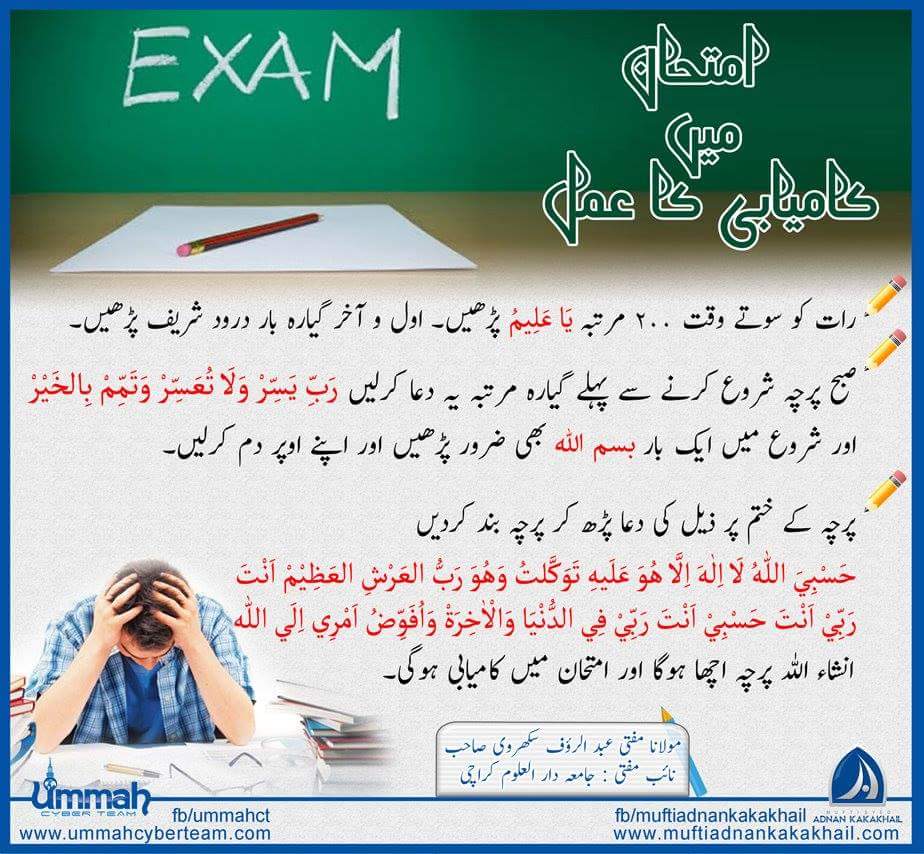
Recite یا عليم two hundred times before sleeping. Recite durood shareef 11 times in the beginning and end. Before starting the paper recite بسم الله and the following dua: رب يسر ولا تعسر وتمم بالخير and then blow on yourself. End your paper with the following dua: حسبي الله لااله الا هو عليه توكلت وهو رب العرش العظيم انت ربي انت حسبي انت ربي في الدنيا والآخرة وافوض امري الي الله Insha'Allah paper will go well and you will be successful. Maulana Mufti Abdul-Ra'uf Sakharwi Sahab Assistant Mufti: Jamia Darululoom Karachi

-
Question #4053 what surah should i recite before exams..i have 2 weeks in hand for preparations... Answer Ulamaa ID 03 Answer last updated on: 20/06/2007 15:51pm Answered by: Ulamaa ID 03 WebsiteLocation: UK Bismihi Subhanahu Wa Ta'aalaa Al-Jawaab Wa Billah-it-Tawfeeq This world is - Dar-ul-Asbaab, i.e. is one of cause of and effect. Hence, the key to success is hard work and thorough revision. A Muslim student will be no different from a non-Muslim student in this regard. After making adequate preparations, a Muslim student will place his trust in Allah (SWT) and seek His assistance instead of relying solely on his/her preparation. The sunnah procedure is to perform Salaat-ul-Haajah and recite the masnoon duaa supplicating to Allah (SWT) for success. As for actual duaas before the exam paper, there are no prescribed duaas or surats. One may recite the following:- (1) Start with reciting Bismillah-ir-Rahmaan-ir-Raheem. (2) Recite Ya Fattaah seven times. Al-Fattah being an attribute of Allah (SWT) meaning the 'One who provides the opening'. (i.e. Seeking Allah's assistance to open up one's mind in order to answer questions with ease and perfection.) (3) Reciting Durood upon Rasulullah (sallallahu alaihi wa sallam). Allah (SWT) Knows Best Abdullah ID 03 Courtesy: Muftisays
-
Ibn Taymiyyah: Best Moisturiser for Dry Hearts In the 1970s, there was an advert on TV for a popular brand of moisturising cream. The advert sought to show how great the cream was by first showing us a dry autumn leaf which, upon being scrunched in the palm of the hand, crumbled into pieces. Next came another dry leaf, this time the moisturising cream was applied to it. After it was squeezed, one saw the dry leaf gently unfolding back to its original shape. Themessage: If this is what the cream can do to a dry leaf, imagine what it could do for your dry or crinkled skin. I suspect many were sold on this moisturiser … including a young, teenage me! The idea of moistening or revitalising faces and hands also applies to spiritual hearts. For the remembrance of Allah – dhikru’Llah– nourishes and revitalises the heart like nothing else. Indeed, it is its very lifeline. So much so, that Ibn Taymiyyah once made this following comparison: .الذِكْرُ لِلْقَلْبِ كَالمَاءِ لِلسَّمَك فَكَيفَ يَكُونُ حَالَ السَّمَك اِذَا فَارَقَ المَاء ‘Dhikr is to the heart as water is to a fish. Don’t you see what happens to a fish when it is taken out of water?’* Islam’s masters of the heart teach us, then, to be constant in remembering Allah and in invoking Him. Consistent dhikr, with the required courtesy or adab towards the One being invoked, is key. As commitment to dhikr grows and deepens, and as souls begin to be illumined by the mention of His holy Name, Allah will cover our weaknesses with His might, cloth our lowliness in His glory, conceal our ignorance with His knowledge, heal the anger of our ego with His clemency, and calm the agitations of our heart with His assurance and serenity; such that one will be given to taste the bliss of the eternal realm whilst still living in this earthly abode. ≈ *Cited in Ibn Qayyim al-Jawziyyah, al-Wabil al-Sayyib (Damascus: Maktabah Dar al-Bayyan, 2006), 93. Source: The Humble I
-
Can Muslim women wear high heels? In the name of Allah, the most Beneficent, the most Merciful. Answer The Qur’an and Sunnah have provided ample guidance on the subject of clothing, which can be summarized into four parts: Our clothing must cover our body adequately, which means those parts, which are cover worthy. Thus for a man it is from his belly button to his knees and for a woman it is her entire body except for her hands and face. These parts must never be exposed to any other person (except in genuine circumstances like in front of a doctor for medical treatment) In addition the clothes must not be see through. Our clothing/ dress should establish our Muslim identity. For men the garment they wear should not be below their ankles. Finally for men silk clothing is also not permissible. (Kitabul Fatawa p.95 v.6) Furthermore, women’s clothing should not attract men’s attention to them. Your question can be looked at in two ways. There are some heels which do not make that much noise when walking. Such heels will be permissible for women to wear. Then there are other “high heels” which attract unwanted attention with the noise they make and the way they make the hips sway. Allah (SWA) in the Holy Qur’an has said, “And stay in your houses, and do not display yourselves like that of the times of ignorance…” (Surah Ahzaab v.33) Also they give a false illusion of height and in a way is a form of deception. The Prophet of Allah Sallallahu Alahi Wasalam has said; “Whoever bears arms against us is not one of us and whoever cheats us is not one of us.” (Sahih Muslim p.70 v.1) Only Allah Knows Best Mohammed Tosir Miah Darul Ifta Birmingham Source
-
Botox Injections (For Beautification)
Bint e Aisha replied to ummtaalib's topic in Hanafi Fiqh (Women)
Botox treatment Answered by Molana Muhammad Adnan Question: I am a dermatologist. My question is regarding temporary facial injections under the skin(hyaluronic fillers and botox) that diminish lines and wrinkles and last for 3-6 months after which the skin returns to pre-treatment state. Women who are psychologically distressed about the wrinkles that come with aging seek these treatments. Is the money earned by providing these treatments haram? Answer: Islamically, we are encouraged to beautify ourselves for our spouses. There are many ways of doing this, some being permissible and some being impermissible. Botox itself would come under the category of permissible as it does not fulfil the conditions to come under the category of impermissible. The Hanafi’s follow an integral principle of “the actuality of everything is permissibility”(Tafeesaat Ahmaddiyyah, Surah Baqarah). So on the basis of this principle it will be permissible. However, there are many risks and side-effects attached to Botox so it should be avoided on medical grounds, a quick google search will show vast amounts of articles written by medical experts outlining the risks and side-effects. In conclusion, of itself botox is permitted but it should be avoided and discouraged on medical and health grounds. In regards to money earned from botox and other permitted procedures, it will be permissible. Written by Molana Muhammad Adnan Checked and approved by Mufti Mohammed Tosir Miah Darul Ifta Birmingham Source -
ABSTAIN FROM PLACES OF SUSPICION Question Is this a statement of Nabi (sallallahu ‘alayhi wasallam): اتَّقُوا مَوَاضِعَ التُّهَمِ What is its explanation. Are there other Hadiths that prohibit going to haram/doubtful places Answer ‘Allamah ‘Iraqi (rahimahullah) has stated that he could not locate this Hadith. (Takhrijul Ihya, Hadith: 2643 and Sharhul Ihya, vol.7, pg.283) A Similar report Sayyiduna ‘Umar (radiyallahu’anhu) is reported to have said: ‘Whoever puts himself in a suspicious position, should not blame others for applying suspicion on him.’ (Rawdatul ‘Uqala of Imam Ibn Hibban (rahimahullah), pg.83. Also see Shu’abul Iman, Hadith: 7993) The narrators in the chain of Rawdatul ‘Uqala of Imam Ibn Hibban are all reliable. Note: This is not quoted as a Hadith, but as the statement of Sayyiduna ‘Umar (radiyallahu’anhu). Meaning The meaning of this is that one should avoid visiting places or doing actions that create suspicion about oneself. Rather stay clear of such places or deeds. An established principle A Hadith in Sahih Bukhari also gives this meaning, wherein two Sahabah (radiyallahu ‘anhuma) saw Rasulullah (sallallahu’alayhi wasallam) walking with a woman in the dark. He (sallallahu’alayhi wasallam) immediately mentioned to them: that that woman was his wife, Sayyidah Safiyyah (radiyallahu’anha). Nabi (sallallahu’alayhi wasallam) also then said to them: ‘Shaytan is as close to a person as his blood, and I feared that he may cast some [ill-thought] into your hearts.’ (Sahih Bukhari, Hadith: 2035) Imam Ghazali (rahimahullah) has quoted this authentic (sahih) narration to support this principle. The lesson here is that one should clear oneself of suspicion, either by avoiding certain deeds or places, or in the event that cannot be avoided, one should explain one’s innocence. Hafiz Ibn Hajar (rahimahullah) while commenting on the lessons derived from this Hadith writes: ‘Another lesson is that a person should avoid situations wherein others could become suspicious of him.’ (Fathul Bari, Hadith: 2035) And Allah Ta’ala Knows best, Answered by: Moulana Muhammad Abasoomar Hadithanswers
-
Son on Drugs Question: Assalaamu ‘alaikum I would like your advice. I have a 33 year old son that’s on drugs. He has been in a few rehabs but just don’t want to come right. He refuses to move out of the house and when we put him out a few times then he comes after a week or 2 and says that his finished with drugs. He is alright for a while then he starts again. We really don’t know what to do anymore. Answer: Bismihi Ta‘ala Respected Sister Wa ‘alaikumus salaam wa rahmatullahi wa barakaatuh We are greatly saddened by your plight. Our suggestion is that you allow him back home provided he agrees to the following aspects: 1. Daily he must participate in ta’leem at home for 10 minutes. Read from the book Fazaail e A’amaal of Shaikhul Hadeeth Moulana Muhammad Zakariyya Kandhelwi (rahimahullah). 2. He must first go out for at least 20 days with the Tableegh Jamaat. If you indicate which area you are from we could suggest who he must contact. 3. He must perform his five daily salaah. 4. He must not be out of the house from maghrib till fajr (except to go straight to the Musjid for esha and return with some good company). 5. He must read the book “Kicking the Habit” a few times. It can be downloaded from Here 6. Do not give him any money or any privilege. May Allah Ta‘ala guide him. Answered by: Uswatul Muslimah Panel of ‘Ulama Uswatulmuslimah
-
Hanzalah bin Abi 'Aamir رضي الله عنه During the battle of Uhud, Hanzalah bin Abi ‘Aamir (radhiyallahu ‘anhu) fought very bravely but was eventually martyred by Shaddaad bin Aswad. Innaa lillaahi wa innaa ilayhi raaji‘oon! When the battle had terminated, Nabi (sallallahu ‘alaihi wasallam) addressed the Sahaabah (radhiyallahu ‘anhum) saying, “Verily I saw the angels bathing (giving ghusl to) the body of Hanzalah bin Abi ‘Aamir (radhiyallahu ‘anhu), between the heavens and the earth, with the water of the clouds in utensils of silver.” Abu Usaid (radhiyallahu ‘anhu) mentions that he, together with a few other Sahaabah (radhiyallahu ‘anhum), then went in search of Hanzalah (radhiyallahu ‘anhu)’s body. When they found it, they saw that his head was dripping with water! They returned to Nabi (sallallahu ‘alaihi wasallam) and informed him of what they had seen. After hearing what had happened, Nabi (sallallahu ‘alaihi wasallam) instructed them to enquire from his wife as to why the angels were giving him ghusl. Hanzalah (radhiyallahu ‘anhu) had shortly before the Battle of Uhud, married Jameelah (radhiyallahu ‘anha), the sister of the infamous ‘Abdullah bin Ubayy bin Salool, the leader of the hypocrites, and had only just consummated his marriage the previous night. While asleep that night, Jameelah (radhiyallahu ‘anha) had a dream in which she saw a door open in the sky into which Hanzalah (radhiyallahu ‘anhu) was ushered. The door was then shut behind him. When she awoke, she instantly realized that the dream she had seen was an indication that her husband, Hanzalah (radhiyallahu ‘anhu), was about to pass away. She therefore called for four witnesses and informed them that her marriage had been consummated the previous night as, if people were unaware of her spending the night with her husband, complications would have possibly arisen later on. Hanzalah (radhiyallahu ‘anhu) was still making ghusl when the call was made for people to arm and depart for Uhud. Although his wife, Jameelah (radhiyallahu ‘anha), had only completed washing half his head, his eagerness to strive and fight in the path of Allah Ta‘ala was such that he immediately grabbed his weapons and left without completing his ghusl. When Nabi (sallallahu ‘alaihi wasallam) was informed of this he said, “That is why the angels gave him ghusl.” (Reference: Nasbur Raayah vol. 2 pg. 316, Ibnu Hishaam vol. 3 pg. 75, and ‘Umdatul Qari vol. 14 pg. 224) Lessons: 1. We need to become so eager for and committed to deen that nothing – not even the joy and excitement of life as newlyweds - will be able to deter us from striving and sacrificing in the path of Allah Ta‘ala. 2. Despite having received indication that her husband would pass away and despite having spent only a single night with him, Jameelah (radhiyallahu ‘anha) was selfless and allowed Hanzalah (radhiyallahu ‘anhu) to strive in the path of Allah Ta‘ala, understanding that no sacrifice is too great to make for deen. 3. In matters of marriage, children etc, it is crucial for us to maintain transparency so that complications do not arise. In this regard, “secret marriages” are to be totally avoided. Uswatulmuslimah
-
Every society is made up of people of different classes, values and ages, and everyone has to play an important, essential and crucial role in the society of today and of future. And it is the duty of every member of society to participate in strengthening the society. And every society is as well made up of different classes of people participating in building and maintaining it. The youths and young ones are part of this society, but their role is more important than others. They are integral and essential part of a society and a society is incomplete without young blood. Therefore it is said: “Today’s youths are the force, hope and leaders of tomorrow”, because they are the future of society, country and community. Young people are the driving force of change and can encourage governments and authorities to declare their priorities. Young people have important responsibilities towards their society. It is important to learn from the past and to live with a hope for a better future, a future that is appropriate for our children and future generations. Based on this, the following, though not limited to them, should be fundamental responsibilities of the youths in a Muslim society: 1- Knowledge of the basic fundamentals of the teachings of Islam and Allah’s guidance through the right sources. It remains a crystal fact that man is lost and blind if not for the divine guidance of the Creator. And to achieve this guidance, one have to know at the very least the most basic fundamentals of his religious teachings and through the correct sources. This will make the youths know what is good for them in the both worlds; their limitations to things, and more importantly it will instill that God consciousness in anything they may be doing. As such, they realize that building the society towards the right direction is a means to attaining paradise and a positive contribution to the world. 2- True Values and Morals: After the basic knowledge stated above, it becomes imperative that the youths take it a responsibility upon themselves to display and put in practice what they have learnt. The future generation has a duty to be honest, genuine, of good values and to work day and night for the betterment of the society and the country. Young people have a duty to use their skills, strength, creativity and imaginations to serve the country and the nation in the best possible manner. These are the young people who can make the difference, because they are the backbone of a nation and can build a bright future for society based on values and courageous behavior. 3- Sound Education: The world we are today requires a very sound and well modeled education to be abreast of happenings or be able to make positive impact in it. It is necessary that one must build his educational carrier upon a very strong sound religious knowledge. This is one of the best ways, if not the only, that can guarantee a balance in educational and worldly achievements, good morals, honesty and true dedication in one’s endeavours. It is the responsibility of the youths to get all these very well imbibed into them to serve as a foundation upon which they will rely as they face the later challenges of life. 4- Good Home. This is a great pillar to the building of a better society. Youths should get married to spouses who are not just beautiful damsels, but God fearing and righteous. Based on Islamic teachings and the reality on ground, beauty will surely fade off, money can diminish or dwindle away as Allah may wish it, but when the fear of God and righteousness are there, the home will forever be a bliss and the kids brought forth in such a house will also be different and unique. If such is achieved, then the future of our society is brighter. In doing this, it is essential that the elderly who are more experienced in life are consulted and their advice well considered. Marriage should be encouraged for the youths and supported as much as possible morally, psychologically and financially. This will prevent the lots of immoralities we witness in our societies. Here, the role of the parents and guardians is very important. 5- Financial Stability. The youths are to be taught how to get financially stable as early as possible. They will by that get prepared to take so much responsibilities without piling more responsibilities on their parents. This will also give them the self confidence to happily shoulder responsibilities. 6- Support of the Elders and needy. It must be made clear to the youth that they are the golden eyes of the society. They have the physical strength and courage, the time and little responsibilities, the health and less boredom. All these are characteristics they should be able to utilize effectively in supporting their parents, elders and other needy ones. These features are so mind blowing and deceitful. They are not for ever but yet the possessor would think they are until they start diminishing. So please, let the youths realize the huge responsibility upon them to make use of these skills and characteristic for the betterment of the society. In our modern society, there are very important challenges being faced by the youth, which the elderly generation may not have a good understanding of their impacts and importance in the life of the growing youths. These are challenges no more restricted to any one ethnic or religious group, but affect young people generally. Most discussions on youth have focussed on issues such as drug abuse, crime, violence, sexuality and poverty. This are well spelt out problems already being tackled by the societies, in a view of making the youths realize their responsibilities towards such challenges as a way to building a better collective society. In addition to the just mentioned are issues like: 1. An Identity Crisis: Who am I? 2. Lack of self confidence and low self esteem: I am worthless 3. A sense of hopelessness: Where am I going? 4. Confusion and ambiguity concerning moral issues: What is right and wrong? 5. The negative impact of the electronic media: Entertainment ? 6. Competitiveness in education: the uneven playing field: Excellence by whom? Not Me. Muslim Youth In the Quran and history of Islam, as found in the life of the Prophet (PBUH), we have numerous examples of outstanding youth. Indeed the image of Abraham (PBUH) in the Quran is one of extreme inspiration, enlightenment and uniqueness. It is the image of a young man rebelling against his people’s decadent traditions, a young man defying the dominant values of his society even in the form of a tyrant king who claims divinity. His son Ismail (PBUH) inherited these qualities of sincerity in worshipping Allah and sacrifice of everything for His sake, as clear in the story of the sacrifice when his father consulted him upon seeing in his dream that he is to sacrifice him, and he answered with determination and certainty to obey Allah’s command “Oh my father, do as you are commanded, you will find me, if Allah so wills, of the patient”. The mission of Muhammad (PBUH) was also one for the youth as the eldest of those who first believed in the prophet was Abu Bakr As-Siddiq who was only thirty five years old then. Most of them had not reached the age of twenty. In fact, some like Ali bin Abi Talib were as young as ten. To give more credence to the importance of the youth in bearing their actual responsibilities in the society, it was not surprising that the leader of the Muslim army following the death of the Prophet (PBUH) was Usama Ibn Zayd who was only sixteen years old, and India was later conquered by Mohamed Ibn Al-Qasim who was the same age. Who is The Ideal Muslim Youth? One may define the ideal youth as a balanced individual exhibiting a highly spiritual life informed by absolute moral values and whose behaviour demonstrates qualities such as righteousness, honesty, humility and conscientiousness in everything he/she does. He/she does not do things just because it is what was the vogue, but they do things because they are the right things to do. They fear no blame from anyone, as far as they are on the right track of attaining the pleasure of Allah. This is because they are well acquainted with the fact that “A man receives but only that for which he strives; that his endeavors will be judged, and only then will he receive his recompense in full.” (Quran, 53:39-41) Saalikeen.org
-
عصر کی نماز مثل اول میں پڑھنے کا حکم کیا مثل اول میں عصر کی نماز پڑھنے سے نماز ادا ہو جائے گی (مجبوری کی حالت میں خاص طور پر پاکستان سے باہر غیرحنفی علاقوں میں؟ کیا مثل اول میں عصر کی نماز باجماعت پڑھنا بہتر ہے یا مثل ثانی میں انفرادی طور پر (مکہ کے علاوہ )۔ بسم اللہ الرحمن الرحیم الجواب حامدا ومصلیا حضرت امام ابوحنیفہ رحمہ اللہ کے راجح قول کے مطابق عصر کا وقت مثل ثانی کے بعد ہے، لہٰذا حتیٰ الامکان مثل ثانی ہونے کے بعد ہی جماعت سے نماز پڑھنی چاہیے ، لیکن اگر کسی علاقے میں فقہ حنفی کے مطابق مسجدوں میں عصر کی نماز باجماعت مثل ثانی کے بعد نہ ہوتی ہو بلکہ مثل اول کے بعد ہوتی ہو توچونکہ مسجد کی جماعت کی بہت فضیلت آئی ہے اس لیے مجبوری کی حالت میں عصر کی نماز مثل اول ہونے کے بعد جماعت کے ساتھ پڑھنا بھی جائز ہے ۔کیونکہ آئمہ ثلاثہ رحمہم اللہ کے ساتھ احناف میں سے حضرات صاحبین رحمہما اللہ کے نزدیک بھی مثل اول میں عصر کی نماز پڑھنا جائز ہے اور حضرت امام ابوحنیفہ رحمہ اللہ کی ایک روایت یہ بھی ہے،لہذا ایسی صورت میں مثل ثانی میں اکیلے پڑھنے کی بجائے مثل اول ہی میں باجماعت مسجد میں نماز پڑھ لینی چاہیے۔ الدر المختار مع رد المحتار (و وقت الظهر من زواله )۔۔۔۔(الی بلوغ الظل مثليه ) وعنه مثله ،وهو قولهما وزفر والائمة الثلاثاء و في الشاميه تحت ۔۔۔ألخ گوہر احمد کشمیری دار الافتاء جامعہ دارالعلوم کراچی ٢٢/٠٣ / ١٤٣٦ ھ ١٤/٠١/٢٠١٥ء Suffahpkء
-
QUESTION: Are Zaydi's Muslims and part of Ahlus Sunnah Wal Jama’ah? Answer In the Name of Allaah, the Most Gracious, the Most Merciful. As-salāmu ‘alaykum wa-rahmatullāhi wa-barakātuh. The Zaidi Shi’ahs[1] are divided into three sects: the Batriyyah, the Sulaymaaniyyah and the Jaarudiyyah. The Batriyyah regard Sayyiduna ‘Ali (Radhiyallaahu ‘anh) to be the best from amongst the Sahaabah (Radhiyallaahu‘anhum). They do however accept the caliphate of Sayyiduna Abu Bakr (Radhiyallaahu ‘anh) and Sayyiduna ‘Umar (Radhiyallaahu ‘anh) while withholding judgment on Sayyiduna ‘Uthman (Radhiyallaahu ‘anh). The Sulaymaaniyyah deem the caliphate of Sayyiduna Abu Bakr (Radhiyallaahu ‘anh) and Sayyiduna ‘Umar (Radhiyallaahu ‘anh) an error. As far as Sayyiduna ‘Uthmaan (Radhiyallaahu ‘anh) is concerned, some amongst them regard him to be an apostate. The Jaarudiyyah curse Sayyiduna Abu Bakr (Radhiyallaahu ‘anh) and Sayyiduna ‘Umar (Radhiyallaahu ‘anh) along with Sayyiduna ‘Uthmaan (Radhiyallaahu ‘anh). According to the contemporary Yemeni scholar, Qaadhi Isma’eel ibn ‘Ali Al-Akwa’, the latter day Houthi Zaidis generally fall within the Jaarudi influence, with notable exceptions[2]. To curse Sayyiduna Abu Bakr (Radhiyallaahu ‘anh) and Sayyiduna ‘Umar (Radhiyallaahu ‘anh) is a grave offence and an act of kufr (disbelief)[3]. In general, the Zaidi Shi’ahs are regarded to be Muslims, albeit not from the Ahlus Sunnah Wal Jamaa’ah. We cannot pass a blanket ruling of kufr on them. One should not approach them in an abusive or disrespectful manner. They should rather be approached in an adequate and diplomatic manner. If this method is adopted, they may lend an ear and Allaah Ta’aala may guide them through us. And Allaah Ta’aala Knows Best Muajul I. Chowdhury Student, Darul Iftaa Astoria, New York, USA Checked and Approved by, Mufti Ebrahim Desai. [1] الموسوعة الميسرة في الأديان والمذاهب والأحزلب المعاصرة (1/76) والزيدية هي: إحدى فرق العدلية القدرية التي تقول بالعدل، إذ تنفي خلق الله تعالى لأفعال العباد بزعم نفي الجبر، كما تعطل نصوص الصفات الذاتية والفعلية لله تعالى تحت دعوى التوحيد. وتعد الزيدية (الهادوية) أقرب فرق الشيعة إلى أهل السنة والجماعة، إذ يتصف مذهبهم بالابتعاد عن غلو الاثني عشرية وباقي فرق الشيعة، كما أن نسبتها ترجع إلى مؤسسها زيد بن علي زين العابدين، الذي كان يرى صحة إمامة أبي بكر وعمر وعثمان رضي الله عنهم جميعاً، ولم يقل أحد منهم بتكفير أحد من الصحابة. ومن مذهبهم جواز إمامة المفضول مع وجود الأفضل، إلا أن فرق الزيدية انحرفت، ما عدا الهادوية، عن مبادئ زيد هذه ورفضوا خلافة الشيخين وتبرؤوا من عثمان وقالوا بالرجعة وعصمة الأئمة موافقة للرافضة. من هم الزيدية؟ للسيد يحيى بن عبد الكريم الفضيل الزيدي http://zaydiya.blogspot.co.za/2009/10/zaidiya-zaidia-zaydiya-zaidism.html http://zaidiah.com/sites/default/files/articles_files/_hm_lzydy.pdf الملل والنحل (1/ 155) فتلمذ في الأصول لواصل بن عطاء الغزال الألثغ رأس المعتزلة ورئيسهم الفرق بين الفرق (ص 26) البدر الليالي شرح بدء الأمالي (2/ 543) تاريخ الفرقة الزيدية لفضيلة عبد الأمير الشامي الموسوعة الشاملة للفرق المعاصرة في العالم (ص 193) [2] Taken from our correspondence with Hazrat Mufti Taha Karan (Hafizahullaah) [3] لسان الحكام (ص: 414) الرافضي إِذا كَانَ يسب الشَّيْخَيْنِ رَضِي الله تَعَالَى عَنْهُمَا ويلعنهما يكون كَافِرًا وَإِن كَانَ يفضل عليا على أبي بكر وَعمر رَضِي الله عَنْهُمَا أَجْمَعِينَ لَا يكون كَافِرًا لكنه يكون مبتدعا الفتاوى الهندية (2/ 264) الرافضي إذا كان يسب الشيخين ويلعنهما والعياذ بالله فهو كافر رد المحتار (4/ 237) أقول: نعم نقل في البزازية عن الخلاصة أن الرافضي إذا كان يسب الشيخين ويلعنهما فهو كافر، وإن كان يفضل عليا عليهما فهو مبتدع. اهـ. تفسير ابن كثير (7/ 338) وَمِنْ هَذِهِ الْآيَةِ انْتَزَعَ الْإِمَامُ مَالِكٌ رَحِمَهُ الله عليه فِي رِوَايَةٍ عَنْهُ، بِتَكْفِيرِ الرَّوَافِضِ الَّذِينَ يُبْغِضُونَ الصحابة رضي الله عنهم قال: لأنهم يغيظونهم ومن غاظ الصحابة رضي الله عنهم فَهُوَ كَافِرٌ لِهَذِهِ الْآيَةِ متن الطحاوية (ص: 81) ونحب أصحاب رسول الله صلى الله عليه وسلم ولا نفرط في حب أحد منهم ولا نتبرأ من أحد منهم ونبغض من يبغضهم وبغير الخير يذكرهم ولا نذكرهم إلا بخير وحبهم دين وإيمان وإحسان وبغضهم كفر ونفاق وطغيان متن الطحاوية (ص: 82) ومن أحسن القول في أصحاب رسول الله صلى الله عليه وسلم وأزواجه الطاهرات من كل دنس وذرياته المقدسين من كل رجس فقد برئ من النفاق صحيح البخاري (5/ 8) 3673 - حدثنا آدم بن أبي إياس، حدثنا شعبة، عن الأعمش، قال: سمعت ذكوان، يحدث عن أبي سعيد الخدري رضي الله عنه، قال: قال النبي صلى الله عليه وسلم: «لا تسبوا أصحابي، فلو أن أحدكم أنفق مثل أحد، ذهبا ما بلغ مد أحدهم، ولا نصيفه» تابعه جرير، وعبد الله بن داود، وأبو معاوية، ومحاضر، عن الأعمش فضائل الصحابة لأحمد بن حنبل (1/ 49) 4 - حَدَّثَنَا عَبْدُ اللَّهِ، حَدَّثَنِي زَكَرِيَّا بْنُ يَحْيَى بْنِ صَبِيحٍ زَحْمَوَيْهِ، وَحَدَّثَنِي مُحَمَّدُ بْنُ خَالِدِ بْنِ عَبْدِ اللَّهِ، قَالَا: نا إِبْرَاهِيمُ بْنُ سَعْدٍ قَالَ: حَدَّثَنِي عُبَيْدَةُ بْنُ أَبِي رَائِطَةَ، عَنْ عَبْدِ اللَّهِ بْنِ عَبْدِ الرَّحْمَنِ، عَنْ عَبْدِ اللَّهِ بْنِ مُغَفَّلٍ الْمُزَنِيِّ قَالَ: قَالَ رَسُولُ اللَّهِ صَلَّى اللهُ عَلَيْهِ وَسَلَّمَ: «اللَّهَ اللَّهَ فِي أَصْحَابِي، لَا تَتَّخِذُوا أَصْحَابِي غَرَضًا، مَنْ أَحَبَّهُمْ فَبِحُبِّي أَحَبَّهُمْ، وَمَنْ أَبْغَضَهُمْ فَبِبُغْضِي أَبْغَضَهُمْ، وَمَنْ آذَاهُمْ فَقَدْ آذَانِي، وَمَنْ آذَانِي فَقَدْ آذَى اللَّهَ عَزَّ وَجَلَّ، فَيُوشِكُ أَنْ يَأْخُذَهُ» .
-
On Kibr (Pride/Arrogance) & The Cure
Bint e Aisha replied to ummtaalib's topic in Matters of the Heart
Humility: Our master Abu Yazid [al-Bistami] (d. 261/875) (Allah have mercy on him) was asked, “When is a person deemed humble?” He replied, “When he sees neither a [high] station nor state for himself, and when he cannot find among mankind anyone who is worse than himself.” al-Risala al-Qushayriya Ashrafiya -
Abdullah ibn Mas'ud When he was still a youth, not yet past the age of puberty, he used to roam the mountain trails of Makkah far away from people, tending the flocks of a Quraysh chieftain, Uqbah ibn Muayt. People called him "ibn Umm Abd"-- the son of the mother of a slave. His real name was Abdullah and his father's name was Mas'ud. The youth had heard the news of the Prophet who had appeared among his people but he did not attach any importance to it both because of his age and because he was usually far away from Meccan society. It was his custom to leave with the flock of Uqbah early in the morning and not return until nightfall. One day while tending the flocks, Abdullah saw two men, middle-aged and of dignified bearing, coming towards him from a distance. They were obviously very tired. They were also so thirsty that their lips and throat were quite dry. They came up to him, greeted him and said, "Young man, milk one of these sheep for us that we may quench our thirst and recover our strength." "I cannot," replied the young man. "The sheep are not mine. I am only responsible after them." The two men did not argue with him. In fact, although they were so thirsty, they were extremely pleased at the honest reply. The pleasure showed on their faces... The two men in fact were the blessed Prophet himself and his companion, Abu Bakr Siddiq. They had gone out on that day to the mountains of Makkah to escape the violent persecution of the Quraysh. The young man in turn was impressed with the Prophet and his companion and soon became quite attached to them. It was not long before Abdullah ibn Mas'ud became a Muslim and offered to be in the service of the Prophet (PBUH). The Prophet (PBUH) agreed and from that day the fortunate Abdullah ibn Mas'ud gave up tending sheep in exchange for looking after the needs of the blessed Prophet. Abdullah ibn Mas'ud remained closely attached to the Prophet. He would attend to his needs both inside and outside the house. He would accompany him on journeys and expeditions. He would wake him when he slept. He would shield him when he washed. He would carry his staff and his siwak (toothbrush) and attend to his other personal needs. Abdullah ibn Mas'ud received a unique training in the household of the Prophet. He was under the guidance of the Prophet, he adopted his manner and followed his every trait until it was said of him, "He was the closest to the Prophet in character." Abdullah was taught in the "school" of the Prophet. He was the best reciter of the Qur'an among the companions and he understood it better than them all. He was therefore the most Knowledgeable on the Shariah. Nothing can illustrate this better than the story of the man who came to Umar ibn al-Khattab as he was standing on the plain of Arafat and said: "I have come, O Amir al-Mu'mineen, from Kufah where I left a man filling copies of the Qur'an from memory." Umar became very angry and paced up and down beside his camel, fuming. "Who is he?" he asked. "Abdullah ibn Mas'ud," replied the man. Umar's anger subsided and he regained his composure. "Woe to you," he said to the man. "By God, I don't know of any person left who is more qualified in this matter than he is. Let me tell you about this." Umar continued: "One night the Messenger of God, peace be upon him, was having a conversation with Abu Bakr about the situation of Muslims. I was with them. When the Prophet left, we left with him also and as we passed through the mosque, there was a man standing in Prayer whom we did not recognize. The Prophet stood and listened to him, then turned to us and said, "Whoever wants to read the Qur'an as fresh as when it was revealed, then let him read according to the recitation of Ibn Umm Abd." After the Prayer, as Abdullah sat making supplications, the Prophet, peace be on him, said, "Ask and it will be given to you. Ask and it will be given to you." Umar continued: "I said to myself--I shall go to Abdullah ibn Mas'ud straight away and tell him the good news of the Prophet's ensuring acceptance of his supplications. I went and did so but found that Abu Bakr had gone before me and conveyed the good news to him. By God, I have never yet beaten Abu Bakr in the doing of any good." Abdullah ibn Mas'ud attained such a knowledge of the Qur'an that he would say, "By Him besides Whom there is no god, no verse of the book of God has been revealed without my knowing where it was revealed and the circumstances of its revelation. By God, if I know there was anyone who knew more of the Book of Allah, I will do whatever is in my power to be with him." Abdullah was not exaggerating in what he said about himself. Once Umar ibn al-Khattab met a caravan on one of his journeys as caliph, it was pitch dark and the caravan could not be seen properly. Umar ordered someone to hail the caravan. It happened that Abdullah ibn Mas'ud was in it. "From where do you come?" asked Umar. "From a deep valley," came the reply. (The expression used fajj amiq--deep valley--is a Qur'anic one). "And where are you going?" asked Umar. "To the ancient house", came the reply. (The expression used al-bayt al-atiq--the ancient house -- is a Qur'anic one.) "There is a learned person (alim) among them," said Umar and he commanded someone to ask the person: "Which part of the Qur'an is the greatest?" "God! There is no god except Him, the Living, the Self-subsisting. Neither slumber overtakes Him nor sleep," replied the person answering, quoting the Ayat al-Kursi (the verse of the Throne). "Which part of the Qur'an is the most clear on justice?" "God commands what is just and fair, the feeding of relatives..." came the answer. "What is the most comprehensive statement of the Qur'an?" "Whoever does an atom's weight of good shall see it, and whoever does an atom's weight of evil shall see it." "Which part of the Qur'an gives rise to the greatest hope?" "Say, O my servants who have wasted their resources, do not despair of the mercy of God. Indeed, God forgives all sins. He is the Forgiving, the Compassionate." Thereupon Umar asked: "Is Abdullah ibn Mas'ud among you?""Yes, by God," the men in the caravan replied. Abdullah ibn Mas'ud was not only a reciter of the Qur'an, a learned man or a fervent worshipper. He was in addition a strong and courageous fighter, one who became deadly serious when the occasion demanded it. The companions of the Prophet were together one day in Makkah. They were still few in number, weak and oppressed. They said, "The Quraysh have not yet heard the Qur'an being recited openly and loudly. Who is the man who could recite it for them?" "I shall recite it for them," volunteered Abdullah ibn Mas'ud. "We are afraid for you," they said. "We only want someone who has a clan who would protect him from their evil." "Let me," Abdullah ibn Mas'ud insisted, "Allah shall protect me and keep me away from their evil." He then went out to the mosque until he reached Maqam Ibrahim (a few meters from the Ka'bah). It was dawn and the Quraysh were sitting around the Ka'bah. Abdullah stopped at the Maqam and began to recite: "Bismillahir Rahmani-r Rahim. Ar-Rahman. Allama-l Qur'an. Khalaqa-l insan. Allamahu-l bayan... (In the name of God, the Merciful. The Merciful God, He has taught the Qur'an. He has created man and taught him the clear truth...)" He went on reciting. The Quraysh looked at him intently and some of them asked: "What is Ibn Umm Abd saying?""Damn him! He is reciting some of what Muhammad brought!" they realized. They went up to him and began beating his face as he continued reciting. When he went back to his companions the blood was flowing from his face. "This is what we feared for you," they said. "By God," replied Abdullah, "the enemies of God are not more comfortable than I at this moment. If you wish, I shall go out tomorrow and do the same." "You have done enough," they said. "You have made them hear what they dislike." Abdullah ibn Mas'ud lived to the time of Khalifah Uthman, may God be pleased with him. When he was sick and on his death-bed, Uthman came to visit him and said: "What is your ailment?" "My sins." "And what do you desire?" "The mercy of my Lord." "Shall I not give you your stipend which you have refused to take for years now?" "I have no need of it." "Let it be for your daughters after you." "Do you fear poverty for my children? I have commanded them to read Surah al-Waqi'ah every night for I have heard the Prophet saying, 'Whoever reads Al-Waqi'ah every night shall not be afflicted by poverty ever.'" That night, Abdullah passed away to the company of his Lord, his tongue moist with the remembrance of God and with the recitation of the verses of His Book. Source
-
-
❝ Believers fly with two wings: one of hope, the other of fear. Fear should dominate in our youth; hope should dominate as we draw closer to death.❞
-
بسم الله الرحمن الرحيم The Perfume of Piety There was once a person whose body would always exude the fragrance of the most exotic musk and perfume. A friend one day asked him, “What is this wonderful fragrance I always smell on you? You must be spending a lot of money on musk if you apply it so often!” The person replied, “By Allah! Never have I purchased musk nor have I ever applied it!” His friend was astonished and asked, “Then where does your fragrance come from?” Not keen to answer the question, he said to his friend, “Why are you asking me?” His friend explained, “I hope that Allah Ta‘ala will let me benefit in some way by what you will tell me.” On his friend’s coaxing and urging, he eventually narrated the following: In my youth I was a very handsome lad. My father was a merchant and I would generally spend my time with him. One day, an old woman came to him and purchased some cloth. As she did not have the money with her to pay for it, she asked my father if he would send me along to her home where I would collect the money. My father agreed. Hence, I proceeded with her until we finally stood before a grand, palatial home. The old woman ushered me into a stunning courtyard and as I entered, my gaze fell on a beautiful young girl who was seated atop a raised seat on a silken cushion. The instant she saw me, she was dazzled by my beauty and immediately demanded that I join her on her seat. I staunchly refused. Instead of bringing her to her senses, my rejection only incited her to get down and come to me. Then, in a fit of infatuation, she began pulling and tugging me towards herself. I was in a genuine predicament. Thus in order to escape from her embrace, I asked her if I could use the toilet. Although impatient, she acceded and shouted for her slaves who guided me to the toilet. I entered the toilet where I relieved myself into my hands. Not wasting a moment, I smeared the filth over my body, clothing, and face. When I exited the toilet, the eagerly awaiting girl was greeted by the sight and smell of not a handsome youth but a person literally covered in human waste! The flames of her passion were, at once, thoroughly doused and she screamed to her servants in horror and disgust, “This is a madman! Throw him out immediately!” I happened to have only one dirham with me. On leaving, I purchased some soap and thereafter went to the river where I cleansed my body and clothing of the filth. When I was done, I went back to my father and did not tell him a word of what had transpired. When I went to sleep that night, I saw a dream in which a handsome man with an excellent fragrance came to me. I asked him who he was to which he replied that he was Jibreel (‘alaihis salaam). He said to me, “Allah Ta‘ala has sent me to give you the glad tidings of Jannah and to reward you with some of its perfume because of the extent to which you went to avoid falling into sin.” He then passed his hands over my face, body and clothing and departed. When I awoke the next morning, I smelt an exquisite fragrance which, to this day, still perpetually wafts from my body. (At-Targheeb wa Tarheeb lil Yaafi‘ee pg. 165) LESSONS: ┣━◈ 1. The pious youngster was prepared to go to the extreme of covering himself with filth and mess in order to avoid falling into sin. We, on the other hand, make an all out effort to ensure that we fall into sin and filth – resulting in us making a mess of our lives. ┣━◈ 2. In order to avoid sin, a person will have to stay far from the places and environments of sin. This is especially vital as we enter the holiday season in which places and environments of sin greatly increase. ┣━◈ 3. A person who leaves sin for the pleasure of Allah Ta‘ala will enjoy rewards in both this world as well as the Hereafter. ┣━◈ 4. A true Muslim detests sin even more than he detests filth and faeces. ┣━◈ 5. A Muslim is prepared to make any sacrifice necessary in order to keep his link of love with Allah Ta‘ala intact. Uswatulmuslimah.co.za
-
Abu Bakr As-Siddiq (رضي الله عنه) used to say in his sermons: "Where is the beauty and the handsome? Where are those who were delighted by their youth and good looks? Where are the kings who built cities and fenced them with walls? Where are the victorious in wars? They all perished and ended in the depths of dark graves! Hasten and hurry up [to do good deeds]; but death is faster.” [Al-Zuhd by Imam Ahmad (2/18), Hilyah al-Awliya’ (1/34) and Sifat al-Safwah (1/261)]
-
When we think of a religious person who Allāh loves, we tend to think of a man who has a beard, wears an 'imama and a juba, always lives in the mosque, constantly prays, fasts and recites the Qur'an. But you know who we tend to forget that Allāh loves? ▪The mother who manages to get up for Fajr despite sleeping less than an hour because her baby was up all night. ▪The young person who is fighting depression but still musters the strength to get through the day because of a belief that he has in Allāh. ▪The woman who has to speed through her prayer because her little one is crying. ▪The man who lays down the mat and prostrates whilst at work. ▪The lady who wears the hijab correctly in public despite the pressures. ▪The student who lowers his gaze in an environment in college and university because he is conscious of Allāh. ▪The individual who wants to fast throughout the month but his medical situation doesn't allow it. ▪The one who leaves the house in the morning to earn halal so he can feed the family and look after the kids. ▪The guy who leaves what he used to do because it was wrong and returns to Allāh in remorse such that he often feels down. ▪The one who can barely recite a page of the Qur'an and doesn't have a great voice but still sits there and tries. ▪The people who didn't know anything about religion until later on in life but still have the power to humble themselves and seek knowledge. Piety has many forms and comes in different shapes If we are obeying Allāh in whichever way we can, then be pleased and know that Allāh loves us. Something small for one man is like climbing a steep mountain for another, and Allāh knows that. He won't let the tears, the tiredness, the effort, the good intentions and the striving go to waste. Allah bless us all with His love.
-
- 1
-