
ummtaalib
-
Posts
8482 -
Joined
-
Days Won
773
Content Type
Profiles
Forums
Events
Everything posted by ummtaalib
-
Zainab bint Jahsh R.A given in Marriage by Allah ta'ala Himself Hadhrat Zaynab bint Jahash (RA) was the sister of Hadhrat Abdullaah bin Jahash (RA). She had been divorced from Rasulullaah (Sallallahu Alaihi Wa Sallam)’s freed slave Hadhrat Zaid bin Haaritha (RA), after which several verses of the Qur'aan were revealed about her and instructing Rasulullaah (Sallallahu Alaihi Wa Sallam) to marry her. In fact, even the laws of Hijaab were revealed with reference to her. She had the honour of having her marriage announced in the Qur'aan, which is to be recited by all Muslims until the Day of Qiyaamah. She was acquainted with handicrafts, engaged in Ibaadah excessively, fasted very often and greatly assisted the poor. She had also narrated many Ahadeeth. She was the first of Rasulullaah (Sallallahu Alaihi Wa Sallam)’s wives to pass away after him in the year 13 A.H. She is also buried in Jannatul Baqee. From: Madrasah in Just 5 Minutes Mufti A.H.Elias-May Allaah protect him Full Story She was the Prophet Mohammad’s (صلى الله عليه وسلم) cousin. She was first given in marriage by the Prophet Mohammad (صلى الله عليه وسلم) to his adopted son Hadhrat Zaid bin Harithah (Radhiyallaho anho). When Hadhrat Zaid (Radhiyallaho anho) divorced her, she was married to the Prophet Mohammad (صلى الله عليه وسلم) by command of Allah, as mentioned in Surah Al Ahzab. This took place in 5 A.H., at that time she was 35. She was therefore born 17 years before Nubuwwat. She was always proud of the fact that, the other wives while all the other wives were given in marriage to the Prophet Mohammad (صلى الله عليه وسلم) by their guardians, it was Allah Himself Who did this for her. When Hadhrat Zaid (Radhiyallaho anho) divorced her and she had completed her Iddat, the Prophet Mohammad (صلى الله عليه وسلم) sent the proposal to her. She said: “I cannot say anything until I have consulted my Allah.” She performed Wudhu, said two rakaat of Salaat, and prayed to Allah: “O, Allah! Thy Prophet proposes to marry me. If I am fit for the honor, then give me in his marriage.” Allah answered her prayer by revealing the following verse to the Prophet Mohammad (صلى الله عليه وسلم) : “So when Zaid had performed the necessary formality (of divorce) from her, we gave her unto thee in marriage, so that (henceforth) there may be no sin for believers in respect of the wives of their adopted sons, when the latter have performed the necessary formality (of release) from them. The Commandment of Allah must be fulfilled.” (XXXIII:37) When she received the good news about this revelation, she prostrated before Allah in thanksgiving. Prophet Mohammad (صلى الله عليه وسلم) arranged a big feast of Walimah for this marriage. A goat was slaughtered and mutton-curry with bread was served to the guests. People came in groups, and were served till all of them were fed. Hadhrat Zainab (Radhiyallaho anha) had a very large heart for spending in the way of Allah. She earned by working with her hands and spent all “her earnings in charity. It was about her that the Prophet Mohammad (صلى الله عليه وسلم) prophesied: “My wife with long hands will be the first to meet me after my death.” The wives took this to mean the physical length of arms and began to measure their hands with a stick. The hands of Hadhrat Saudah (Radhiyallaho anha) came out to be the longest by measurement. But when Hadhrat Zainab (Radhiyallaho anha) died first, the meaning of the metaphor used by the Prophet Mohammad (صلى الله عليه وسلم) dawned upon them. She fasted very often. She died in 20 and ‘Umar (Radhiyallaho anho) led the funeral service. She fifty at the time of her death. Source
-
The ruling of Qurraa' gatherings Q: I wanted to know if it is permissible to participate in Qur'an memorization competitions, knowing that the prize is a certain amount of money? A: Reciting the Qur'an for any worldly remuneration is impermissible. This goes against the very spirit of ikhlaas and sincerity which one is required to have when reciting the word of Allah Ta'ala. Apart from this, the element of show and ostentation is found in these types of Qiraat competitions.Grave warnings have been sounded in the Ahaadith for one who recites the Qur'an for show and for worldly gain. It is reported in the Hadith of Muslim Shareef that among the three types of people who will be dispatched first to jahnnum will be that Qari or Haafiz who used to recite the Qur'an for show and to earn the praises of people. May Allah Ta'ala save us. Below we will present the Fatwa of Hazrat Mufti Mahmood (rahimahullah) in this regard: Question: It has been decided that a gathering of Qurraa will be held here, in Delhi, wherein famous, recognized Qurraa as well as prominent, notable people will attend. Different Qurraa have been appointed to recite, and judging by their recitation, they will be awarded prizes. What is the ruling of participating in such a gathering? Answer: The Hadith has encouraged as well as given glad tidings to the one who recites the Qur'an Kareem in a melodious tone. The Muhadditheen have explained this (reciting in a melodious tone) to be in reference to the person who recites the Qur’aan Kareem while his heart is filled with the reverence of the Qur’aan and while reciting he is overcome by fear and humility and his heart trembles out of the awe of Allah Ta‘ala. Similarly, while reciting, such a person visualizes the promises and warnings of the Qur’aan and imagines that he is reciting to Allah Ta‘ala thereby resulting in tears flowing from his eyes. Through reciting the Qur'aan in such a manner, there is great spiritual effect and reward and Allah Ta‘ala becomes greatly pleased. This method was practiced among the Sahaabah (radhiyallahu ‘anhum), that one of them would recite the Qur’aan Kareem while the rest of them would listen attentively and refresh their Imaan. Earning money and fame should never be the objective and purpose of reciting the Qur’aan. Allah forbid, but for the Qur’aan Kareem to be made a means of earning money, whether in the guise of conveying reward to the deceased, sitting on the mimbar and competing with other Qurraa to win prizes, or for the Qur’aan Kareem to be recited for the purpose of gaining name and fame, or for the Qur’aan Kareem to be recited according to the laws of music, wherein the one reciting adheres to certain high notes and low notes, then certainly there is absolutely no permission for any of these things and grave warnings have been sounded in their regard as well. Three people have been mentioned in the Hadith Shareef who will be among the first groups of people to be thrown into Jahannum, and Jahannum will be fuelled by them. One of the three is the Qari who would recite so that people praise him for his beautiful recitation and melodious voice and say that he is a good Qari. In the light of the above, you people now decide the nature and ruling of the gathering you wish to hold. (Fataawa Mahmoodiyah 7/198) And Allah Ta'ala (الله تعالى) knows best. عن سليمان بن يسار قال تفرق الناس عن أبي هريرة فقال له ناتل أهل الشام أيها الشيخ حدثنا حديثا سمعته من رسول الله صلى الله عليه وسلم قال نعم سمعت رسول الله صلى الله عليه وسلم يقول إن أول الناس يقضى يوم القيامة عليه رجل استشهد فأتي به فعرفه نعمه فعرفها قال فما عملت فيها قال قاتلت فيك حتى استشهدت قال كذبت ولكنك قاتلت لأن يقال جريء فقد قيل ثم أمر به فسحب على وجهه حتى ألقي في النار ورجل تعلم العلم وعلمه وقرأ القرآن فأتي به فعرفه نعمه فعرفها قال فما عملت فيها قال تعلمت العلم وعلمته وقرأت فيك القرآن قال كذبت ولكنك تعلمت العلم ليقال عالم وقرأت القرآن ليقال هو قارئ فقد قيل ثم أمر به فسحب على وجهه حتى ألقي في النار ورجل وسع الله عليه وأعطاه من أصناف المال كله فأتي به فعرفه نعمه فعرفها قال فما عملت فيها قال ما تركت من سبيل تحب أن ينفق فيها إلا أنفقت فيها لك قال كذبت ولكنك فعلت ليقال هو جواد فقد قيل ثم أمر به فسحب على وجهه ثم ألقي في النار (مسلم رقم 1905) فتاوى محمودية 7/198 Answered by: Mufti Zakaria Makada Checked & Approved: Mufti Ebrahim Salejee (Isipingo Beach)
-
- 1
-

-
Poke Me in My Eyes: The Revival of Pokémon Go Maulana Khalid Dhorat If your life is not already filled with something constructive and fulfilling, then you will fall for the latest fads and madness that this deceptive physical world or the imaginary digital world has to offer. Games like Candy Crush Saga (a tile matching game), 10000000 (fighting bad guys and repairing your castle), Triple Town (building your own city) and Crazy Kitchen (food themed competitions) will occupy your day and night, rob you off your precious time and lead to many other relationship, economic and social complications in life. The latest of these fads is a revival of the old Pokémon game of the late 1990’s devised by the Japanese company Nintendo, now called “Pokémon Go” but with two enhanced features: 1) The first catch is that the game is free. Millions in the western world where normally such frivolous gadgets and programmes originate from, have already downloaded it and are hooked on it. These include ought-to-be mature professionals like auditors, doctors, journalists, lawyers and engineers too. Offering anything for free is an enticement to sample the product without any commitment. When people innocently download it for a short while, or just out of curiosity, they are instantly hooked. It’s just like how drug peddlars deceptively offer people a small dose of drugs via a sweet or a cake. Once hooked, you are a customer for life. The game uses the same idea. Nintendo, the gaming company, then makes money in other ways from the consumer. In this case, it is by charging service providers data usage and by enticing gaming addicts to buy extra virtual pokémons with real money to enhance their game at places called “PokéStops”. Remember that there is always something to pay for anything free. 2) The more alarming feature of this game is that it’s in a simulated reality mode (known as “augmented reality”). In simple terms, Pokémon Go is a game that uses your mobile phone’s GPS and clock to detect where and when you are in the world. It then causes virtual pokémons to suddenly “appear” around you (on your phone screen) so you can go and catch them. As you move around, different and more types of pokémons will appear, depending on where you are and what time it is. The idea is to encourage you to travel around the real world to catch as much pokémons as possible in the game. These pokémons vary in colour, shape and size. Pokémons near water will have watery features, whilst those in your bedroom will be more cuddly. Pokémons in a mall will look like money, in a restaurant they will resemble food, whilst those in a war zone will be dressed as soldiers. As is evident, the game acts as an excellent tracking device too which compromises your safety and your privacy too. The craze for collecting all types of pokémons actually leads one to weird places indoors like within cupboards, on top of one’s roof or under one’s blankets. It can also lead you outdoors for no reason at all, and can be a huge distraction in public spaces – much more dangerous than just chatting on one’s cellphone. Now, one will be intently glued to a screen, not knowing where you are walking, how you are driving or where you have landed. You will be no more greeting and chatting to real people made of flesh and bones and covered in clothing in the world, but picking up and bagging, maybe even fighting with virtual characters that would make you appear as a total zombie and a complete social misfit. Although the outcome of these games are always disastrous on many counts, but historically many of them have taken the world by storm. Mankind, it seems, seems to be progressing in their mistakes, not learning from them. And now Pokémon Go has beaten them all and set new records. You may have heard stories of people maniacally hunting down imaginary Pokémon on their office desks, in hospital rooms, and even in bathrooms. One teenage girl even found a dead body while looking for a Pokémon in a park! It’s so popular that it’s now competing with Twitter in terms of daily active users on Android. So why are people who catch pokémon fever going wild seeking out virtual creatures while at work and as they go to the bathroom? The answer to this is that the designers have programmed the game in such a way so as to detach one from the reality of the present world, to make one forget of one’s purpose in life, and to transport you to another make-believe fantastic world. This world is populated by exotic, powerful monsters – they can look like rats, snakes, dragons, dinosaurs, birds, eggs, trees, and even swords. In this world, people called “trainers” travel around the globe to tame these creatures and, in an ethically questionable manner, and use them to fight against each other. The games first took the world by storm in the late 1990s – a big fad widely known as “Pokémania.” The original handheld games, Pokémon Red and Blue, came out in 1998 in America, followed by Yellow in 1999 and Gold and Silver in 2000. With the games came spinoffs like Pokémon Snap and Pokémon Pinball in 1999, a popular TV show, movies, trading cards, and a lot of other merchandise. But customers get bored and move on to other fads, so what if pokémons are real and inhabited our world? Unfortunately, pokémons aren’t real, but technology has evolved to be able to simulate a world in which they appear to be real. For one, the way you navigate the world is obviously different. In the old handheld games, you simply use a controller to move around the in-game world the developers have made. In Pokémon Go, you have to travel around the real word. What’s more, the game makes you explore your real-world environment at different times. For example, if you go out to a park, you’ll probably see more grass- or bug-type pokémons, and if you go out at night, you’ll see more nocturnal fairy and ghost types. Another huge change from the old version is the combat style. When catching pokémons, you don’t fight them with your own team of pokémons. Instead, the battle is between you and the creature directly: You swipe to throw a Poké Ball — the device used to capture Pokémon — in their direction, which then catches them. In fact, there are no traditional Pokémon battles in the game at all. When you fight gym leaders and other trainers, you don’t set up your team of six with four moves each and select among those four moves to outsmart your opponent, as you do in the handheld games. Instead, battles are largely decided by your Pokémon’s combat power. You simply tap the screen to attack the enemy while swiping to dodge enemy attacks. A lot of the strategy is gone. Much more can be said of this big time waste, but in conclusion, attach your heart to Allah Ta’ala – the Ever Living, our Sustainer and Cherisher. When we sleep, He is awake, when we are unconscious, He is awake. He is awake in all situations. Let’s not be like the mythical pokémons or become attached to screen phantoms. As soon as the battery goes flat, they all disappear.

-
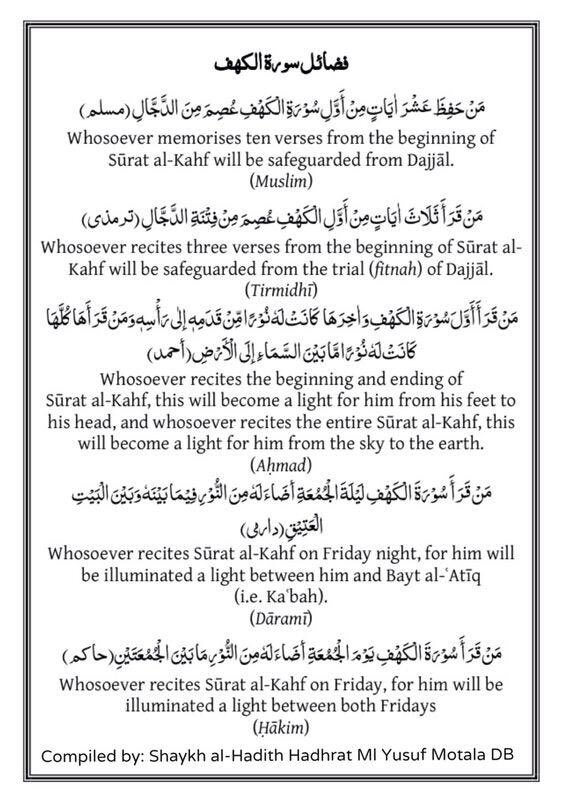
Virtues of Suratul Kahf (Click on picture to enlarge)
-
'Aisha's RA Chastity & Purity Proved MADINAH-AL-MUNAWARRA, THE CITY OF THE PROPHET , IS ABUZZ with rumors. Ever since the Muslims returned from the battle of Bani al-Mustaliq the hypocrites have been busy spreading lies against Aisha radi-Allahu anha. These stories have become the topic of every gathering, the subject of discussion in every household in Madinah. Though most of the sincere Muslims are confident in the innocence of Aisha radi-Allahu anha, they are still quiet, waiting for this to be ascertained by the Prophet. The Prophet is also quiet, waiting for Allah to inspire him towards the truth. Thus, the hypocrites led by Abdullah bin Ubayy bin Salool have advantage over the seemingly confusing situation and gear all their energies in spreading the lies. Unsuspectingly influenced by the hypocrites' rampage, a few Muslim thus begin to believe this false story. Some of these Muslims even actively help propagate it. Among them is Mistah bin Uthatha radi-Allahu anhu, a cousin of Abu Bakr radi-Allahu anhu. He is an extremely poor man with no money except that which Abu Bakr radi-Allahu anhu regularly gives him. Mistah's endorsement of the hypocrites' story adds somewhat more weight to it, as he is a man with a fine reputation. It can be no longer said that belief in this story is limited to the circle of hypocrites. And so a trying and gruesome month passes before Allah subhanahu wa ta'ala reveals the innocence of Aisha radi-Allahu anha. The Muslims finally exhale a sigh of relief and a sense of normalcy returns to Madinah. Hurt and angered by Mistah's previous allegations, Abu Bakr takes an oath that he will never spend on Mistah again.... More on Abu Bakr RA's hurt Here Related verses in the Qur'an: Sura An-Noor:11-21
-
Paying Zakaat before it is due Q. Can I give extra Zakaat after I give my Zakaat for the current year? If I can, would it be counted as Zakaat for the following year or would it be counted as optional charity? A. It is permissible for a person to discharge Zakaat for the following lunar year after discharging Zakaat for the current lunar year. This is subject to the following conditions: a) a person possesses the Zakaat Nisaab amount at the time of discharging Zakaat. b) a person's financial condition remains such that he is liable to pay Zakaat for the following year. If a person did not fulfil the above mentioned conditions, then the extra amount given as Zakaat will not be counted as Zakaat. It would be counted as optional charity. However, if the above conditions were fulfilled, then the extra amount given as Zakaat for the following year would be counted in the following years Zakaat. (Hindiyyah 1/176) And Allah Ta’ala Knows Best Mufti Ismaeel Bassa Confirmation: Mufti Ebrahim Desai (Islamic rulings on this Q&A newsletter are answered in accordance to the Hanafi Fiqh) Fatwa Department Jamiatul Ulama (KZN) Council of Muslim Theologian
-
Pearls of Wisdom: No.41 “Food for the Soul” SUBJECT: HUMILITY Allah, The Most Exalted, says: “And the true servants of Rahman (the most gracious Allah) are they who walk on the earth with humility.” (Qur’an Sur’an Al-Furqan 25: 63) The Messenger of Allah (peace be upon him) said: “Allah has revealed to me that you must be humble, so that no one oppresses another and boasts over another." (Hadith Abu-Dawood) Note: Being humble is an intricate part of our faith.To be humble is to not be proud, arrogant, or assertive. Humility is the ability to give up your pride and still maintain your dignity. It is not thinking less of yourself but rather thinking of yourself less! www.eislam.co.za
-
awww poor little girl! Allah grant 'aafiyat and safeguard her from all harm, aameen I'm sure you pray over her the Quls, Aayatul Kursi and maybe even the Manzil?
-
The Prohibition of Photography Hazrat Maulana Yunus Patel (Rahmatullahi 'alayh)
-
Treasure every sunrise Sayyiduna ‘Abdullah Ibn Mas’ud (radiyallahu’anhu) would recite the following du’a at sunrise. Lets ponder over its meaning, take heed and practice. اَلْحَمْدُ ِلِله الَّذِى اَقَالَنَا يَوْمَنَا هَذَا وَلَم يُهْلِكْنَا بِذُنُوْبِنَا Allahumdulillahil ladhi aqalana yawmana hadha wa lam yuhlikna bi dhunubina Translation All praise is for Allah, who has afforded us this day and did not destroy us for our sins. (Sahih Muslim, Hadith: 1908) Sayyiduna ibn Mas’ud is the most knowledgeable Sahabi after the Four Khulafa (radiyallahu’anhum). In this supplication, he teaches us to treasure every new day! One more day, is one more chance to earn Allah Ta’ala’s pleasure, it’s one more chance to repent for our sins. One who commences his day with this mindset of gratitude to Allah Ta’ala, will truly value his time and life. He who is grateful doesn’t disobey his Rabb. The meaning of this du’a is so profound, it’s worthy of being recited/remembered throughout the day too, especially in times of the current global disasters. May Allah Ta’ala protect us all. al-miftah
-
- 1
-
-
Fidya to Compensate for Qadhaa fasts Q: I have been negligent for paying in my fasts on time. I’ve had a miscariage, been pregnant twice and breastfed. I knew at that time that pregnant women don’t need to fast but I didn’t know that I had to repay it. Now many years later I’m sitting with this burden. I paid fidyah couple of years back but I think that according to hanafis I need to repay my days. What happens if next ramadaan comes and I’m not done fasting yet. Can I continue fasting next ramadaan and so on? A. Firstly you need to repent for being negligent in this regard, for it is sinful to delay Qadhaa fasts without a valid reason. May Allah Ta’aala accept your Taubah, Aameen. Fidyah will not compensate for the missed fasts. You will have to keep Qadhaa of the missed fasts. If the next Ramadhaan comes and all the Qadhaa have not yet been fulfilled, you will observe the fast of Ramadhaan and after Eid, continue with the Qadhaa of your missed fasts. Moulana Yusuf Laher Checked by: Mufti Siraj Desai Source
-
Should lizards be killed on sight? Question 1Should lizzards be killed on seeing them and if yes why? Answer In the Name of Allah, the Most Gracious, the Most Merciful. As-salāmu ‘alaykum wa-rahmatullāhi wa-barakātuh. There are numerous ahaadeeth regarding killing lizards and rewards for the one who does so. Consider the following hadith: عَنْ أَبِي، هُرَيْرَةَ قَالَ قَالَ رَسُولُ اللَّهِ صلى الله عليه وسلم “ مَنْ قَتَلَ وَزَغَةً فِي أَوَّلِ ضَرْبَةٍ فَلَهُ كَذَا وَكَذَا حَسَنَةً وَمَنْ قَتَلَهَا فِي الضَّرْبَةِ الثَّانِيَةِ فَلَهُ كَذَا وَكَذَا حَسَنَةً لِدُونِ الأُولَى وَإِنْ قَتَلَهَا فِي الضَّرْبَةِ الثَّالِثَةِ فَلَهُ كَذَا وَكَذَا حَسَنَةً لِدُونِ الثَّانِيَةِ ” . Abu Hurairah reported Allah’s Messenger (ﷺ) as saying: He who killed a gecko with the first stroke for him is such and such a reward, and he who killed it with a second stroke for him is such and such reward less than the first one, and he who killed it with the third stroke for him is such and such a reward less than the second one.[1] The reason for this can be know from the following hadith: عَنْ أُمِّ شَرِيكٍ ـ رضى الله عنها أَنَّ رَسُولَ اللَّهِ صلى الله عليه وسلم أَمَرَ بِقَتْلِ الْوَزَغِ وَقَالَ “ كَانَ يَنْفُخُ عَلَى إِبْرَاهِيمَ عَلَيْهِ السَّلاَمُ ”. Narrated Um Sharik: Allah’s Messenger (ﷺ) ordered that the salamander should be killed and said, “It (i.e. the gecko) blew (the fire) on Ibraheem, alayhi al-salaam.”[2] The word used in the hadith for this particular animal is وزغة. Multiple translations have been given for this word. Some dictionaries translate it as gecko[3] while others use the word lizard.[4] However, both of these animals are very similar and it is very likely that the word encompasses both these meanings and that the one word could include both these animals. And Allah Ta’āla Knows Best Muhammad Haris Siddiqui Student Darul Iftaa Melbourne, Australia Checked and Approved by, Mufti Ebrahim Desai. [1] وَحَدَّثَنَا يَحْيَى بْنُ يَحْيَى، أَخْبَرَنَا خَالِدُ بْنُ عَبْدِ اللَّهِ، عَنْ سُهَيْلٍ، عَنْ أَبِيهِ، عَنْ أَبِي، هُرَيْرَةَ قَالَ قَالَ رَسُولُ اللَّهِ صلى الله عليه وسلم “ مَنْ قَتَلَ وَزَغَةً فِي أَوَّلِ ضَرْبَةٍ فَلَهُ كَذَا وَكَذَا حَسَنَةً وَمَنْ قَتَلَهَا فِي الضَّرْبَةِ الثَّانِيَةِ فَلَهُ كَذَا وَكَذَا حَسَنَةً لِدُونِ الأُولَى وَإِنْ قَتَلَهَا فِي الضَّرْبَةِ الثَّالِثَةِ فَلَهُ كَذَا وَكَذَا حَسَنَةً لِدُونِ الثَّانِيَةِ ” . (مسلم) [2] حَدَّثَنَا عُبَيْدُ اللَّهِ بْنُ مُوسَى، أَوِ ابْنُ سَلاَمٍ عَنْهُ أَخْبَرَنَا ابْنُ جُرَيْجٍ، عَنْ عَبْدِ الْحَمِيدِ بْنِ جُبَيْرٍ، عَنْ سَعِيدِ بْنِ الْمُسَيَّبِ، عَنْ أُمِّ شَرِيكٍ ـ رضى الله عنها أَنَّ رَسُولَ اللَّهِ صلى الله عليه وسلم أَمَرَ بِقَتْلِ الْوَزَغِ وَقَالَ “ كَانَ يَنْفُخُ عَلَى إِبْرَاهِيمَ عَلَيْهِ السَّلاَمُ ”. (بخاري) [3] Hava pg.859 [4] Ibid Steingass pg.1211 Source
-

Is Prayer Of Men And Women The Same In Saheeh Bukhari?
ummtaalib replied to ColonelHardstone's topic in Hanafi Fiqh (Women)
A refutation of claims made by Shaykh al-Albani that there is no difference between the salah of men and women. The truth concerning differences in the salah of men and women By Mufti Talha Desai The following was written in response to an article found on the well known Islam QA website relating to the issue of difference in the salah of a man and a woman. Mufti Talha Desai, under the guidance of Mufti Ebrahim Desai, penned a response refuting this idea and affirming that there is in fact differences in the salah of a man and a woman in light of the ahadith of Allah’s Messenger (Allah bless him and grant him peace) and the teachings of the Sahabah and the salaf. Mufti Talha Desai writes: Majority of the proofs presented in the article are taken from the book authored by Shaykh Nasir al-Din al-Albani (d. 1420 H) titled Sifat Salat al-Nabi. This book contains many mistakes and was refuted by many ‘ulama throughout the world like the late Shaykh Hamud al-Tuwayjiri (d. 1420 H). In fact, the late Shaykh ‘Abd al-Aziz bin Baz (d. 1420 H) and Shaykh Salih al-Munajjid have also given rulings contrary to that which is in the book of al-Albani regarding this issue. So, it seems as though al-Albani was the only scholar claiming that there is no difference between the salah of men and women. Hereunder, is our response to the article: The article states: “Rather the general meaning of the words of the Prophet (peace and blessings of Allaah be upon him), “Pray as you have seen me praying,” include women too” Response: 1. The interpretation of the above hadith provided by al-Albani was never given by any scholar of the past. Not a single traditional and expert commentator of Sahih al-Bukhari, including the likes of Ibn Hajar ‘Asqalani, ‘Allamah ‘Ayni, Ibn Battal etc. had given this interpretation. It is only al-Albani that has given this interpretation and logically it will be incorrect for us to follow this interpretation of al-Albani. 2. It should be known that the interpretation by al-Albani and his logical inference of this hadith cannot be accepted at all, because it goes against other ahadith in which Allah’s Messenger (Allah bless him and grant him peace) clearly draws a difference between the salah of men and women, aside from the many verdicts and practices of Sahaba and those after them that were mentioned above. The article states: “The general meaning of the words of the Prophet (peace and blessings of Allaah be upon him): “Women are the twin halves of men.” Response: 1. This hadith cannot be used to prove that women are like men in all aspects of din. The ahadith above are sufficient evidence to show that men and women are not equal in all aspects of din. The meaning of the above hadith is that women resemble men with regards to their body constitution. This is because Hawwa (Allah’s peace be on her) was created from Adam (Allah’s peace be on him) and thereof the progeny of men and women began. (Ma’arif al-Sunan, 1:374) 2. Even if we had to accept this “principle” that women are like men in all aspects, then this principle only applies to those cases where there are no proofs indicating to the contrary. In the issue of women’s salah , there are many ahadith in which Allah’s Messenger (Allah bless him and grant him peace) differentiated between the salah of both genders. Surprisingly, this principle is stated in the article but has not being implemented. 3. Not a single traditional muhaddith and expert commentator of hadith has interpreted the above hadith as it is interpreted in this article. Thus, it will be illogical for us to accept this interpretation. The article states: The other is the hadeeth of Abu Mutee’ al-Hakam ibn ‘Abd-Allaah al-Balkhi from ‘Umar ibn Dharr from Mujaahid from ‘Abd-Allaah ibn ‘Umar who said: The Messenger of Allaah (peace and blessings of Allaah be upon him) said: “When a woman sits during the prayer she should place one thigh against the other and when she prostrates she should press her stomach against her thighs, compressing herself in the most concealing manner, for Allaah looks at her and says: ‘O My angels, I call you to bear witness that I have forgiven her.’” Sunan al-Bayhaqi al-Kubra, 2/222. this hadeeth is da’eef, because it was narrated by Abu Mutee’ al-Balkhi. Response: According to the principles of hadith laid down by the fuqaha and muhaddithin, this hadith can be relied on, since it is supported by many other ahadith and verdicts of Sahabah, who were the students of Allah’s Messenger (Allah bless him and grant him peace). It is supported by many shawahid (corroborative reports – a term of usul al-hadith). (I’la al-Sunan, 3:33) The article states: A third hadeeth was narrated from Yazeed ibn Abi Habeeb, saying that the Messenger of Allaah (peace and blessings of Allaah be upon him) passed by two women who were praying. He said: “When you prostrate, press some of your flesh to the ground, for women are not like men in that.” This was narrated by Abu Dawood in al-Maraaseel (p. 118) and by al-Bayhaqi (2/223). This hadeeth is mursal, which is a category of da’eef (weak). Response: 1. The issue of woman’s salah is purely a fiqhi issue and has to be dealt with in the light of what the fuqaha state. They were masters in understanding the meanings of the ahadith as stated by the great muhaddith and student of Imam Bukhari, Imam Tirmidhi (Allah have mercy on them). The fuqaha of all four madhahib accept mursal ahadith, but obviously with certain conditions (Athar al-Hadith al-Sharif). Therefore, it will totally incorrect to blatantly state that; “this hadith is mursal, which is a category of da’if (weak)” indirectly inferring that this hadith cannot be accepted. We do not wish to go into the discussion of mursal ahadith, since this is not the purpose of this article. However, all the narrators of the above hadith are reliable and there is no reason to reject it as stated in I’la al-Sunan, 3:26. The article states: In al-Musannaf (1/242), Ibn Abi Shaybah narrated some reports from some of the salaf which suggest that there is a difference in the way women and men sit (in prayer), but the only evidence that counts is the words of Allaah and His Messenger (peace and blessings of Allaah be upon him). Then he narrated from some of the salaf that the way in which men and women pray is the same. Response: 1. It is incorrect to state; “but the only evidence that counts is the words of Allah and His Messenger (peace and blessings of Allaah be upon him)”.This statement infers that the statements of tabi’in and ‘ulama cannot be accepted. This is totally incorrect and goes against the teachings of the Qur’an and the ahadith. Allah mentions in the Qur’an: يَا أَيُّهَا الَّذِينَ آَمَنُوا أَطِيعُوا اللَّهَ وَأَطِيعُوا الرَّسُولَ وَأُولِي الْأَمْرِ مِنْكُمْ “O those who believe obey Allah and obey His Messenger and those in authority amongst you” (4: 59) Early commentators of Qur’an such as Ibn Abbas, Mujahid and Hasan Basri have stated that; “those in authority amongst you” refer to the fuqaha and ‘ulama (Ma’arif al-Qur’an). We are commanded to follow the teachings of tabi’in and ‘ulama for there teachings are based on the Qur’an and ahadith. The author of this article states that; “only the words of Allah and Allah’s Messenger (Allah bless him and grant him peace) are the only evidence that count”, then why does he quote from the writings of al-Albani, etc? The article states: In al-Musannaf (1/242), Ibn Abi Shaybah narrated some reports from some of the salaf which suggest that there is a difference in the way women and men sit (in prayer), but the only evidence that counts is the words of Allaah and His Messenger (peace and blessings of Allaah be upon him). Then he narrated from some of the salaf that the way in which men and women pray is the same. Al-Bukhaari (may Allaah have mercy on him) said: Umm al-Darda’ used to sit in prayer as a man sits and she was a scholarly woman. Al-Haafiz stated in Fath al-Baari that Abu’l-Darda’ had two wives, both of whom were called Umm al-Darda’. The older one was a Sahaabiyyah and the younger one was a Taabi’iyyah. He suggested that the one who was referred to here by al-Bukhaari was the younger one. Response: 1. In light of what the author of this article has written, it is incorrect for him to present the above narration as a proof. This is so, because he states that only the words of Allah and Allah’s Messenger (Allah bless him and grant him peace) count and here he presents the action of a tabi’iyyah as proof. 2. However, it is not sufficient enough to present the above narration regarding the action of Umm ‘l-Darda’ as proof, because there is a narration recorded by Imam Tahawi (Allah have mercy on him) which states contrary to it. The hadith is as follows: قال رأيت أم الدرداء تصلي متربعة Ibrahim bin Abi Ablah narrates: “I saw Umm ‘l-Darda’ performing salah in the tarabbu’ position” (Tuhfa al-Akhyar, 2:338) 3. The author of the article claims that Imam Ibn Abi Shaybah recorded from the salaf that the way in which men and women performed salah was the same. This is absolutely false and incorrect accusations labelled against this great imam. He has never mentioned this in his Musannaf. Not a single salaf has mentioned that a woman will perform salah as a man performs salah . The author of this article has probably relied on the book Sifat Salat al-Nabi authored by al-Albani. This is because the mistake made by al-Albani in his book is the same mistake made by the author of this article. Al-Albani claimed that Ibrahim al-Nakha’i said: “A woman will do as a man does in salah ”. He also adds that this narration has a sahih sanad (authentic chain of narrators). However, this was not what Ibrahim al-Nakha’i said and nor was this ever his view. The correction words of Ibrahim al-Nakha’i that appear in Musannaf Ibn Abi Shaybah are: عن إبراهيم ، قال : تقعد المرأة في الصلاة كما يقعد الرجل “A woman will sit as a man sits in salah ” (Musannaf Ibn Abi Shaybah, #2804) Hereunder, are the interpolated words of al-Albani: كل ما تقدم من صفة صلاته صلى الله عليه وسلم يستوي فيه الرجال والنساء ولم يرد في السنة ما يقتض استثناء النساء من بعض ذلك بل إن عموم قوله صلى الله عليه وسلم : ( صلوا كما رأيتموني أصلي ) يشملهن وهو قول إبراهيم النخعي قال : ( تفعل المرأة في الصلاة كما يفعل الرجل ) أخرجه ابن أبي شيبة ( 1 / 75 / 2 ) بسند صحيح عنه In conclusion we would like to mention that all the ahadith mentioned in this article are sufficient to prove that there exists a difference between the salah of men and women and it would be incorrect to claim that the salah of both genders are common. We ask Allah to grant us sincerity and make this humble effort a means of exposing the truth. Friends of Deoband -
Enjoining Good & Forbidding Evil (Criteria/Advices)
ummtaalib replied to ummtaalib's topic in General Islamic Articles
Source
-
Question: Are Overdraft Facilities in Bank Accounts Permissible? In the Name of Allah, the Most Gracious, the Most Merciful. As-salāmu ‘alaykum wa-rahmatullāhi wa-barakātuh. The Answer: If you withdraw more money than you have in your bank account, the extra money you take out after your bank balance reaches zero is called an overdraft. An overdraft will allow you to borrow money through your current account. You might request one from your bank or your account may automatically offer you an overdraft (with your agreement). Hence, overdrafts are loans from the bank to the customer. If the overdraft facility comes with a fee, such a facility will not be permissible as the fee is interest. If the overdraft facility is free, it is permissible to avail of such a facility. If one has an account with an overdraft facility which charges, one should deactivate or cancel such a facility or switch to an account which does not have such a facility. And Allah Ta’ālā Alone Knows Best Mufti Faraz Adam al-Mahmudi, www.darulfiqh.com
-
- 1
-
-
Advice for Intending Holiday Makers By Hadrat Mawlānā Muhammad Saleem Dhorat hafizahullāh It is a common trend in this day and age for people to take a break for recreation, including going on holiday. Undertaking leisure activities, such as travel, are regarded as promoting general wellbeing. This concept is not inconsistent with our Dīn, as from amongst the commands of Allāh ta‘ālā is the safeguarding of one’s health, both physically and mentally. Alhamdulillāh, as with all areas of life, we find guidance in our Dīn for this aspect too, so we can make our actions a means of acquiring the pleasure of Allah ta‘ālā. Be a Healthy Believer Health and strength are from the blessings of Allāh ta‘ālā that help us to excel in Dīn and in this worldly life. Rasūlullāh sallallāhu ‘alayhi wasallam has stated: A strong believer is better than a weak believer. (Muslim) We can understand from this Hadīth that a believer who looks after his health and wellbeing, will be able to perform those good actions, which a believer weaker in health will not. Health is of such importance that we find in another Hadīth Rasūlullāh sallallāhu ‘alayhi wasallam lamenting a sahābī radhiyallāhu ‘anhu who was neglecting his health: Verily your body has a right upon you (Al-Bukhārī) Rasūlullāh sallallāhu ‘alayhi wasallam has encouraged us to give our bodies rest and relaxation, so that a person remains motivated and does not fall prey to boredom or exhaustion. This will enable one to maintain enthusiasm and energy to carry out the Commands of Allāh ta‘ālā and perform good deeds. It is related by Anas ibn Mālik radhiyallāhu ‘anhu that once Nabī sallallāhu ‘alayhi wasallam entered the masjid and found a rope hanging between two pillars. He sallallāhu ‘alayhi wasallam asked, “What is this?” The Sahābah radhiyallāhu ‘anhum replied, “It is for Zaynab. When she feels tired (whilst praying), she holds onto it.” Nabī sallallāhu ‘alayhi wasallam said, “No, untie it (i.e. this is incorrect). Pray as long as you feel energetic; when you become tired, you should sit down.” (Al-Bukhārī) Stay Focused Like the need for a good balanced diet, sleep and exercise, a break from one’s daily routine, if spent in line with the principles of Sharī‘ah, can help to enhance a person’s health both physically and mentally. However, it is important to remember that in fulfilling this necessity, we do not take a break from our religious obligations, nor cross the boundaries laid down by the Sharī‘ah. Precautions must be undertaken to ensure that whilst engaging in any leisure activity, a person does not become heedless of the remembrance of Allāh ta‘ālā and compromise his religious and spiritual obligations, thereby causing harm to his eternal life of the hereafter. The following advices will inshā’allāh help us achieve a balance and make our ‘time out’ fruitful in this world and the hereafter. 1. Intention and Objective The intention for taking a break must be correct; it should not be to merely follow the prevalent culture of the day. Our every action should be to fulfil the objective of our existence and creation, the worship of Allāh ta‘ālā. Allāh ta‘ālā states: I did not create the Jinns and the human beings except for the purpose that they should worship me. (56:51) In light of this, if one’s objective for taking a break is to rest and refresh the body and mind, in order to return home and thereafter exert more effort to perform good deeds and fulfil the rights of the Creator and the creation, then this will be a rewarding action. Similarly, the aim to spend quality time with the family is also a worthy intention. 2. Ensure Suitability We must ensure that the trip we are undertaking is in compliance with Sharī‘ah. Many are those who, without having undertaken research, book a holiday package. Only after arriving at their destination do they realise that they have arrived at an unsuitable place; an environment of irreligiousness, obscenity and nudity. On returning home, they are regretful and concede that the environment was such that they were unable to refrain from sin. If one intends to travel abroad for a holiday, then it is not necessary to visit those places where everyone else is going. To avoid finding oneself in an unsuitable situation, thorough research should be undertaken on the proposed destination and to only proceed to such places wherein the disobedience of Allāh ta‘ālā is not taking place. 3. Shaytān’s Ploy As stated earlier, during any leisure activity or holiday we should not overlook our obligations. Shaytān places into the mind this thought, ‘We have come here for rest and relaxation, there must be total freedom from every type of restriction’. Those on holiday therefore absolve themselves from tilāwah of the Glorious Qur’ān, dhikr, ma‘mūlāt etc. Only salāh remains and that too is of the lowest standard. In this respect, we should ask ourselves the following questions: Do I reduce the hours of my sleep while on holiday? Do I reduce the amount of food that I consume? When we do not reduce our sleep nor food intake, there is no excuse for reducing or altering one’s ‘ibādah. It is therefore of paramount importance to prepare a timetable, so that one will remain punctual in all of one’s a‘māl. It should also be noted that, just as supplications made during travel are more accepted, similarly there is greater barakah in the dhikr and ‘ibādah performed while on a journey. 4. Avoid Extravagance We should avoid unnecessary expenses and extravagance. Allāh ta‘ālā states: Surely, squanderers are brothers of satans, and the Satan is very ungrateful to his Lord. (27:17) As it has become common to take a break by travelling abroad, all too often people go on holiday packages that they cannot afford by taking out loans. In their desire for a luxury holiday, they become embroiled in unnecessary extravagance. It is incorrect to believe that rest and relaxation can only be achieved by travelling abroad for a holiday. Even if one cannot afford a holiday due to financial difficulty or is unable to identify a suitable destination, then what is the harm or loss? People in the past did not go on such holidays, yet arguably had greater peace and happiness in their lives in comparison to ours. Beneficial Guidelines In order to safeguard one’s time and a‘māl, in particular during a holiday journey, some further beneficial guidelines should also be borne in mind: 1. Always remain engaged in the remembrance of Allāh ta‘ālā. Keep this thought in mind that my Allāh ta‘ālā is watching me with love. 2. Maintain modesty and be mindful about unlawful gazes, dressing appropriately in accordance with Sharī‘ah and injunctions relating to contact with non-mahrams. 3. Take out some time for muhāsabah (taking account of one’s past actions) daily. In particular, ponder over how much of life has passed and how much more remains. 4. Make firm resolutions for the future by thinking about what one needs to and what one intends to do from now to make amends for the past. 5. Refrain from the disobedience of Allāh ta‘ālā at all times. Stay away from places of sin and indecency and avoid unnecessary extravagance in spending. 6. Abstain from all non-Islamic practices. Spend your time in such a way that when you return, it is with both a healthy body and a healthy soul. May Allāh ta‘ālā safeguard us all and grant us the correct tawfīq. Āmīn. © Riyādul Jannah (Vol. 25 No. 3, Mar 2016)
-
Pride, its Reality and Remedy (Correspondence of Hazrat Mufti Mahmood Hasan Gangohi rahimahullah) Letter: (The questioner has apparently requested advice with regards to the remedy of pride. Hereunder is the reply to the question) Pride is when a person considers himself to be superior and thinks of others to be lower than him. The remedy for pride is that a person should ponder over this: “Whatever perfection I may see in myself is not on account of my own achievement. Rather, it is from Allah Ta‘ala and in his control. He may take it back whenever He wishes. Then what achievement will I have? Allah Ta‘ala has power over everything. He gives honour to whom He wishes and disgrace to whom He wishes.” One should think over this to such an extent that it firmly settles in the mind. Insha-Allah, in this way pride will be removed. (Maktoobaat vol. 1, pg. 23)
-
The Greatest Return There are many great “returns” that people experience in their lives. The returning of a missing child, finding a very valuable lost item or a close family member returning home after spending many years overseas are some instances of a great return. These are moments of immense joy and happiness. The greatest “Return,” however, is when a sinful servant who had abandoned Allah Ta’ala and fallen into sin makes sincere taubah (which literally means “to return”) and returns to his Creator. There can never be a happier moment for such a person. Retuning to Allah Ta’ala in sincere repentance brings down the showers of the Mercy of Allah Ta’ala. Due to his repentance, the one who was previously known in the court of Allah Ta’ala as a faasiq (sinner) earns the title of Habibullah (the beloved of Allah). His crying and sobbing while begging for forgiveness is more beloved to Allah Ta’ala than the recitation of tasbeeh of those who are busy glorifying Allah Ta’ala. Can there be a greater return? YARDSTICK OF PIETY The object of the auspicious month of Ramadhaan is to truly return to Allah Ta’ala by repenting from all sin and adopting piety. The Qur’an-al-Kareem declares: “O you who believe, fasting has been prescribed upon you, just as it was pescribed upon those before you, so that you may acquire taqwa (piety)” (S2:183). Taqwa, in simple terms, refers to giving up every sin. The one who forsakes all sin is the greatest worshipper and the most pious person, even though he may not be performing nafil (optional) Haj and Umrah every year, giving thousands in charity or standing the entire night in tahajjud salaah. Indeed, these great acts of worship should be performed as much as possible. However, the yardstick of piety is taqwa – abstaining from sin. Taqwa cannot be acquired without first making sincere taubah. It thus follows that the one who does not make taubah has to a degree def eated the purpose of Ramadhaan, even though he may have performed many other good deeds in the blessed month. MENTAL NOTE It is thus evident that in order to acquire the object of Ramadhaan, one must start with sincere taubah (repentance). One should sit in solitude and list down, or make a mental note, of all the laws of one’s beloved Master and Creator which are being disobeyed. Think: Have I performed all my Salaah, Zakaah, Qurbaani, etc? Have I taken anyone’s property wrongfully? Did I lie, backbite, slander? Do I have pride, harbour jealousy and do actions for name and fame? What about the laws of hijaab? Am I obeying my most beloved Rabb in this regard or do I disobey Him? Am I involved in any illicit relationship? Have I sinned with my eyes, ears, tongue and heart? Have I fulfilled the rights of my neighbours and relatives? Do I take intoxicants? Am I shaving or trimming my beard to less than a fist length? … After having carefully taken note of all the sins in one’s life, sincerely repent from ea ch one. Beg Allah Ta’ala’s forgiveness. For one’s taubah to be accepted, the following pre-conditions apply: * Give up the sin immediately. * Regret having sinned. Feel the pain in your heart, just as you would be pained if you lost a million rands. * Resolve never to commit the sin again. * The unfulfilled rights of Allah Ta’ala (salaah, zakaah, etc.) and the rights of people (debts, etc.) must be discharged. NO TAUBAH Often many people stop committing various sins in Ramadhaan. Gambling comes to a hault. The T.V. is switched off. Intoxicants are given up. Lying, vulgar languages, zina and a host of other evils are forsaken. Similarly, many actions that were previously neglected are performed in Ramadhaan. Salaah is performed regularly. The Musjid is full even for Fajr Salaah. Many other good deeds are performed. It is indeed a great gift from Allah Ta’ala that one respects the month of Ramadhaan by refraining from sins and engaging in good deeds. However, the tragedy is that as soon as Ramadhaan leaves, it is as if Deen has left. The day after Eid the Musjid is crying out for those who were regularly there for the entire month. The gambling dens are once again frequented by those who were frequenting the Musjid. Numerous other evils which were given up during Ramadhaan are once again perpetrated. One of t he fundamental reasons for this speedy slide into a life of disobedience is that, while we respected Ramadhaan, we did not sincerely return to Allah Ta’ala and repent from our sins. Thus this is our need of the moment To undertake the Greatest Return. Having repented sincerely, one should also closely link oneself to a pious personality who one feels comfortable with. Take his guidance in all aspects and one will be saved from the many hazards, Insha Allah. ENCOURAGE Furthermore, actively encourage others to undertake the Greatest Return. While your encouragement will insha Allah benefit them, it will also greatly help you to remain steadfast. May Allah Ta’ala grant s the ability to repent incerely, forgive us and nable us to refrain from very sin in future. Aameen.
-
Shaikh Rasheed Ahmad Gangohi (Allah have mercy on him) said, Shaykh Hussain Ahmed Madani Ma’riful Hadith – by Shaykh Muhammad Manzoor Numani
-
Shaykh Muhammad Saleem Dhorat explains: Allah Ta’ala says in Surah Saaffaat, “Thus do We reward the Muhsineen” “If you desire acceptance in this world and in the Hereafter, then become of the Muhsineen, (those who do good deeds). Work hard, adopt Taqwa and become deserving of Sifate Ihsaan. But what is this quality of Ihsaan? Worship Allah as though you see Him and if not, then know that if you do not see Him, He definitely sees you. When the notion is born in one that my Allah is watching me at all times, and He is Great and Powerful (Azmat wala, Qudrat wala), so He will reward me on my good but He will punish me on my bad deeds, to have this azmat in one’s heart is called Maqaame Muraaqabah. When in the heart and mind one is constantly aware that my Allah is watching me and He is the Maalik of Nafaa-Nuksaan (The Lord of benefit and harm), I have to obey Him and not disobey Him, after one becomes firm on this, then this stage develops whereby the person will see Allah’s Qudrat (power) in everything i.e. if the hand is raised then he will realise the hand is being raised. This is Maqaame Mushaahadah.This is Sifate Ihsaan.
-
Importance of Adab (Respect) and Righteous Company Hadhrat Mufti Ebrahim Salejee (Daamat Barakaatuhu) once mentioned: The era of the Sahaabah was the most blessed of eras in the history of Islam. It was an era replete with righteousness and piety. Despite the various means of acquiring Islamic information being non-existent in the time of the Sahaabah viz. the internet, CD’s, Islamic cassettes, radio stations, Islamic literature, etc., yet the entire ummah is unanimous upon this fact, that the Sahaabah possessed the greatest knowledge of Deen. Their consciousness and awareness of Allah Ta’ala was unparalleled. They were a nation absolutely devoted and committed to Deen. Their steadfastness upon the Sunnah was proverbial. In short, they were guiding stars for humanity till the Day of Qiyaamah. In retrospect, when we examine the present situation, despite there being an explosion of Islamic information everywhere, in the form of the internet, CD’s, Islamic cassettes, radio stations, Islamic literature, etc., yet people’s understanding of Deen is extremely weak. Many people are stormed with doubts and misunderstandings in regards to Deeni issues. The desired level of commitment to Deen isn’t seen in the lives of the Muslims. At this critical juncture, the question that arises is: “Why have the levels of Deen dropped so drastically? What is the missing link in the entire equation, that link which formed the corner stone of success in the lives of the Sahaabah, and today is missing in our lives?” Hadhrat Moulana Thaanwi (Rahmatullahi Alayh) explained that the cause for the current Deeni decline and spiritual retrogression is mainly due to two aspects lacking in the lives of the Muslims. Practising upon these two aspects will earn one success. The first is acquiring a high degree of adab (respect) for everything related to Deen. The second is suhbat i.e. remaining in the company of the learned and righteous. Hadhrat Haaji Imdaadullah (Rahmatullahi Alayh) is reported to have said: “Deen in totality is adab.” Ihyaauddeen.co.za
-
- 1
-
-
Income from a business started with interest money? Q. Years ago, I was not inclined to Deen. So a friend of mine asked me for a R100.000.00 loan and I gave it to him on interest for a R150.000.00 return. After he repaid me the interest loan of R150.000.00, I used the same money to start-up my business which is a multi-million Rand buisness Today. I am concerned about the interest money I used to start my multi-Million Rand business. Is my entire business Haraam or just the interest portion of it? A. As a general rule, it is Haraam for person to take or give interest loans. If an interest loan had been taken or given to a person, the interest money has to be returned to its original owner. A person should make sincere Taubah and Istighfaar for involving himself in such loans. In the enquired case, the Halaal profit earned from your capital investment (interest) to your start-up business over the years is Halaal. The capital investment of interest to your start-up business will not affect the status of your Halaal profit of your multi Million Rand business Today. However, the interest portion of your capital investment (R50.000.00) to your start-up business is Haraam for you and has to be returned to your friend. Note: It should be kept in mind that this is a case of a person giving an interest loan and benefitting from it negligently or ignorantly. Otherwise, it is not allowed at all for a person to do so intentionally or make this a means or source of income. And Allah Ta’ala Knows Best Mufti Ismaeel Bassa Confirmation: Mufti Ebrahim Desai (Islamic rulings on this Q&A newsletter are answered in accordance to the Hanafi Fiqh) Fatwa Department Jamiatul Ulama (KZN) Council of Muslim Theologians
-
Changing our attitude to POSITIVE MODE
ummtaalib replied to ummtaalib's topic in General Islamic Articles
Attitude leads to Altitude!!! www.eislam.co.za Ayoob was the kind of person who would always amaze you. He was always in a good mood and always had something positive to say. When someone would ask him how he was doing, he would reply, "If I were any better, I would be twins!" He was a unique manager because he had several waiters who had followed him around from restaurant to restaurant. The reason the waiters followed Ayoob was because of his attitude. He was a natural motivator. If an employee was having a bad day Ayoob was there telling the employee how to look on the positive side of the situation. Seeing this style really made me curious, so one day I went up to Ayoob and asked him, "I don't get it! You can't be a positive person all of the time. How do you do it?" Ayoob replied, "Each morning I wake up and say to myself, ' Ayoob, Allah Ta’ala has given you two choices today. You can choose to be in a good mood or you can choose to be in a bad mood.' I choose to be in a good mood. Each time something bad happens, I can choose to be a victim or I can choose to learn from it. I choose to learn from it. Every time someone comes to me complaining, I can choose to accept their complaining or I can point out the positive side of life. I choose the positive side of life." "Yeah, right, it's not that easy," I protested. "Yes, it is," Ayoob said. "Life is all about choices Allah has given us. When you cut away all the junk, every situation is a choice. You choose how you react to situations. You choose how people will affect your mood. You choose to be in a good mood or bad mood. The bottom line: Allah has given you an option how you live your life!" I reflected on what Ayoob said. Soon thereafter, I left the restaurant industry to start my own business. We lost touch, but I often thought about him when I made a choice about life before reacting to it. Several years later, I heard that Ayoob did something you are never supposed to do in a restaurant business: he left the back door open one morning and was held up at gunpoint by three armed robbers. While trying to open the safe, his hand, shaking from nervousness, slipped off the combination. The robbers panicked and shot him. Alhamdulillah , Ayoob was found relatively quickly and rushed to the local hospital’s trauma centre. After 18 hours of surgery and weeks of intensive care, Ayoob was released from the hospital with fragments of the bullets still in his body. I saw Ayoob about six months after the accident. When I asked him how he was, he replied, "Alhamdulillah , Allah is so Great and so Merciful” and then he added “If I were any better, I'd be twins. Wanna see my scars?" I declined to see his wounds, but did ask him what had gone through his mind as the robbery took place. "The first thing that went through my mind was that I should have locked the back door," Ayoob replied. "Then, as I lay on the floor, I remembered that Allah had given me two choices: I could choose to live, or I could choose to die. I chose to live. By the Will and Acceptance of Allah I choose to live and Allah accepted my dua" "Weren't you scared? Did you lose consciousness?" I asked. Ayoob continued, "The paramedics were great. They kept telling me I was going to be fine. But when they wheeled me into the emergency room and I saw the expressions on the faces of the doctors and nurses, I got really scared. In their eyes, I read, 'He's a dead man.' "I knew I needed to take action." "What did you do?" I asked. "Well, there was a big, burly nurse shouting questions at me," said Ayoob. "She asked if I was allergic to anything. 'Yes,' I replied. The doctors and nurses stopped working as they waited for my reply. I took a deep breath and yelled, 'Bullets!' Over their laughter, I told them. 'I am choosing to live. Operate on me as if I am alive, not dead." Ayoob lived, thanks to Allah who made available skilled doctors at this critical moment and also because of his amazing attitude that Allah had given him. I learned from him that every day we have the choice to live fully. Attitude is like a price tag, it shows how valuable you are! The Messenger of Allah (peace be upon him) is reported to have said;“The best of people in Islam are those who have the best attitude (towards others).” (Hadith At-Tabaraani). We may not be feeling happy or at ease at the moment, however we can still show a smile on our face or share a few friendly words and kind gestures. Often times, it is simply our attitudes that can influence someone to do good or inspire someone to seek the beauty of Islam. It only takes a second to affect a person in a bad or good way, and this may very well depend not on your actions or deeds, but simply upon the attitude you have at that second. If you carry a frown walking into a house where there are guests, they may feel un-welcomed. The frown may only last a few moments, but that will be long enough to leave a bad impression on some hearts. “No greater deed will be placed in the balance than a good attitude towards others”(Hadith-Tirmidhi) Indeed attitude will lead a person to altitude. Often persons with the worst past build the best future!- 1 reply
-
- 1
-
-
Q. How should one give Azaan in the ears of a new born baby? A. When a child is born, the Azaan and Iqaamah should be called out in the ears of a child. The Azaan should be called out in the right ear of the child and the Iqaamah should be called out in the left ear of the child. This should, preferably, be done after the child has been cleaned and given a bath. At the time of calling out the Azaan and Iqaamah in the ears of a child, the child may be held in one's hands. It is Mustahab (preferable) to face the Qiblah in doing so. However, it is not necessary. It is also not necessary to keep the fingers in the ears, turn to the right and left or call out the Azaan loudly as is normally the case. The Azaan should be called out at a slow pace and the Iqaamah should be called out at a moderate pace to differentiate between Azaan and Iqaamah. It may be given standing or sitting. If there is a delay for some reason, the Azaan and Iqaamah should not be left out and it should be done at a later stage. (Fataawa Darul Uloom Zakariyyah 6/503) And Allah Ta’ala Knows Best Mufti Ismaeel Bassa Confirmation: Mufti Ebrahim Desai (Islamic rulings on this Q&A newsletter are answered in accordance to the Hanafi Fiqh) Fatwa Department Jamiatul Ulama (KZN) Council of Muslim Theologians