ummtaalib
-
Posts
8,467 -
Joined
-
Days Won
773
Content Type
Profiles
Forums
Events
Everything posted by ummtaalib
-
Jazanah Salah: Jazanah Salah is usually done after Dhohar Salah spelling mistakes above Also the part on "The original Mosque of Omar" needs more clarification I feel, since there appears to be confusion on the one where 'Umar RA is said to have prayed before entering. This page says: This article is about mosque in Bethlehem. For the mosque with the same name in Jerusalem, see Mosque of Omar.
-
Jazakallaahu khayraa for the excellent compilation...may Allah ta'ala accept. For future visitors to Al-Quds Before our visit we did a lot of research and reading up and Alhamdulillah it worked out wonderful with the grace of Allah ta'ala...we had very little time due to flights for umrah so almost no sightseeing, next time inshaAllah! The following report (entry to Jerusalem through Amman) is how we went as well however on our own and not with a tour group and it worked out fine Alhamdulillah...and one thing: the staff on the Israeli side are extremely obnoxious and intimidating and plan to scare people by picking one or two persons from a group and trying to intimidate them with long, unnecessary questions, checking luggage and keeping back the whole group for hours! No need to be scared. Remain calm and answer their questions.The worst they can do is send you back. Perform Salah when time and ignore dirty looks : )
-

The Accepted Whispers: Munajaat-e-Maqbul
ummtaalib replied to Acacia's topic in Du’as for Various Occasions
اَللّٰهُمَّ أِنِّيْ أَسْأَلُكَ مِنْ خَيْرِ مَا سَأَبَكَ Acacia, please check this du'a again....the "Baa" should be a "laam" in سَأَبَكَ -
Legal Status of the Blood after Miscarriage
ummtaalib replied to ummtaalib's topic in Fiqh of Menstruation
Bleeding after a miscarriage Q: I was 11 and half weeks pregnant and started brownish spotting. I went to the gynae who couldn't find a heartbeat (they refer to it as a missed miscarriage as I had no symptoms of a miscarriage). Few hours later I had a heavy flow and the next morning went in for a D&C (scraping of the womb) please advise if this is istihaaza? A: If the limbs of the foetus were not formed then if the blood flowed for three days or more it would be regarded as haidh. The woman will follow her previous menstruating cycle. E.g. If she was used to bleeding for five days and she now bled for over ten days, five days will be regarded as haidh and the remainder days as istihaadhah. If the limbs of the foetus were formed, then the bleeding will be regarded as nifaas. And Allah Ta'ala (الله تعالى) knows best. والسقط إن ظهر بعض خلقه من أصبع أو ظفر أو شعر ولد فتصير به نفساء هكذا في التبيين وإن لم يظهر شيء من خلقه فلا نفاس لها فإن أمكن جعل المرئي حيضا يجعل حيضا وإلا فهو استحاضة (هندية 1/37) Answered by: Mufti Zakaria Makada Checked & Approved: Mufti Ebrahim Salejee (Isipingo Beach) -
Performing Sunnats while on a journey Q: I read in one narration that the prophet (Sallallahu Alayhi Wasallam) would not read sunnats after Salaah while on a journey. So should we only read fard and sunnah of fajr and Witr? Is this correct? A: Apart from the witr salaah and the two sunnats of fajar, during a journey one has been given the choice in regard to the other Sunnats. The status of the Sunnat salaah becomes nafil. It is reported in the Hadith that during the safar at times Rasulullah (Sallallahu Alayhi Wasallam) would perform the Sunnats and at times he would leave out performing the Sunnats. Hence if no inconvenience will be caused to those with whom one is travelling with and one is at ease (e.g. one reaches one's destination where one will be staying for less than 15 days), then it is better for one to perform the Sunnats. And Allah Ta'ala (الله تعالى) knows best. (ويأتي ) المسافر ( بالسنن ) إن كان ( في حال أمن وقرار وإلا ) بأن كان في خوف وفرار ( لا ) يأتي بها هو المختار لأنه ترك لعذر تجنيس قيل إلا سنة الفجر (الدر المختار 2/131) Answered by: Mufti Zakaria Makada Checked & Approved: Mufti Ebrahim Salejee (Isipingo Beach)
-
Sell not Your Religion! Among the most compelling contemporary challenges, are the alarmingly increasing temptations to compromise on one’s basic beliefs. When a person loses focus of what is important in his/her life, then to sell off the most valuable asset becomes easy. In so doing, he/she is the biggest loser. In a Hadith of Sahih Muslim, Rasulullah (sallallahu’alayhi wasallam) warned the ummah of a time when people would put their worldly aspirations ahead of their religious obligations. Sayyiduna Abu Hurayrah (radiyallahu’anhu) reports that Rasulullah (sallallahu’alayhi wasallam) said: ‘Be quick in increasing your good deeds, before such trials arrive, in which a person who was a believer in the morning will become a kafir (non believer) by the evening, or he who was a believer in the evening would become a non believer by the morning; because of him selling his din (religion) in exchange of the acquisitions of the world.’ (Sahih Muslim, hadith: 309) The different forms ‘Selling one’s religion has two forms’, says the Grand Mufti; Muhammad Rafi’ ‘Uthmani (may Allah protect him): ‘Formally renouncing one’s religion for another because of the temptation of wealth etc. To forgo/compromise a deed of Islam in exchange of worldly gain. Such a person doesn’t necessarily become a non believer, but he is guilty of a very serious sin.’ (Dars Muslim, vol.1 pg.402) This Hadith is actually a diagnosis of the current state of the world. This epidemic has engulfed all facets of society, the leaned and the layman. When a man’s priority is his worldly assets, then to compromise on his religion is not considered serious anymore! For this reason, we find it has become so easy for people to say (or do) the wrong just to satisfy certain individuals, or merely to attain particular positions etc. The increasing number of such opportunities is scary. These are people who were actually given a subtle choice; either stick to your religious practice and be deprived of the worldly gain that’s on offer, or vice-versa. Those who choose wisely will not regret their decision. One should be scared at the thought of being in such a situation, for very few in these days will pass the test! May Allah Subhanahu wa Ta’ala save me and all from such trials. Amin. Allah Ta’ala says regarding those who chose unwisely: ‘Those are the ones who have purchased misguidance in exchange of guidance. Their trade was not profitable, and neither were they guided. Their example is like that of a person who lights a fire. When it brightens his surroundings, Allah removes their light and leaves them in darkness, unable to see.’ (Surah: 2, Ayah: 16-17) A Lesson from History There are countless inspirational anecdotes on the subject, of which I chose to quote the following only: Imam ‘Affan ibn Muslim As-Saffar (rahimahullah) was a reliable Muhaddith (Hadith Master) but he possessed little of this world. His condition was so dire, that he once had to ask his associate; Imam ‘Amr Al-Fallas (rahimahullah) for some food as he had nothing to feed his household; who numbered close to forty! When this illustrious Imam was asked to support the innovated view of the then leader regarding the Holy Quran, he refused. He was threatened that his monthly pension from the public treasury –which was a hundred silver coins-, would be withheld. He responded by reciting the verse: ‘And in the sky is your sustenance and whatever you are promised’ (Surah: 51, Ayah: 22) When he returned home, his family (who were nearly 40 in number) reproached him for this. A few moments later, he heard a knock on the door. It was a person who seemed to be a hard labourer that had come to hand him a bag of one hundred silver coins saying: ‘O Abu ‘Uthman! May Allah preserve you like you preserved the din (religion). I will be giving this to you every month.’ (Adabul ikhtilaf of Al-Muhaddith Shaykh Muhammad ‘Awwamah, pg.105) Moral Those who value their religion are actually valued by their creator. Who forsakes his religion in any way, may be forsaken by his Creator when he needs Him the most… History is filled with proofs for both of the above. We ask Allah Ta’ala to save us from such trials, but in the event that they cannot be avoided, may He inspire us with the strength to withstand the temptations of this world, especially when it results in serious damage to our din. Amin. al-miftah

-
The Fiqh of the Wedding Feast (Walima) QUESTION Can you please explain the various aspects related to Walima (marriage feast) in detail? ANSWER In the name of Allah, Most Compassionate, Most Merciful, The Arabic word Walima (marriage banquet) is derived from the root word Walam, which literally means to gather and assemble. The Arabs used it for a meal or feast where people were invited and gathered. Later, the term became exclusive for the wedding banquet. The Arabs used different terms for the various feasts they enjoyed. For example: al-I’zar on the occasion of a child’s circumcision, al-Khurs for a marriage not ending in divorce, al-Wakira on building a new home, al-Naqi’ah when a traveller returns home, al-Aqiqah on the seventh day after childbirth, al-Ma’duba for a general meal without any specific reason, etc. (See: Ibn Hajar, Fath al-Bari, 9/300 & Ibn Qudamah, al-Mugni, 7/1) The marriage feast (walima) is a Sunnah of our beloved Messenger of Allah (Allah bless him & give him peace). It is an outward expression of gratitude and pleasure and a great means of publicising the marriage, which has been greatly encouraged. Sayyiduna Anas ibn Malik (Allah be pleased with him) narrates that the Messenger of Allah (Allah bless him & give him peace) saw a yellow mark on Abdur Rahman ibn Awf (Allah be pleased with) and said: “What’s this?” He replied: “I have married a woman with the dowry being gold to the weight of a date-stone.” The Messenger of Allah (Allah bless him & give him peace) said: “May Allah bless you (in your marriage), perform a Walima, even if it is only with a goat.” (Sahih al-Bukhari,no. 4872) The Messenger of Allah (Allah bless him & give him peace) himself provided a Walima after many of his marriages. He provided meat and bread on the occasion of his marriage with Zaynab bint Jahsh (Allah be pleased with her), Hays (a type of sweat-dish cooked with dates, cheese & butter) on the occasion of his marriage with Safiyya (Allah be pleased with her) and barley on another occasion. (See: Sahih al-Bukhari & Sahih Muslim) Thus, it is a Sunnah and strongly recommended to have a Walima. Ibn Qudamah, the great Hanbali Imam, states in his renowned al-Mugni: “There is no difference of opinion between the scholars, in that Walima is a prescribed Sunnah at the time of marriage, for the Messenger of Allah (Allah bless him & give him peace) ordered it and himself practiced it…..It is not necessary (wajib) in the opinion of most of the scholars.” (al-Mugni, 7/1-2) The time of Walima The scholars have disagreed as to the correct time of this Walima. There are many opinions. For example: 1) At the time of the marriage contract, 2) After the marriage contract and before consummation of marriage, 3) At the time of the wedding procession (bride leaving for her husband’s house). (Ibn Hajar, Fath al-Bari, 9/287) However, the majority of the scholars (jumhur) are of the opinion that Walima is a meal that is prepared after the marriage has been consummated. This was the practice of the Messenger of Allah (Allah bless him & give him peace), as explicitly mentioned in one narration. Sayyiduna Anas ibn Malik (Allah be pleased with him) narrates that he was a boy of ten when the Messenger of Allah (Allah bless him & give him peace) migrated to Madina. (He added): “My mother and aunts used to urge me to serve the Messenger of Allah (Allah bless him & give him peace) regularly, thus I served him for ten years. When the Messenger of Allah (Allah bless him & give him peace) passed away, I was twenty years old, and I knew about the order of Hijab more than anyone else, when it was revealed. It was revealed for the first time when the Messenger of Allah (Allah bless him & give him peace) had consummated his marriage with Zainab bint Jahsh (Allah be pleased with her). The Messenger of Allah (Allah bless him & give him peace) in the morning was a bridegroom, and he invited the people to a banquet. So they came, ate, and then all left except a few who remained with the Messenger of Allah (Allah bless him & give him peace) for a long time….. (Sahih al-Bukhari, no. 4871) Sayyiduna Anas (Allah be pleased with him) said: “The Messenger of Allah (Allah bless him & give him peace) consummated his marriage with a woman (Zainab), so he sent me to invite people for a meal.” (Sahih al-Bukhari, no. 4875) The great Hadith master (hafidh), Ibn Hajar al-Asqalani (Allah have mercy on him) states: “The Hadith of Anas (quoted above) is clear in determining that Walima is considered to be after the consummation of marriage.” (Fath al-Bari, 9/199. Also see: I’la al-Sunan, vol. 10, p. 11) It is stated in al-Fatawa al-Hindiyya: “The marriage banquet (walima) is a Sunna and there is great reward in it. And it is carried out when the marriage is consummated.” (al-Fatawa al-Hindiyya, 5/343) Having said this, scholars mention that there is also scope in following the other opinions, thus if one had a Walima before consummation, it is hoped that one will gain the reward of Sunnah, Insha Allah. How many days? The Hanafi jurists (fuqaha) are of the opinion that, a banquet up to two days will be considered to be a Walima, after which it will no longer be considered a Walima. It is stated in al-Fatawa al-Hindiyya: “There is nothing wrong in inviting people the next day after consummation or the day after. After that, marriage and Walima celebrations will come to an end.” (5/343) It has also been reported from the Messenger of Allah (Allah bless him & give him peace) that he stated: “Walima on the first day is confirmed (haq), and on the second day, it is good (ma’ruf), and on the third day, it is showing off.” (Sunan Abu Dawud, no. 3738) Although scholars mention that if there is a need, such as not being able to invite everybody on one day, then it will not be wrong to invite them on separate days. Who should be invited? Sayyiduna Abu Huraira (Allah be pleased with him) states: “The worst food is that of a wedding banquet (walima) to which only the rich are invited whilst the poor are not invited. And he who refuses an invitation (to a banquet) disobeys Allah and His Messenger (Allah bless him & give him peace).” (Sahih al-Bukhari, no. 4882) It is stated in al-Fatawa al-Hindiyya: “It is recommended to invite neighbours, relatives and friends.” (5/343) Thus, one should invite family-members, relatives, friends, associates, scholars and pious people and others. It is wrong to invite only rich people or those who are regarded to be from the upper-class. Accepting a Walima invitation Sayyiduna Abd Allah ibn Umar (Allah be pleased with him) narrates that the Messenger of Allah (Allah bless him & give him peace) said: “If one of you is invited to a wedding banquet (walima), then he must accept the invitation.” (Sahih al-Bukhari, no. 4878) Sayyiduna Abd Allah ibn Umar (Allah be pleased with him) narrates that the Messenger of Allah (Allah bless him & give him peace) said: “Accept this (marriage) invitation if you are invited to it.” And Abd Allah ibn Umar used to accept the invitation whether to a wedding banquet or to any other feast, even when he was fasting. (Sahih al-Bukhari, no. 4884) Due to the above and other narrations, many scholars regard the acceptance of a Walima invitation to be binding, and one will be sinful for refusing it. The great Hadith and Sahfi’i scholar, Imam al-Nawawi (Allah have mercy on him) has mentioned various opinions of the scholars in this regard: 1) It is personally obligatory (fard ayn), except if there is an excuse, 2) It is a general obligation (fard kifaya) 3) It is recommended (mandub) (See: Nawawi, al-Minhaj, Sharh Sahih Muslim, 1080) In the Hanafi Madhhab, the preferred opinion is that, accepting a Walima invitation is an emphatic Sunnah (sunnah al-Mu’akkada), and accepting other invitations is recommended (mandub). This is in normal cases, for if there is a valid reason, one will be excused from not attending. Imam Ibn Abidin (Allah have mercy on him) states: “The (hanafi) scholars have differed as to the ruling of accepting a Walima invitation. Some have stated that it is necessary (wajib), in that it is impermissible to refuse. However the majority of the scholars mention that it is a Sunnah. It is better to accept it if it is a Walima invitation, otherwise (on other occasions) one has a choice to accept it, and to accept it would be better, because it creates joy and happiness in the heart of a Muslim. When one accepts the invitation and attends the party, one has fulfilled the responsibility, regardless of whether one ate or otherwise, although it is better to eat if one is not fasting……It is stated in al-Ikhtiyar: “A Walima is an established Sunna. The one who does not accept it would be sinful, for the Messenger of Allah (Allah bless him& give him peace) said: “He who refuses an invitation (to a banquet) disobeys Allah and His Messenger (Allah bless him & give him peace).” If one is fasting, then one should attend and make Dua, and if not, then one should eat and make Dua. However, if one neither eats nor attends, then one will be sinful…. This indicates that accepting a Walima invitation is Sunnah al-Mu’akkada, contrary to meals and invitations on other occasions. Some commentators of al-Hidaya have declared that it is close to being a Wajib.” (Ibn Abidin, Radd al-Muhtar ala al-Durr, 6/349) In light of Ibn Abidin’s explanation, it becomes clear that accepting a Walima invitation is Sunnah al-Mu’akkada, and one must accept it. Refusing to attend will be offensive if not sinful, provided one does not have an excuse, and also that one was specifically invited to the Walima. Simplicity Finally, it should be remembered that, the simpler the Walima (and the marriage ceremony as a whole) is kept, the better it will be. At times, people spend thousands upon thousands in feeding people, a sum which can be used for other indispensable needs of the Muslims. And if the intention behind spending such an amount is to show-off, then this will be regarded a grave sin. The idea here is to feed people with sincerity and simplicity. If one feeds people with the simplest of meals but it is from the heart, that is far better (and the food is also more enjoyable) than feeding them quality food, where the intention is not so sincere. Sayyida A’isha (Allah be pleased with her) narrates that the Messenger of Allah (Allah bless him & give him peace) said: “The most blessed marriage (nikah) is the one with the least expenses.” (al-Bayhaqi in his Shu’ab al-Iman & Mishkat al-Masabih). And Allah knows best [Mufti] Muhammad ibn Adam Darul Iftaa Leicester , UK Source
-
Bride's father contributing towards a Waleemah Question 1. In a Walimah, will it be permissible and within sunnah if the brides father contributes some money and physically assist in the Waleemah preparation? 2. Is it permissible to delay the Walimah after the expiry of three days? Answer 1. The Walimah meal is essentially an invitation from the groom. If the bride's father, of his own will, wishes to contribute monetarily or physically it is permissible and there is no bar from doing so. 2. This is permissible, though it is best to have the Walimah soon after consummation of the Nikah. Mufti Shafiq Jakhura Iftaa Department, Darul Ihsan Islamic Services Centre I concur with the answer: Mufti Zubair Bayat Ameer, Darul Ihsan Islamic Services Centre Source
-
Time of the Waleemah Ideal time for a Walimah
-
Accepting the Invitation Abu Hurayrah (radi Allahu anhu) reported that the Prophet (sal Allahu alaihi wa sallam) said, “The worst food is the food of the marriage banquet from which those are left out who would like to come; and to which those are invited who refuse to come. He who rejects an invitation disobeys Allah and His Messenger.” [sahih Muslim] In another narration of Sahih Muslim the Messenger of Allah (sal Allahu alaihi wa sallam) said, “The worst food is the food of the marriage banquet to which the rich are invited and from which the poor are left out.”
-
Haraam Activities in a Waleemah
-
Who to Invite
-
Simplicity in a Waleemah Anas Radhiyallahu Anhu states, “Rasulullah Sallallahu Alayhi Wa Sallam camped at a place between Khaybar and Madinah for three days. It was here that he consummated his marriage to Safiyyah Radhiyallahu Anha, after which I invited the Muslims present to a Walimah meal that featured neither bread nor meat. Rasulullah Sallallahu Alayhi Wa Sallam instructed for a leather tablecloth to be layed. He then spread dates, cheese and butter unto it. This was the Walimah of Rasulullah Sallallahu Alayhi Wa Sallam.” [bukhari]
-
Food for the Waleemah The Messenger of Allah (Allah bless him & give him peace) himself provided a Walima after many of his marriages. He provided meat and bread on the occasion of his marriage with Zaynab bint Jahsh (Allah be pleased with her), Hays (a type of sweat-dish cooked with dates, cheese & butter) on the occasion of his marriage with Safiyya (Allah be pleased with her) and barley on another occasion. [sahih al-Bukhari & Sahih Muslim]
-
It is a Sunnah The marriage feast (walima) is a Sunnah of our beloved Messenger of Allah (Allah bless him & give him peace). Sayyiduna Anas ibn Malik (Allah be pleased with him) narrates that the Messenger of Allah (Allah bless him & give him peace) saw a yellow mark on Abdur Rahman ibn Awf (Allah be pleased with) and said: “What’s this?” He replied: “I have married a woman with the dowry being gold to the weight of a date-stone.” The Messenger of Allah (Allah bless him & give him peace) said: “May Allah bless you (in your marriage), perform a Walima, even if it is only with a goat.” [sahih al-Bukhari, no. 4872]
-
What is a Waleemah? The Arabic word Walima (marriage banquet) is derived from the root word Walam, which literally means to gather and assemble. The Arabs used it for a meal or feast where people were invited and gathered. Later, the term became exclusive for the wedding banquet. The Arabs used different terms for the various feasts they enjoyed. For example: al-I’zar on the occasion of a child’s circumcision, al-Khurs for a marriage not ending in divorce, al-Wakira on building a new home, al-Naqi’ah when a traveller returns home, al-Aqiqah on the seventh day after childbirth, al-Ma’duba for a general meal without any specific reason, etc. (See: Ibn Hajar, Fath al-Bari, 9/300 & Ibn Qudamah, al-Mugni, 7/1) It is an outward expression of gratitude and pleasure and a great means of publicising the marriage, which has been greatly encouraged. Mufti Muhammad Ibn Adam Source
-
Omitting a Surah in-between two Surahs Q: I have been told that if, for example one reads surah Nasr in the first rakaat, then in the next rakaat one cannot read surah Ikhlaas. One must recite the surah immediately thereafter or there should be at least a gap of two surahs. Please clarify this rule for me (e.g., does it apply only to short surahs? Does it apply to a 4 rakaat salaah as well?) A: In nafl Salaah it is permissible for one to omit one Surah in between two Surahs. However in fardh Salaah if one intentionally omits one surah between two surahs, it will be makrooh except in the case where the surah omitted is considerably longer than the surah before it, in that case it will be permissible to omit one surah. Hence you should not read surah Nasr in the first rakaat and surah Iklaas in the second rakaat of a fardh Salaah. And Allah Ta'ala (الله تعالى) knows best. لا بأس أن يقرأ سورة ويعيدها في الثانية وأن يقرأ في الأولى من محل وفي الثانية من آخر ولو من سورة إن كان بينهما آيتان فأكثر ويكره الفصل بسورة قصيرة وأن يقرأ منكوسا إلا إذا ختم فيقرأ من البقرة وفي القنية قرأ في الأولى الكافرون وفي الثانية ألم تر أو تبت ثم ذكر يتم وقبل يقطع ويبدأ ولا يكره في النفل شيء من ذلك قال الشامي : قوله ( ويكره الفصل بسورة قصيرة ) أما بسورة طويلة بحيث يلزم منه إطالة الركعة الثانية إطالة كثيرة فلا يكره شرح المنية كما إذا كانت سورتان قصيرتان وهذا لو في ركعتين أما في ركعة فيكره الجمع بين سورتين بينهما سور أو سورة فتح وفي التاترخانية إذا جمع بين سورتين في ركعة رأيت في موضع أنه لا بأس به وذكر شيخ الإسلام لا ينبغي له أن يفعل على ما هو ظاهر الرواية ا هـ وفي شرح المنية الأولى أن لا يفعل في الفرض ولو فعل لا يكره إلا أن يترك بينها سورة أو أكثر... قوله ( ولا يكره في النفل شيء من ذلك ) عزاه في الفتح إلى الخلاصة ثم قال وعندي في هذه الكلية نظر فإنه نهى بلالا رضي الله عنه عن الانتقال من سورة إلى سورة وقال له إذا ابتدأت سورة فأتمها على نحوها حين سمعه ينتقل من سورة إلى سورة في التهجد ا هـ واعترض ح أيضا بأنهم نصوا بأن القراءة على الترتيب من واجبات القراءة فلو عكسه خارج الصلاة يكره فكيف لا يكره في النفل تأمل وأجاب ط بأن النفل لاتساع بابه نزلت كل ركعة منه فعلا مستقلا فيكون كما لو قرأ إنسان سورة ثم سكت ثم قرأ ما فوقها فلا كراهة فيه (رد المحتار 1/ 546-547) Answered by: Mufti Zakaria Makada Checked & Approved: Mufti Ebrahim Salejee (Isipingo Beach)
-
- 1
-

-
Caller: O Shaikh, I enter the toilet having my mobile phone and the whole Quran is stored on it, is that allowed? Shaikh: Yes, there is nothing wrong with that. Caller: But Shaikh!!! the Quran is saved there! how come??!! Shaikh: O borther! its okay, its only saved the memory of the phone. Caller: Shaikh!! THIS IS THE QURAN!!! HOW CAN IT BE IN THE TOILET??? Shaikh: Do you memorize any of the quran? Caller: Yea, I memorized many of it. Shaikh: Okay then. Whenever you wanna enter the toilet, leave your brain outside! (Halal and islamic funny stuff)
-
A father's advice to his daughter after marriage From the translation of a biography of Amir-ul-Hind Maulana sayyid As'ad Madani Source: Qafila The following is advice Maulana As'ad rendered to his daughter in a letter after her marriage. Indeed the advices in this letter are so valuable that it would be most appropriate if it could be framed and given to every newly-married girl to hang in her house and reflect on daily. The daughter writes; After getting married, my father sent me the following letter:
-
An Indispensable Weapon for the Believer – Divine Protection from Every Enemy Contained in the words below of Rasulullah (sallallahu alayhi wasallam) is an indispensable weapon for every sincere believer today who wishes to submit him or herself to a pure Deen that has become Ghareeb (lone, forlorn, strange) in this age in which such submission has been likened by Rasulullah (sallallahu alayhi wasallam) to holding onto burning coals with one’s bare hands, and one that will invariably attract a whole host of enemies from both within the Ummah and outside, and from both Mankind and Jinn. In his famous Tafseer entitled Ma’aariful Qur’an, Hazrat Mufti Muhammad Shafi Usmani quotes the great Muhaddith and Imam, al-Baghawi, as follows: Imam al Baghawi reports a hadith from the Holy Prophet (sallallahu alayhi wasallam) in which he said, “It is Allah’s promise that anyone who recites, after every Salah, the Surah al Fatihah, the aayatul Kursi, two verses of Al-Imran, that is Shahidallaahu..(3:18) and the present verse: Qulillaahumma Maalikal Mulki upto Bi ghairi hisaab (3: 26, 27), He will make his abode in Paradise, and have him placed in the Sacred Enclosure, and bless him with His mercy seventy times every day, and fulfil seventy of his needs, and protect him against every envier and enemy and make him prevail over them”. Just as the efficacy and effectiveness of medicinal cures is wholly dependent on the diet and life-style of the patient, so too are the efficacy and effectiveness of Quranic cures dependant on our spiritual diet and lifestyle. Such spiritual factors include Yaqeen (conviction) in the absolute Power of Allah (azza wa jal) and His words, abstinence from Haraam and Doubtful matters, regular introspection of one’s own life, and sincere Tawbah (repentance) for any momentarily lapses. The relevant verses are as follows: بِسْمِ اللَّهِ الرَّحْمَٰنِ الرَّحِيمِ {1} الْحَمْدُ لِلَّهِ رَبِّ الْعَالَمِينَ {2} الرَّحْمَٰنِ الرَّحِيمِ {3} مَالِكِ يَوْمِ الدِّينِ {4} إِيَّاكَ نَعْبُدُ وَإِيَّاكَ نَسْتَعِينُ {5} اهْدِنَا الصِّرَاطَ الْمُسْتَقِيمَ {6} صِرَاطَ الَّذِينَ أَنْعَمْتَ عَلَيْهِمْ غَيْرِ الْمَغْضُوبِ عَلَيْهِمْ وَلَا الضَّالِّينَ اللَّهُ لَا إِلَٰهَ إِلَّا هُوَ الْحَيُّ الْقَيُّومُ ۚ لَا تَأْخُذُهُ سِنَةٌ وَلَا نَوْمٌ ۚ لَهُ مَا فِي السَّمَاوَاتِ وَمَا فِي الْأَرْضِ ۗ مَنْ ذَا الَّذِي يَشْفَعُ عِنْدَهُ إِلَّا بِإِذْنِهِ ۚ يَعْلَمُ مَا بَيْنَ أَيْدِيهِمْ وَمَا خَلْفَهُمْ ۖ وَلَا يُحِيطُونَ بِشَيْءٍ مِنْ عِلْمِهِ إِلَّا بِمَا شَاءَ ۚ وَسِعَ كُرْسِيُّهُ السَّمَاوَاتِ وَالْأَرْضَ ۖ وَلَا يَئُودُهُ حِفْظُهُمَا ۚ وَهُوَ الْعَلِيُّ الْعَظِيمُ شَهِدَ اللَّهُ أَنَّهُ لَا إِلَٰهَ إِلَّا هُوَ وَالْمَلَائِكَةُ وَأُولُو الْعِلْمِ قَائِمًا بِالْقِسْطِ ۚ لَا إِلَٰهَ إِلَّا هُوَ الْعَزِيزُ الْحَكِيمُ قُلِ اللَّهُمَّ مَالِكَ الْمُلْكِ تُؤْتِي الْمُلْكَ مَنْ تَشَاءُ وَتَنْزِعُ الْمُلْكَ مِمَّنْ تَشَاءُ وَتُعِزُّ مَنْ تَشَاءُ وَتُذِلُّ مَنْ تَشَاءُ ۖ بِيَدِكَ الْخَيْرُ ۖ إِنَّكَ عَلَىٰ كُلِّ شَيْءٍ قَدِيرٌ تُولِجُ اللَّيْلَ فِي النَّهَارِ وَتُولِجُ النَّهَارَ فِي اللَّيْلِ ۖ وَتُخْرِجُ الْحَيَّ مِنَ الْمَيِّتِ وَتُخْرِجُ الْمَيِّتَ مِنَ الْحَيِّ ۖ وَتَرْزُقُ مَنْ تَشَاءُ بِغَيْرِ حِسَابٍ
-
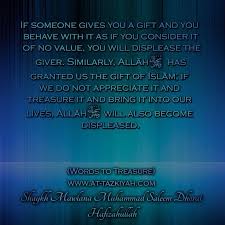
Quotable Quotes - Shaykh Muhammad Saleem Dhorat
ummtaalib replied to ummtaalib's topic in Inspiring Quotes & Poems
(Click on the picture to read)
-
Hadhrat Abu Bakr (Radhiyallahu Anhu) and his love for Rasulullah (Sallallahu Alaihi Wasallam) Hadhrat Abu Bakr (Radhiyallahu Anhu) once addressed Rasulullah (Sallallahu Alaihi Wasallam) saying: Though I am happy that my father embraced Islam, however the happiness I would have experienced with the Islam of your uncle Abu Taalib would be far greater. The reason is that if your uncle Abu Taalib embraced Islam, it would have brought great happiness to you. (Hikaayaate Sahaabah pg. 174) يَا رَبِّ صَلِّ وَ سَلِّمْ دَائِمًا أَبَدًا عَلَى حَبِيبِكَ خَيرِ الخَلْقِ كُلِّهِمِ
-
Spelling Inshāallāh – another “MAJOR” concern of the Ummah By سليمان الكندي on April 28, 2013 I have been asked, both in cyber space and real life, why I’m not writing articles. Until such time as Allāh wills me to be up to speed, I thought I might as well reply to text and email queries via my blog. One such query is the spelling of inshāallah. The query is on the below message doing the rounds: We should not write it as “InshaAllah” or “Inshallah” because it means “Create Allah” (Naoazobil lah) [sic]. Whether arabic [sic] or english [sic]… please write it properly as “In shaa Allah” (In 3 separate words). This means “If Allah Wills” So make sure you forward this to everyone and help them correct their mistake. JazakAllah khair [sic]. As if the Ummah does not have enough problems, there are those dedicated to finding more problems for us to deal with! Qarīnah It is correct that inshā as a maṣdar (root-word) means “to create,” but to pull any word from an Arabic dictionary without further knowledge of at least Arabic grammar results in Fitnah, even if the person is sincere. A basic tool of translation and Tafsīr is Qarīnah (context). Thus Allāh says in al-Baqarah, “O people, worship your Rabb Who created you and those before you that you may acquire Taqwā.” The very same words can in terms of literal translation be translated as, “O People, worship your Rabb who created you and [worship] those who came before you that you may acquire Taqwā.” The dictionary fully supports both translations. It is only because of the monotheistic context of the Qurān that we can reject the second idiotic translation. Similarly, even if the dictionary says “inshā” is “to create” the Qarīnah of every Muslim is “if Allāh wills.” This is even more so since most non-Arabs never even heard of inshā, before that message got circulated. Amr If you were for some reason going to write “create Allāh” in Arabic, and for some reason you chose “inshā” إنشاء you would not simply grab the word from the dictionary and place it before “Allāh” الله. “inshā” would have to be changed into the Amr or the verbal command form of “inshā” which is “anshi” أنشئْ ending in a sākin. When any letter appears before “Allāh” , the Hamzah drops, thus it is “wallāhi” و الله not “wa Allāhi” Here too the Hamzah would drop, but leaving a conjunction of two sākins – one on the Hamzah in the end of “anshi” and one on the first Lām of “llāh”. As this is not possible in Arabic, the first Sākin is forced to become a Kasrah. Thus the sentence reads, “anshi illāha” أنشئِ الله a far cry from “inshāallāhu” Even the final Ḥarkah is different. Thus is the danger of applying and spreading incomplete knowledge. My spelling I don’t see what the big deal is, but I prefer inshāallāh. Yes, it is actually three Arabic words, but as the last two join, it looks cumbersome to leave the first on its own when the Ummah at large has adopted the phrase as a single word in the Latin script. I do not write a capital “A” because the Hamzah of Allāh drops as explained above. It is the Hamzah of shāa, not Allāh. Bigger picture Are they no issues of greater import to concern the Ummah than a transliteration issue? What is the state of knowledge of the Ummah when they jump at such half-baked “facts”? Muslims have become victims of technology, instead of utilising technology. Most spread every message they receive without verification. How about encouraging the use of inshāallāh in an age of increasing westernisation, instead of harping on the spelling of those who still use the phrase? The Ḥadīth forbids the phrase when directed at Allāh i.e. in Du‘ā. Thus for example we should say, “I am going to perform Ḥajj inshāallāh,” and pray, “O Allāh, accept me to perform Ḥajj, āmīn,” but never, “O Allāh, accept me to perform Ḥajj inshāallāh/if You so will.” Many people are ignorant of this fact. Why not educate people on what is in the Sunnah instead of sucking rulings from our thumbs? Kindi's Blog2
-
Part 2 The following are some of the practices that are meticulously carried out during the sacred occasions of Nikah and proposal despite the fact that they are either expressly forbidden in Shariah, or have no bases in Islam: 1. The engaged couple meet at a public gathering where the boy holds the girl’s hand and slips a ring onto her finger whilst the two look romantically at each other. This act is void of modesty and completely foreign to Islamic culture. It is furthermore, a flagrant violation of the Quranic Law of Purdah. It is an evil innovation of the godless west, and those indulging in it should take cognizance of Rasulullah's Sallallahu Alayhi wa Sallam stern warning that “those who imitate others will rise on the Day of Judgment as of them”. 2. The prohibition in Islam of the gathering and free mixing of the sexes is nowhere else more flagrantly violated than at engagement and wedding feasts. Members of both sexes, young and old, are accommodated in the same tent or hall without so much as a curtain partition between them and to add insult to injury, women, including immodestly dressed young spinsters, are waited upon by men. What shameless impudence on the part of the organizers, who appear to be blissfully unaware of the tremendous responsibility which they must shoulder for the resultant decline in the moral standard of the Muslims. 3. Another very indecent practice copied from the west is the joint appearance on the stage of the married couple after the Nikah. Here, the new husband presents his bride with a wedding ring, kisses her, and then (in a growing number of cases) allows his male friends to kiss her too! And that in full view of the hundreds of guests! This is indeed the total and tragic destruction of Islamic modesty and shame. 4. It has become a norm at Muslim weddings for the bridegroom to appear before his mother-in-law to be showered with confetti and gifts of rings, ties, hankies, etc. in full view of women guests whose envious eyes and flattering tongues add to the morbidity of the whole act. 5. The parents take great pride in making a public display of the bride’s “trousseau”, advertising all the individual items therein, thus wasting valuable time and effort which could otherwise have been more fruitfully spent in teaching the bride how to conduct her self with credit in her new responsibilities. This show (of the “trousseau”) is motivated by the spiritually destructive elements of “riya”(ostentation) and “takabbur”(pride). 6. A large number of Nikahs are performed in specially rented halls or tents. The Musjid as a central pivot of all Muslim religious activity is often ignored. It is no exaggeration to say that many people regard a Nikah at the Musjid as “inconvenient” simply because they are well aware that some of their ill-conceived western rituals are too shameless to be permitted there. However, according to the Tradition of the Prophet Sallallahu Alayhi wa Sallam marriages performed in the House of Allah, immediately preceded and followed by prayers, will attract the maximum of Allah’s Blessings, whereas this is not, and cannot, be the case where alternative venues are chosen with the express purpose of facilitating the performance of things Un-Islamic. 7. Many people are known to be labouring under the misconception that the conduction of marriages on certain specific Islamic dates is contrary to Islamic Law. Such beliefs are not only unfounded, but are also against the grain of common sense. Likewise, the notion that it is incumbent upon the bride to spend her first Ramadaan and Eid after marriage at the parents’ home has no basis in Islam. In recent years, more and more innovatory and satanic western practices have been added by the Muslim commercial elites whose coffers are bursting at the seams as a result of the inflationary trends and economic booms of the past decade. Among these are the European-orientated fashions of printing expensive, pictorially-embossed “thank you” cards, and, more despicably, the insidious practice of a male member of the family escorting the bride arm-in-arm from the comparative seclusion of her home, through the mixed crowd of envious guests, right on to the stage for the ultimate “puppet” show. All of these morbid, soul-destroying scenes being “shot” for posterity by specially appointed and professionally equipped “video and photography” teams, with a fully fledged and “high ranking” musical band in close attendance! Furthermore, the progressive deterioration of the bride’s wedding-day garments, from bad to worse, in the very latest and obnoxious “see-thru” materials has been causing grave misgivings among the Ulama , many of whom are known to have turned down invitations from close acquaintances for fear of being confronted with scenes too shameless to comprehend. Several more instances can be cited where a great deal of expense and trouble are incurred over acts that are counter-productive of Islamic ethical and moral values. It is a tragic fact that each year hundreds of thousands of Rand are squandered in the process of upholding and intensifying these senseless, soul-destroying procedures. “Lo! The squanderers were ever brothers of the devils, and the devil was ever an ingrate to his Rabb.” (Xvii-27) “The best of marriage is one over which the least trouble and expense have been incurred” is a most oft-quoted Hadith of the Holy Prophet Sallallahu Alayhi wa Sallam. The Great Master’s sound teachings have been thoughtlessly and savagely thrown overboard and substituted by the fast-decaying cultural trends of the godless west. Someone was heard to remark at a recent wedding reception: “Here is part of the reason for the drought….and for escalating Muslim divorce rate…. (to heights unknown in previous generations)….and for downward plunge of the Muslims…. into the abyss of physical and spiritual destruction….in this world and the next……” It should be remembered that adopting Haraam at the time of Nikah and ‘Wedding’ does not lead to a blissful and happy marriage. May Allah grant Hidaayat, to one and all! Aameen Jamiatul Ulama (KZN) Council of Muslim Theologians 223 Alpine Road, Overport, Durban
-
The Westernized Muslim Wedding Of Today Part 1 The Western Whirlwind of Destruction has been constantly blowing across the developing world for decades and undermining the morals of the Youth. Of more recent times it has found new victims in young Muslim men and women who appear to be voluntarily stepping into its evil path. And whilst this “Tornado of the West” is leaving in its wake a continuous trail of crushed moral values amongst our young brothers and sisters, the parents are openly and unashamedly displaying an attitude of incredible irresponsibility by aiding and abetting the youngsters in their suicidal ventures. Clear evidence of this open disobedience can be found, for instance, at Muslim weddings and engagement parties where the type of conduct reminiscent of the western way of life is fully exercised in its most naked form. At such function Muslim men and women, boys and girls, act and do things that have nothing in common with the actions and doings of true Muslims. Indeed, some of the formalities which are considered indispensable (by modern standards) at these gatherings are in diametric conflict with Islam and reminiscent of the pre-Islamic times of jahiliyyah (ignorance). Notwithstanding the fact that western-styled garments are designed primarily to emphasize the shape of the female body and to attract the attention of members of the opposite sex, these immodest apparels are worn by Muslim women who, in anticipation of the opportunity to show themselves off at weddings or engagements, start making preparations on a lavish scale by acquiring the more “modern” versions of these shamelessly styled clothing. What is even more deplorable is the practice of subjecting the bride to a most humiliating display on an elaborately prepared stage after clothing her in a gaudy western wedding gown and obliterating all her natural beauty with western cosmetics. And to ensure perfection in the scrupulously observed rituals of the west, the bride is provided with a retinue of bridesmaids, flower-girls and page-boy, with their faces similarly disfigured with the same satanic object of attracting the maximum of lustful stares. Crowds of people, including fashionably dressed men, are then allowed to queue up to see the “puppet show” and quench their unholy thirsts whilst trampling under their feet all the Islamic standards of modesty. Thus the auspicious occasion of nikah commences with many sins the primary one being zina of the eyes. This slaughter of Islamic morals and principles by no means ends here. Some parents even go further and not only permit but actively encourage their off-spring to meet and speak, dine and dance and even roam around with strangers of the opposite sex in blatant violation of the Sunnah of the Holy Prophet Sallallahu Alayhi wa Sallam. These extremely dangerous divergences from traditional Islamic precepts are becoming more and more common and their perpetrators more and more shameless. In some Muslim weddings, even dancing forms part of these revolting innovations. In the words of Dr E.S. Sonners, “…..social dancing is fundamentally sinful and evil…..It is nothing more or less than damnable, diabolical, animal, physical dissipation”. It is not, certainly not, beyond one’s imagination to think of the lustful gazes and corruption of the minds of young, impressionable audiences which such diabolical displays are bound to cause. And as an ironical prelude, some invitation cards printed to advertise these most insidious and sinful programmes are headed: “In the Name of Allah…….” What a mockery of Islamic values! Jamiatul Ulama (KZN) Council of Muslim Theologians 223 Alpine Road, Overport, Durban