
ummtaalib
-
Posts
8,467 -
Joined
-
Days Won
773
Content Type
Profiles
Forums
Events
Everything posted by ummtaalib
-
The Sunnah of exchanging gifts Among the many Sunnats of our Nabi (sallallahu ‘alayhi wasallam) that pertain to our social life is the beautiful Sunnah of exchanging gifts. Rasulullah (sallallahu ’alayhi wasallam) said: ‘Offer gifts to each other, for this creates affection and removes the anger of the hearts.’ (Muwatta Imam Malik, see Al-Tamhid, vol.15 pg.85-91 and Takhrijul Ihya, Hadith: 1453) Sayyidah ‘Aaishah (radiyallahu ‘anha) states: ‘Rasulullah (sallallahu ’alayhi wasallam) use to accept gifts and would give something in return.’ (Sahih Bukhari, Hadith: 2585) This is more appreciated when one comprehends the state of poverty of Rasulullah (sallallahu ’alayhi wasallam). Despite his dire conditions, he (sallallahu ’alayhi wasallam) would ensure to replace the gift offered to him. Repay, at all costs! In one Hadith, Nabi (sallallahu ’alayhi wasallam) instructs us with the following: ‘Repay him who does good to you. If you cannot afford to, then [at least] make du’a for him till you feel that you have sufficiently repaid him.’ (Sunan Abi Dawud, Hadith: 1669 with an authentic chain. See Ma’alim Irshadiyyah, pg.325) Let us inculcate this noble Sunnah and thereby increase our mutual bond with fellow Muslims/relatives. almiftah
-
Part Eight Dream before Islam: Hazrat Yazid bin Roomaan (rahimahullah) narrates: Hazrat ‘Uthmaan (radhiyallahu ‘anhu) and Hazrat Talhah (radhiyallahu ‘anhu) had proceeded, after Hazrat Zubair bin ‘Awwaam (radhiyallahu ‘anhu) had accepted Islam, until they entered into the blessed presence of Rasulullah (sallallahu ‘alaihi wasallam). Rasulullah (sallallahu ‘alaihi wasallam) invited them to Islam, recited a portion of the Qur’aan Majeed to them, informed them of the rights of Islam and promised them to receive honor from Allah Ta‘ala if they upheld the Deen of Islam. They both brought Imaan and accepted the message of Rasulullah (sallallahu ‘alaihi wasallam). Hazrat ‘Uthmaan (radhiyallahu ‘anhu) then said, “O Rasul of Allah (sallallahu ‘alaihi wasallam)! I arrived recently from Shaam. (While we were travelling from Shaam,) when we were between Mu‘aan and Zarqaa’, we were as if asleep when we heard a person announce, ‘O people who are asleep! Wake up, for Ahmed (sallallahu ‘alaihi wasallam) has appeared in Makkah Mukarramah!” When we thereafter arrived in Makkah Mukarramah, we heard of you (claiming to be the Nabi of Allah Ta‘ala).” Hazrat ‘Uthmaan (radhiyallahu ‘anhu) had accepted Islam in the very early days, before Rasulullah (sallallahu ‘alaihi wasallam) had entered Daar-ul-Arqam. (Ibn Sa’d 3/40)
-
The Map of Marriage Any intelligent person undertaking a very long journey – through a route which he has not travelled before – will ensure that he makes adequate preparations before he departs. He will seek advice and directions and will make enquiries regarding the road and what to expect. After making all the appropriate preparations and taking all the necessary advice and directions, he will most likely carry a GPS to guide him along the way and prevent him from taking any wrong turns. Marriage is also a journey. However, the journey of marriage is meant to last a lifetime. It takes one through different terrains and past various sceneries. While it may generally be smooth sailing, like a luxury car on an open freeway, there are sometimes the odd and unexpected gravel patches. While the route may mainly usher one past gardens, rivers, waterfalls and rolling seas, it does also sometimes lead one through dry and quiet deserts. If the traveller keeps his eye on the road and focuses on his destination, he will Insha’Allah safely pass through all the hills and valleys as well as gardens and deserts. The believer’s destination in marriage, like everything else, is the pleasure of Allah Ta‘ala. The perfect, all-terrain vehicle that will transport him safely and smoothly through the open freeways as well as the rocky patches is Deen – the path of the Quraan Majeed and Sunnah, while the advice of the ‘Ulama and elders is the GPS, assisting them to remain on this path. As long as the couple are in the right vehicle and remain on the path of Deen and focused on their destination, Insha’Allah they will travel smoothly and will not have a bumpy ride. They will thus travel safely through their journey of marriage, until the angel of death makes them part from each other. uswatulmuslimah.co.za
-
(Click on pictures to enlarge) darultahqiq

-
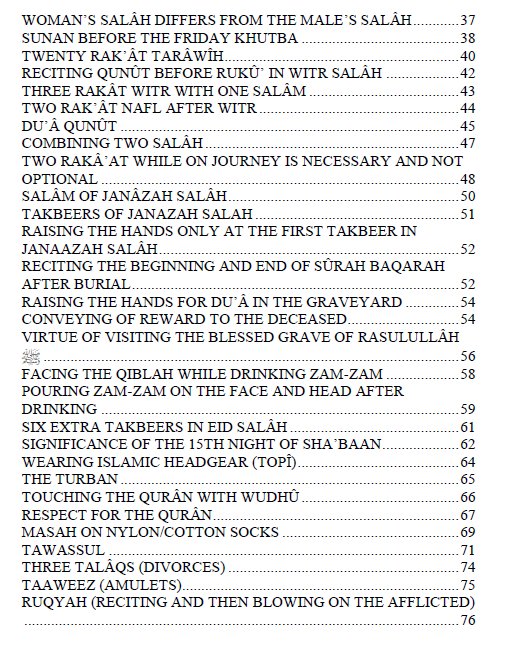
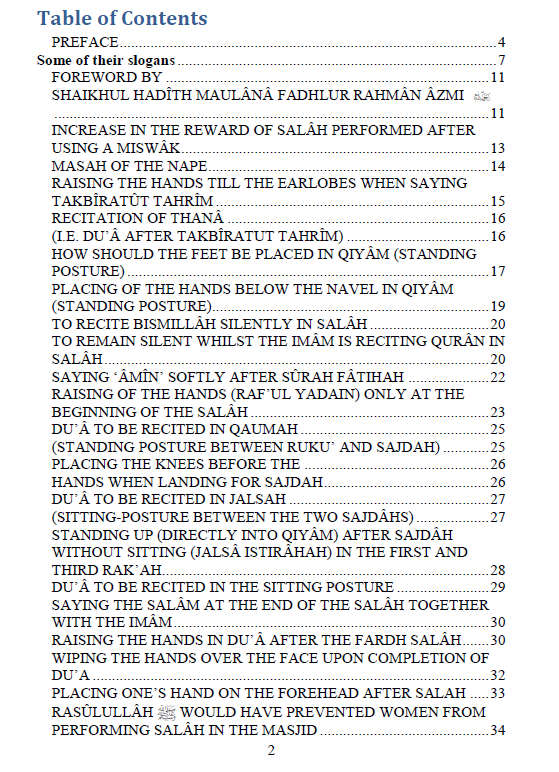
From Our Perspective (part 1) In the recent past, due to several reasons, there has been a significant shift in the channel of Islamic information in our societies. In the past, our system of information was in line with the ancient methods; that is to acquire Islamic knowledge from heart to heart. This was done in madrasahs as well as via the mimbars of the masajid. Now that the world has become a global village, the channel of education has been broadened. Just as this brings some benefit, it also has its hazards. As a result, we have become beset with fitnahs of all kinds. One such trial is the scourge of salafism; a doctrine or ideology that deceitfully claims to uphold the teachings of the salaf, but in reality actually defames the very same thing!! A consequence of this is that people begin to question the legality of other madhahib. In our province, the overwhelming majority are Hanafis. Therefore the attack of these ill-informed individuals would be focused on the Hanafi Madhab. The purpose of this booklet; entitled: ‘From Our Perspective’ is to enlighten one and all about the authentic proofs that support the Hanafi standpoint on issues that these individuals raise objection to. The book is meant to be brief, and therefore most of the chapters have just one clear authentic proof. For more elaboration on such issues, the ‘Ulama can refer to the detailed Arabic works on this subject. Download the e-book – HERE
-
5 Point Plan: Preparing For Ramadan In a few days time, we will enter Rajab followed by Sha'ban and then Ramadan. "O Allah, make the months of Rajab and Sha'ban blessed for us, and let us witness the month of Ramadan." Rajab itself is a blessed month being from the Al-Ash'hur Al-Hurum (Sacred months), where the rewards of virtuous deeds are increased. It is therefore perfect to start our preparation for Ramadan 1) Fast some extra days during these 2 months. For Example the Sunnah fast of Mondays & Thursdays. 2) Increase and renew our Tawbah (repentance) and practice perfecting it. 3) Increase our Ibadah (acts of worship) For example, 2 extra Raka'at of Nafl Salah, 2 extra pages of the Qur'an daily, practice 1 more daily Dua'a. 4) Train our Tongue, Ears & Eyesight Get them used to the act of worship and to refrain from sins. 5) Gradually reduce the time we spend on Social Media and The Television. For example remove yourself from 2/3 unnecessary groups and stop watching few unnecessary television shows. kitaabun.com
- 6 replies
-
- 1
-

-
- preparation
- rajab
- (and 1 more)
-
Protection from Dajjal Question Is the recital of the first ten (10) and last ten (10) verses of Surah Kahf described as protection from the fitnah of Dajjal in the Hadith? Also, if yes / no, what a’maal are mentioned in the ahadith for protection from the fitnah of Dajjal? Answer Sayyiduna Abud Darda (radiyallahu’anhu) reports that Rasulullah (sallallahu’alayhi wasallam) said: ‘Whoever memorises the first ten verses of Surah Kahf, will be saved from the trial of Dajjal.’ There are a few narrations of this Hadith. Some mention the first ten (10) verses and others, the last ten (10). Both have been recorded by Imam Muslim in his Sahih (Hadith 1880, 1881). As a precaution, one should recite/memorise both sets, the first ten as well as the last ten verses. This (reciting the beginning and end of Surah Kahf) has actually been recorded in a narration of Musnad Ahmad, without any mention as being protection from Dajjal. The reward in this version is that one will be blessed with light (nur) from one’s feet till the sky. (Musnad Ahmad, vol.3 pg.439) Reciting the entire Surah In one narration of Nasa’i, there is no specification of the first ten (10) or last ten (10). (Mukhtasar Abi Dawud of Hafiz Mundhiri vol.6 pg.176; Hadith: 4154, 4156) Some commentators have recommended reciting the entire surah, as is recorded in the above version, as well as in the narration of Mustadrak Hakim (vol.1 pg.511). They explain that Rasulullah (sallallahu ‘alayi wasallam) probably initially mentioned the first ten verses, followed by the last ten to gradually encourage its complete recital. (Al-Mufhim, Hadith: 683) Another recital for protection from Dajjal Sayyidatuna ‘Aaishah (radiyallahu’anha) reported that Rasulullah (sallallahu’alayhi wasallam) would recite the following du’a before the salam in his salah Allahumma inni a’udhu bika min ‘adhabil Qabr, wa a’udhu bika min fitnatil masihid dajjal, wa a’udhu bika min fitnatil mahya wa fitnatil mamat. Allahumma inni a’udhu bika minal ma-thami wal maghram ‘O Allah I seek you refuge from the punishment of the grave, and from the trial of Dajjal, and the trials of life and death. O Allah I seek your protection form sin and debt.’ (Sahih Bukhari, Hadith: 832) And Allah Ta’ala Knows best. Answered by: Moulana Muhammad Abasoomar Checked by: Moulana Haroon Abasoomar hadithanswers
-
 Taqlid of the Mujtahid Imams: Shaykh Kiranawi’s reply to Ibn al Qayyim The following work is an English translation of a treatise known as al-Din al-Qayyim by Shaykh Habib Ahmad al-Kiranawi of India, it was originally written in Arabic as a riposte to Ibn Qayyim al-Jawziyya (d. 751 AH) of Damascus, on the latter’s treatment and claims on the issue of Taqlid. Thus, it is esentially a scholarly defence of the need and permissibility of following qualified scholarship (Taqlid) of the highest ranking Imams known as Mujtahids, like Abu Hanifa (d. 150 AH), Malik ibn Anas (d. 179 AH), al-Shafi’i (d. 204 AH) and Ibn Hanbal (d. 241 AH). These Imams are the founders of the four most accepted schools of Islamic jurisprudence (Madhhabs) in Sunni Islam for more than 1200 years. Their schools represent the real understanding of the teachings of the earliest Muslims, meaning, the Way of the Sahaba, and what they received from the Companionship of Allah’s Messenger, sallallahu alaihi wa sallam. Till this day, most Muslim scholars and laiety on the surface of the earth are adherents of one of these four recognised Madhhabs. It is only a small minority who have distanced themselves from Taqlid via the centuries as the books of Islamic scholarship and history attest to for more than a millenium. The English edition was translated from Arabic by Shaykh Zameelur Rahman from England, and with his permission it has been uploaded here for the benefit of all readers who wish to understand the issue of Taqlid, and why it is necessary for most Muslims to practice Islam in their lives with the conviction that it is based on not only the sources of the Sharia, but explained and detailed accurately by premier authorities known as Mujtahid Imams. Download link darultahqiq
 -
Part 9 1. Meals should not be served at the home of the deceased to those who come for ta’ziyah. Serving meals at the home is an innovatory practice. 2. It is impermissible to hire a person to recite a portion of the Quraan Majeed and convey the reward to the deceased.
-
Using Social Media - A Responsibility
ummtaalib replied to ummtaalib's topic in General Islamic Articles
Accept responsibility when it’s your's! (From al-Miftah) It has become a common trend nowadays for people to pass on information with the following disclaimer: ‘Retweets are not necessarily endorsements’ or: ‘The views expressed in this publication are not necessarily that of the editor.’ Whilst this may be a legal shield in this world, in no way does it absolve one in the court of Allah! We are indeed responsible for whatever we say, write, pass on or share. One who is sharing information actually assumes the position of a muballigh (preacher). Every preacher is duty bound to verify the information he shares and to ensure he isn’t a carter of falsehood. The gem of the last century, Shaykh ‘Abdul Hay Laknawi (rahimahullah) writes: ‘If the view is baseless, it is not permissible to quote it, but for the motive of pointing out its flaw... ...it is not permissible to remain silent whilst quoting it, which gives the impression of it being correct.’ (Tadhkiratur Rashid, pg.74) Let’s ask ourselves the following questions: • If we do not endorse what we are propagating, then why are we spreading it?! • Why do we want for others what we do not want for ourselves?! • What is the purpose of publicising such information? Whatever the answer to the above, we are still responsible in Allah’s court. Many of us seem to be unaware of this. As Received Some of us have the habit of adding the following disclaimer at the end of text messages: ‘As received’. This may be a legitimate form of precaution, but one should still weigh up the information before passing it on. If it seems legitimate, but one is not completely sure, then one may add this note when sharing it. All of the ‘disclaimers’ discussed in this article are a result of the ill habit of passing/sharing whatever we receive or discover, without verification. One who passes everything he receives, without verification is considered a liar in the Hadith of Rasulullah (sallallahu’alayhi wasallam). كفى بالمرء كذبا أن يحدث بكل ما سمع -
Signs in Allah's Wonderous Ceations
ummtaalib replied to ummtaalib's topic in General Islamic Articles
Signs of Allah in the Sugarcane Allah has placed innumerable bounties for us on earth, one of them being the sugar cane. Although it looks like bamboo, it is filled with a liquid from which sugar is extracted and so many sweets and other foods are made. Allah has also placed many cures in this juice, which physicians prescribe for their patients. It is only by the power of Allah that such sweetness and benefit is found in an ordinary cane.
-
The True Meaning of “Zikrullah” Hazrat Moulana Muhammad Ilyaas (rahmatullahi ‘alaih) once mentioned: The true meaning of “Zikrullah” (the remembrance of Allah Ta’ala) is that no matter which place, situation and condition a person may be in, he is conscious and aware of Allah Ta’ala and of what Allah Ta’ala wants from him at that time. Similarly, he is conscious of the laws of Deen that are directed towards him at that moment. Generally, I emphasize and encourage my friends upon acquiring this form of zikr in their lives. (Malfoozaat Hazrat Moulana Muhammad Ilyaas (rahmatullahi ‘alaih) pg. 21)
-
Part Seven Islam: (Continuing from Part Six) Hazrat ‘Uthmaan (radhiyallahu ‘anhu) continued: By Allah! Just a few moments later, Rasulullah (sallallahu ‘alaihi wasallam) passed by with Hazrat ‘Ali (radhiyallahu ‘anhu) who was carrying a cloth for Rasulullah (sallallahu ‘alaihi wasallam). When Hazrat Abu Bakr (radhiyallahu ‘anhu) saw him, he stood and went to him. He then spoke quietly into the blessed ear of Rasulullah (sallallahu ‘alaihi wasallam), after which Rasulullah (sallallahu ‘alaihi wasallam) came and sat. After sitting, he turned to me and said, “O ‘Uthmaan (radhiyallahu ‘anhu)! Accept the invitation which Allah Ta‘ala is giving you to His Jannah, as I am indeed the messenger of Allah Ta‘ala to you and to His entire creation.” Hearing these blessed words of Rasulullah (sallallahu ‘alaihi wasallam), I could not help but accept Islam. I then recited the Shahaadah saying, “There is no deity besides Allah alone, who has no partner, and Muhammed (sallallahu ‘alaihi wasallam) is His servant and messenger.” Soon thereafter, I married Hazrat Ruqayyah (radhiyallahu ‘anha), the respected daughter of Rasulullah (sallallahu ‘alaihi wasallam). (Isaabah vol. 4 pg. 327 and Al-Riyaadh-un-Nadhrah vol. 3 pg. 8)
-
One should recite tasbeeh-e-Faatimi after every salaah i.e. 33 times Suhbaanallah, 33 times Alhamdulillah, 33 times Allahu Akbar, and complete the hundred by reciting: لَا إلَهَ إلَّا اللهُ وَحْدَهُ لَا شَرِيْكَ لَهُ لَهُ الْمُلْكُ وَلَهُ الْحَمْدُ وَهُوَ عَلَى كُلِّ شَيْءٍ قَدِيْر عن أبي هريرة رضي الله عنه عن رسول الله صلى الله عليه وسلم من سبح الله في دبر كل صلاة ثلاثا وثلاثين وحمد الله ثلاثا وثلاثين وكبر الله ثلاثا وثلاثين فتلك تسعة وتسعون وقال تمام المائة لا إله إلا الله وحده لا شريك له له الملك وله الحمد وهو على كل شيء قدير غفرت خطاياه وإن كانت مثل زبد البحر ( صحيح مسلم رقم 597) Hadhrat Abu Hurairah (Radhiyallahu Anhu) reports that Rasulullah (Sallallahu Alaihi Wasallam) said: “The one who recites after the fardh salaah tasbeeh (Subhaanallah) 33 times, tahmeed (Alhamdulillah) 33 times, takbeer (Allahu Akbar) 33 times, and completes the hundred by reciting لَا إلَهَ إلَّا اللهُ وَحْدَهُ لَا شَرِيْكَ لَهُ لَهُ الْمُلْكُ وَلَهُ الْحَمْدُ وَهُوَ عَلَى كُلِّ شَيْءٍ قَدِيْر his previous (minor) sins will be forgiven even though it be as much as the foam of the ocean.”
-
GAME OVER Playing is a natural activity for a child and is even important for the correct, healthy development of a child. For a child, playing is not merely a pastime. Rather, it is a developmental and educational process through which the child learns many basic principles such as cause and effect, effort and reward, etc. It is due to the process of playing being such an effective medium of education that teachers seek to capitalize on playing and use it to engage the students in games through which they will be educated in a subtle yet definite and enjoyable manner. However, since the world has taken the route of technology, the nature of ‘the game’ has changed. Now, games are seldom played on fields and in backyards. Rather, the computer, tablet and phone screen has become the new field of play, and once the game begins, players become glued to the screen. For many parents, ‘parking’ the child before the PC or placing an iPad in their hands is a daily solution to occupying the child, leaving the parent free to attend to their own responsibilities or even relax. This has led to children becoming increasingly addicted to these games. As a result, if a child is invited to play soccer in the backyard, it is not farfetched to imagine him replying, “Why should I kick a ball when I already have an app for that!” The result? The virtual world is now preferred to living life in the real world. The dangers that accompany these games are numerous. Games that contain music, pictures of animate objects, indecent content and other similar elements of Haraam are impermissible, and playing these games cause devastating damage to the Imaan of the player. However, even if the game is void of these Haraam elements, these games transmit many subtle messages to these young, impressionable players. Children who grow up playing car racing games generally grow up mimicking the same behaviour by living life “in the fast lane”. Similarly, when games are played that depict and encourage violence, such as fighting, shooting and war games, then the child develops violent tendencies as his natural, inborn aversion to violence is desensitized. In many cases, children who pulled a gun on their classmates and went onto a shooting rampage, murdering innocent people, were found to be avid players of these games. The fundamental difference between these games and the real world is that there are no real consequences in the gaming world. Rather, when one encounters difficulty, one can easily escape by pressing the convenient ‘reset’ button. In real life, there is no reset. When reckless driving leads to an accident and the loss of lives, there is no reset. When a gun is pulled and lives are lost, there is no reset. In real life, there is only one result – the child’s life is ruined and it’s GAME OVER. Furthermore, the playing of the past almost always benefited the child in one way or another. If the child was running in a field, his body benefited. If the child was playing in the kitchen, they were perhaps learning a basic skill such as peeling potatoes, rolling dough, etc. If the child played in the garden, they learnt how to wield a spade, etc. Hence, even though the child was playing, the child was developing a practical skill with which they would be able to benefit themselves and others. On the contrary, most children glued to their screens suffer obesity, anti-social behaviour and a range of other physical and psychological problems. If we truly love our children, let us wake up to the damage that these devices are wreaking on our innocent children. At the very least, let us limit their screen time. Switch off the game before it’s GAME OVER. Jamiatul Ulama (KZN) Council of Muslim Theologians
-
يَا رَبِّ صَلِّ وَ سَلِّم دَائِمًا أَبَدًا عَلَى حَبِيبِكَ خَيرِ الخَلْقِ كُلِّهِمِ
-
Part 8 1. The Shari’ah has not specified any particular type or colour of clothing that should be worn by those that are bereaved. 2. The practice of visitors coming on the seventh day, tenth day and fortieth day for “khatam” etc. are innovations and should be discarded.
-
-
Part Six Islam: (Continuing from Part Five) Hazrat ‘Uthmaan (radhiyallahu ‘anhu) continued: I then left my aunt. Her statements had left an impression on my heart and I continued to ponder over what she had said. I would sometimes associate with Hazrat Abu Bakr (radhiyallahu ‘anhu) and sit with him. After Monday had passed, I came to sit with him and found him seated alone. On sitting with him, he noticed that I was in deep thought. Being a very soft-natured person, he asked me what the matter was. I replied by mentioning to him the statements that my aunt had made. Hearing this, he exclaimed, “O ‘Uthmaan (radhiyallahu ‘anhu)! May Allah have mercy on you! You are an intelligent, foresighted man. You are able to discern between truth and falsehood. These idols which your people worship – are they not (made of) mere stone that is deaf, unable to hear, see, harm or benefit?” I replied, “Most certainly! By Allah! They are definitely as you described!” Hazrat Abu Bakr (radhiyallahu ‘anhu) then said, “By Allah! Your aunt spoke the truth to you. This is Muhammed (sallallahu ‘alaihi wasallam), the son of ‘Abdullah. Allah Ta‘ala has deputed him with His message to the entire creation. Would you like to come to him and listen to his message?” I replied in the affirmative. (To be continued insha Allah) (Isaabah vol. 4 pg. 327 and Al-Riyaadh-un-Nadhrah vol. 3 pg. 8) Source: Whatisislam.co.za
-
Part Five Islam: (Continuing from Part four) Hazrat ‘Uthmaan (radhiyallahu ‘anhu) continued: I was astonished and perplexed at what my aunt had said, and so I asked her, “O aunt! What are you saying?” She replied by reciting the following couplets: عثمان يا عثمان يا عثمان لك الجمال ولك الشان هذا نبي معه البرهان أرسله بحقه الديان وجاءه التنزيل والفرقان فاتبعه ولا تغيا بك الأوثان ‘Uthmaan! O ‘Uthmaan! O ‘Uthmaan! You have been blessed with beauty and you have been blessed with prestige. This is a Nabi with whom there are clear proofs and signs. The Lord of recompense has deputed him with the truth. The word of Allah is revealed to him, which distinguishes between truth and falsehood. So follow him and do not allow the idols to misguide you. Hearing these couplets, I asked her, “O aunt! You are speaking of something that has yet to be (known and) mentioned in our land, so clarify it for me.” She replied, “Muhammed (sallallahu ‘alaihi wasallam), the son of ‘Abdullah, is the Rasul of Allah. He brought the message of Allah, inviting mankind towards Allah. His lamp is a true lamp (of guidance), his word is righteousness and piety, his deen is one of success and his affair is one of salvation. He will face opposition and the valleys will be under his control. Calls and shouts made against him will be of no avail, even if the spears fall (against him), sides are struck and spears are wielded (against him).” (To be continued insha Allah) (Isaabah vol. 4 pg. 327 and Al-Riyaadh-un-Nadhrah vol. 3 pg. 8)
-
Part Four Islam: ‘Amr bin ‘Uthmaan (rahimahullah) narrates that Hazrat ‘Uthmaan (radhiyallahu ‘anhu) had mentioned the following when explaining to them the manner in which he accepted Islam: I was a man whom many women were interested in marrying. One night, I was in the courtyard of the Ka‘bah Shareef, seated among a group of the Quraish, when someone came to us and gave us the news that Rasulullah (sallallahu ‘alaihi wasallam) had married his respected daughter, Hazrat Ruqayyah (radhiyallahu ‘anha), to ‘Utbah bin Abi Lahab. Hazrat Ruqayyah (radhiyallahu ‘anha) was blessed with outstanding beauty. On receiving the news, I was filled with remorse and regret as I thought to myself, “Why did I not precede him in attaining the honor of marrying the respected daughter of Rasulullah (sallallahu ‘alaihi wasallam)?” After some time elapsed, I returned home. When I arrived at home, I found my aunt (mother’s sister) seated within. Her name was Su’daa bint Kuraiz, and she had studied soothsaying by her people. When she saw me, she recited the following couplets: أبشر وحييت ثلاثا وترا ثم ثلاثا وثلاثا أخرى ثم بأخرى كي تتم عشرا لقيت خيرا ووقيت شرا نكحت والله حصانا زهرا وأنت بكر ولقيت بكرا Accept glad tidings and congratulations thrice, then thrice more, and then thrice more And then once more to complete ten.You have encountered goodness and have been saved from evil By Allah! You have married an extremely chaste and beautiful woman. You are a virgin and you have married a virgin. (To be continued insha Allah) (Isaabah vol. 4 pg. 327 and Al-Riyaadh-un-Nadhrah vol. 3 pg. 8)
-
Part Three Physical Description: Hazrat ‘Uthmaan (radhiyallahu ‘anhu) was neither too tall nor too short (i.e. he was of moderate height), and was blessed with a handsome face. His beard was large and he had a fair, wheat-colored complexion. He was large-jointed and broad-shouldered. He would dye his hair yellow. (Siyar A’laam min Nubalaa vol. 2 pg. 567) The Companion of Rasulullah (sallallahu ‘alaihi wasallam) in Jannah: Hazrat Talhah bin ‘Ubaidillah (radhiyallahu ‘anhu) reports that Rasulullah (sallallahu ‘alaihi wasallam) said, “Every Nabi will have a special friend (in Jannah), and my special friend (in Jannah) will be Hazrat ‘Uthmaan (radhiyallahu ‘anhu).” (Sunan Tirmizi #3698)
-
Part Two Title: The title of Hazrat ‘Uthmaan (radhiyallahu ‘anhu) was ‘Zun-Noorain’ (the possessor of the two lights). ‘Two lights’ referred to the two blessed daughters of Rasulullah (sallallahu ‘alaihi wasallam), Hazrat Ruqayyah (radhiyallahu ‘anha) and Hazrat Ummu Kulthoom (radhiyallahu ‘anha). Hazrat Hasan Basri (rahimahullah) has explained that Hazrat ‘Uthmaan (radhiyallahu ‘anhu) was given this title as he was the only person who had married two daughters of a Nabi (Hazrat ‘Uthmaan (radhiyallahu ‘anhu) married Hazrat Ummu Kulthoom (radhiyallahu ‘anha) after the demise of Hazrat Ruqayyah (radhiyallahu ‘anha)). (Siyar A’laam min Nubalaa 2/566/568) Hazrat Nazaal bin Sabrah (rahimahullah) narrates, “We asked Hazrat ‘Ali (radhiyallahu ‘anhu), ‘Tell us something regarding Hazrat ‘Uthmaan (radhiyallahu ‘anhu).’ Hazrat ‘Ali (radhiyallahu ‘anhu) responded, ‘He was a man who would be referred to by the title ‘Zun-Noorain’ in the Mala’-ul-A’laa (assembly of angels).’” (Isaabah 4/378) Family Relationship with Rasulullah (sallallahu ‘alaihi wasallam): The lineage of Hazrat ‘Uthmaan (radhiyallahu ‘anhu) meets the lineage of Rasulullah (sallallahu ‘alaihi wasallam) at ‘Abd Manaaf. (Usdul Ghaabah 3/215) The maternal grandmother of Hazrat ‘Uthmaan (radhiyallahu ‘anhu) was Baydhaa’, the daughter of ‘Abdul Muttalib. Hence, the maternal grandmother of Hazrat ‘Uthmaan (radhiyallahu ‘anhu) was the paternal aunt of Rasulullah (sallallahu ‘alaihi wasallam). (Isaabah 4/377)
-
Hazrat Uthmaan (radhiyallahu ‘anhu) – Part One Name: Hazrat ‘Uthmaan bin ‘Affaan (radhiyallahu ‘anhu) Birth: Hazrat ‘Uthmaan (radhiyallahu ‘anhu) was born six years after ‘Aam-ul-Feel (the Year of the Elephants i.e. the year in which Abrahah tried to destroy the Ka‘bah Shareef with elephants). (Isaabah 4/377) Kunyah (Filial Title): Hazrat ‘Uthmaan (radhiyallahu ‘anhu) was first given the kunyah “Abu ‘Abdillah” on account of his son, Hazrat Abdullah (radhiyallahu ‘anhu). Thereafter, Hazrat ‘Abdullah (radhiyallahu ‘anhu) passed away. The next son of Hazrat ‘Uthmaan (radhiyallahu ‘anhu) was Hazrat ‘Amr (radhiyallahu ‘anhu). Hence, Hazrat ‘Uthmaan (radhiyallahu ‘anhu) was next given the kunyah “Abu ‘Amr” by which he was famously known until the end of his life. (Istee‘aab 3/155) Mother: The respected mother of Hazrat ‘Uthmaan (radhiyallahu ‘anhu) was Hazrat Arwaa bint Kuraiz (radhiyallahu ‘anha). (Siyar A’laam min Nubalaa 2/566) Demise of Hazrat ‘Abdullah (radhiyallahu ‘anhu): Hazrat ‘Abdullah (radhiyallahu ‘anhu), the son of Hazrat ‘Uthmaan (radhiyallahu ‘anhu) from Hazrat Ruqayyah (radhiyallahu ‘anha), passed away in the year 4 A.H. at the age of six. (Usdul Ghaabah 3/216) A rooster had pecked Hazrat ‘Abdullah (radhiyallahu ‘anhu) in his eyes, causing him injury. It was on account of this injury that he fell ill and passed away. Rasulullah (sallallahu ‘alaihi wasallam) performed his janaazah salaah after which Hazrat ‘Uthmaan (radhiyallahu ‘anhu) descended into the grave to bury him. This was in the month of Jumaadaa-Oolaa of the year 4 A.H. (Tabaqaat Ibn Sa’d 3/39) Source: Whatisislam.co.za
-
Water Conservation in Wudhu Wudhu is a great Ibaadah (act of worship). Rasulullah Sallallahu Alayhi wa Sallam is reported to have said that when a person performs wudhu in the proper manner, all the (minor) sins that were committed are washed off by means of the wudhu. However, certain acts spoil this great Ibaadah and deprive one of the full benefits and virtues of wudhu. Among these acts is the wasting of water. The Sunnah Amount of Water It has been conservatively estimated that on average most people use more than six litres of water to perform one wudhu. This is in stark contrast to the amount of water that Rasulullah Sallallahu Alayhi wa Sallam used for his wudhu. Sayyidatuna Aisha Radhiyallahu Anha reports that Rasulullah Sallallahu Alayhi wa Sallam used one mudd of water for wudhu and one saa for ghusal. (Abu Dawood) One mudd amounts to approximately 1 litre and one saa is approximately 4 litres. In other words, we generally use more water for wudhu than Rasulullah Sallallahu Alayhi wa Sallam used for ghusal. Once Sayyiduna Jaabir Radhiyallahu Anhu narrated the saying of Rasulullah Sallallahu Alayhi wa Sallam that one mudd of water suffices for wudhu and one saa for ghusal. A person sitting there remarked: “It does not suffice for me.” Jaabir Radhiyallahu Anhu silenced him by saying, “It sufficed for him (Rasulullah Sallallahu Alayhi wa Sallam) who was better than you and who even had more hair than you.” (hence he would require more water than you to wash the head during ghusal). (Ibn Majah) Israaf (Wastage) To use more than necessary is termed israaf. Regarding israaf, Allah Ta'ala declares, "Verily Allah Ta'ala does not love the wasters.” On one occasion Rasulullah Sallallahu Alayhi wa Sallam asked a person performing wudhu: “Why are you wasting water?” The person enquired: “Is there israaf even in wudhu?” Rasulullah Sallallahu Alayhi wa Sallam replied, "Yes indeed, (do not waste) even if you are at the bank of a river." (Ibn Majah) Hence it is necessary to become conscious of this important aspect and refrain from wasting water during wudhu. How to Save Water A few ways by which we can save water whilst making wudhu: Make wudhu using a jug rather than the tap. If you are using the tap, do not open it “full blast”. Rather open it until the flow is just sufficient for you to make wudhu. Close the tap while using the miswaak, making masah, khilaal, etc. Only re-open it when the water is again needed. Avoid taking a shower. Use a bucket instead. If the shower is used, open the water to just a little more than a trickle and finish off very quickly. Jamiatul Ulama (KZN) Council of Muslim Theologians