
ummtaalib
-
Posts
8,467 -
Joined
-
Days Won
773
Content Type
Profiles
Forums
Events
Everything posted by ummtaalib
-

Quotable Quotes - Shaykh Muhammad Saleem Dhorat
ummtaalib replied to ummtaalib's topic in Inspiring Quotes & Poems
Allāh ta‘ālā has made certain things obligatory. He first gave humans the ability to carry them out, and then ordered them to do them. lf it wasn't possible to do them, he would not have made them obligatory. Shaykh Mawlānā Muhammad Saleem Dhorat hafizahullāh -
Dyslexia is a common learning difficulty that mainly affects the way people read and spell words. Signs and symptoms Dyslexia is a spectrum disorder, with symptoms ranging from mild to severe. People with dyslexia have particular difficulty with: phonological awareness verbal memory rapid serial naming verbal processing speed These terms are explained in more detail below. Phonological awareness Phonological awareness is thought to be a key skill in early reading and spelling development. It is the ability to identify how words are made up of smaller units of sound, known as phonemes. Changes in the sounds that make up words can lead to changes in their meaning. For example, a child with a good level of phonological awareness would understand that if you change the letter "p" in the word "pat" to "s", the word becomes "sat". Verbal memory Verbal memory is the ability to remember a sequence of verbal information for a short period of time. For example, the ability to remember a short list such as "red, blue, green", or a set of simple instructions, such as "Put on your gloves and your hat, find the lead for the dog and then go to the park." Rapid serial naming This is the ability to name a series of colours, objects or numbers as fast as possible. Verbal processing speed Verbal processing speed is the time it takes to process and recognise familiar verbal information, such as letters and digits. For example, someone with a good verbal processing speed has the ability to quickly write down unfamiliar words when they are spelled out, or write down telephone numbers they are told. Read more about the symptoms of dyslexia. Dyslexia and intelligence Dyslexia only affects some skills and abilities, and is not linked to a person's general level of intelligence. Children of all intellectual abilities, from low to high intelligence, can be affected by dyslexia. Similarly, the difficulty a child with dyslexia has with reading and spelling is not determined by their intelligence, but by how severe their dyslexia is. Children with average intelligence and mild dyslexia are likely to be more skilled at reading and writing than children with high intelligence and more severe dyslexia. How common is dyslexia? Dyslexia is thought to be one of the most common learning difficulties. It's estimated that up to 1 in every 10 people in the UK has a certain degree of dyslexia. Dyslexia affects people of all ethnic backgrounds, and has even been shown to affect languages based on symbols rather than letters, such as Cantonese. However, a person’s native language can play an important role in the condition. For example, dyslexia is less problematic in languages with consistent rules around pronunciation, such as Italian and Spanish. Languages such as English, where there is often no clear connection between the written form and sound (for example, words such as "cough"and "dough"), can be more challenging for a person with dyslexia. What causes dyslexia? The exact cause of dyslexia is unknown, but it's seen more commonly in families. Six genes have been identified that may be responsible for the condition, four of which affect the way the brain is formed during early life. Specialist brain scans (functional magnetic resonance imaging (MRI) scans) also show there is reduced function of one area towards the back of the brain, called the occipito-temporal cortex. Read more about the causes of dyslexia. Identifying dyslexia It can be difficult to diagnose dyslexia in young children as the signs are not always obvious. If you think your child has dyslexia, the first step is to speak to their teacher or the school’s special needs coordinator. Identifying your child’s strengths (such as picture puzzles or maths) as well as their difficulties can be helpful. Many schools identify children who are having difficulty learning in particular areas and offer additional support. If your child does not make progress when offered this support, the school may request a more in-depth assessment from either a specialist teacher or educational psychologist. It is also possible to request private assessments, either directly from an educational psychologist or through voluntary organisations such as Dyslexia Action. Adults who wish to be assessed for dyslexia can visit their local Dyslexia Action Centre. Read more about how dyslexia is diagnosed. Treating dyslexia Although dyslexia is a lifelong problem, a range of educational programmes and interventions are often effective in improving reading and writing skills in many children with the condition. Research has shown that the earlier appropriate interventions are adopted, the better. Most children respond well to educational interventions and go on to make progress with reading and writing, although some children continue to find reading and writing difficult and will require more intensive support and long-term assistance to help them learn strategies for managing their difficulties. Children with dyslexia face challenges on a day-to-day basis, but even children who have severe dyslexia can go on to lead full and productive lives. NHS UK
-
Dyslexia Muallimah Kaashifa Dyslexia is the most common learning disability in children and persists throughout life. It is a neurological problem of genetic origin which makes the acquisition of language skills extremely difficult. The condition is sometimes referred to as word blindness, specific language based disability, developmental dyslexia and mirror reading. Dyslexia is not a disease, but a specific language difficulty characterised by problems in expressive or receptive, oral or written language. It is usually recognised when a child is of school age. If the child is bright, dyslexia can go unrecognised by teachers and parents for years as was the case with one of my learners. The sooner dyslexia is treated, the more favorable the outcome. However, it is never too late for people with dyslexia to learn to improve their language skills. Children with dyslexia have difficulty in learning to read despite traditional instruction. It is caused by an impairment in the brain’s ability to translate images received from the eyes or ears into understandable language. It does not result from vision or hearing problems. It is not due to mental retardation, brain damage, or a lack of intelligence. True dyslexia is much broader than simply confusing or transposing letters, for example mistaking ”b” and “d.” Now if you think that teaching English to a dyslexic child is a task, wait till you teach Arabic! Arabic is arguably one of the most difficult languages in the world for many, can you imagine how tough this is for a dyslexic child? Yet my learners don’t give up which is why I say, they are my provision when the road seems so long and arduous. Their spirit breathes in me the courage to hang on, to keep going when I am worn to the bone. There are different types of dyslexia, “Trauma dyslexia” usually occurs after some form of brain trauma or injury to the area of the brain that controls reading and writing. It is rarely seen in today’s school-age population. “Primary dyslexia.” This type of dyslexia is a dysfunction of, rather than damage to, the left side of the brain (cerebral cortex) and does not change with age. Individuals with this type are rarely able to read above a fourth-grade level and may struggle with reading, spelling, and writing as adults. Primary dyslexia is passed in family lines through their genes (hereditary). It is found more often in boys than in girls. “Secondary” or “developmental dyslexia” and is felt to be caused by hormonal development during the early stages of foetal development. Developmental dyslexia diminishes as the child matures. It is also more common in boys. Dyslexia may affect several different functions. Visual dyslexia is characterized by number and letter reversals and the inability to write symbols in the correct sequence. Auditory dyslexia involves difficulty with sounds of letters or groups of letters. The sounds are perceived as jumbled or not heard correctly. Many subtle signs can be observed in children with dyslexia. Children may become withdrawn and appear to be depressed. They may begin to act out, drawing attention away from their learning difficulty. Problems with self-esteem can arise, and peer and sibling interactions can become strained. These children may lose their interest in school-related activities and appear to be unmotivated or lazy. The emotional symptoms and signs are just as important as the academic and require equal attention.
-
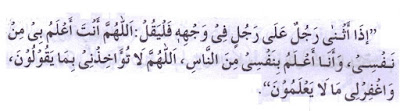
What to do when some one praises you- Mufti Taqi Usmani (reported from Imam Auza’i in Shu’ab al -iman of Imam Baihaqi) Imam Baihaqi reported in Shu'ab al-Iman from Imam Auza’i (R.A) “When some one praises a person infront of him, he should say: Allahumma anta a’alamu bee minnafsee wa ana a’alamu binafsee minan naas Allaahumma laa tu'aakhidhnee bimaa yaqooloona, waghfir lee maa laa ya'lamoona” " Oh Allah! You know me better than myself and I know about myself better than what the people know about me. Oh Allah do not call me to account for what they say & forgive me for what they have no knowledge of (i.e. my faults and defects)." The praise of people is not less than a fitnah for those who serve the deen by speech or writing. So, praising in front of the person is prohibited as it gives rise to the disease of vanity. Imam Auza’i has prescribed this du’a to cure it. Shaykh Dr. Abdul Hai Arifi (R.A)'s advise: Shaykh Dr. Abdul Hai Arifi (R.A) used to say that if someone praises you, then say in your heart, “Oh Allah! All thanks be to you that you have shown only my virtues to this person, for, if you were to expose my weaknesses and defects, he would hate me.” He would also say, “ Desire for fame and praise cannot be satisfied by one’s own effort but it is up to others to fulfill it. Even if it is fulfilled, it is very short lived. Man should think, “what is the benefit achieved from this praise”? Source

-
-
The Reply
-
".........Messenger of Allah (sallallaahu ’alayhi wa sallam) asked, "Have you informed him?'' He said, "No". Messenger of Allah (sallallaahu ’alayhi wa sallam) then said, "Tell him (that you love him)". Tell the person you love that you love them!
-
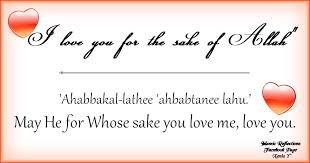
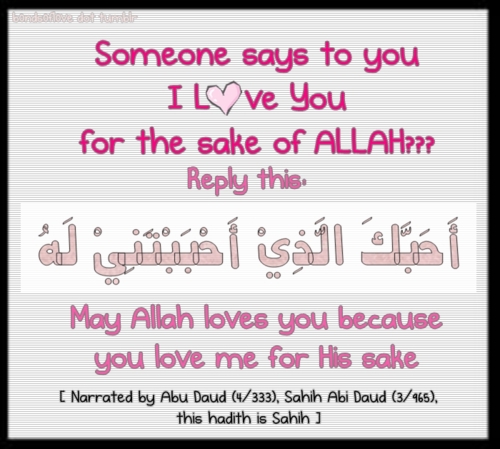
I Love you for the sake of Allah Abu Karima al-Miqdad ibn Ma'dikarib reported that the Prophet, may Allah bless him and grant him peace, said, "If a man loves his brother, he should tell him that he loves him." [Abu Dawud and at-Tirmidhi] Anas bin Malik (May Allah be pleased with him) reported: A man was with the Prophet (sallallaahu ’alayhi wa sallam) when another man passed by and the former said: "O Messenger of Allah! I love this man (for Allah's sake)". Messenger of Allah (sallallaahu ’alayhi wa sallam) asked, "Have you informed him?'' He said, "No". Messenger of Allah (sallallaahu ’alayhi wa sallam) then said, "Tell him (that you love him)". So he went up to the man and said to him, "I love you for the sake of Allah;'' and the other replied, "May Allah, for Whose sake you love me, love you.'' [Abu Dawud].
-
-
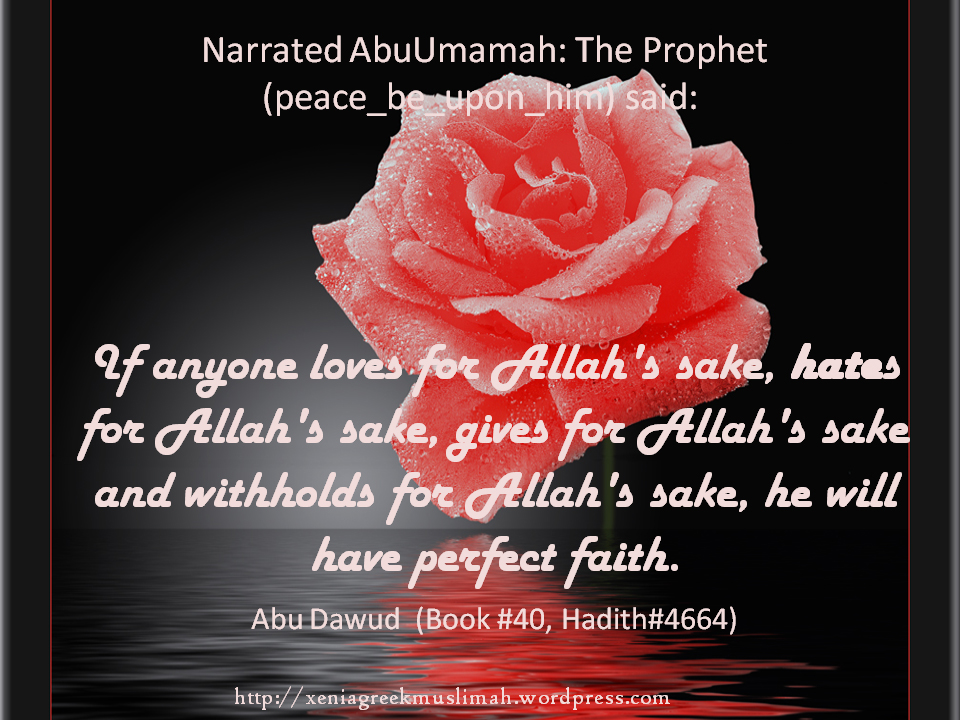
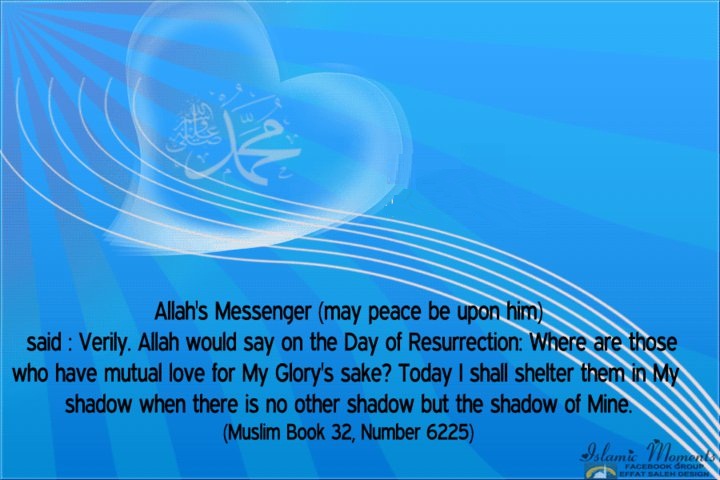
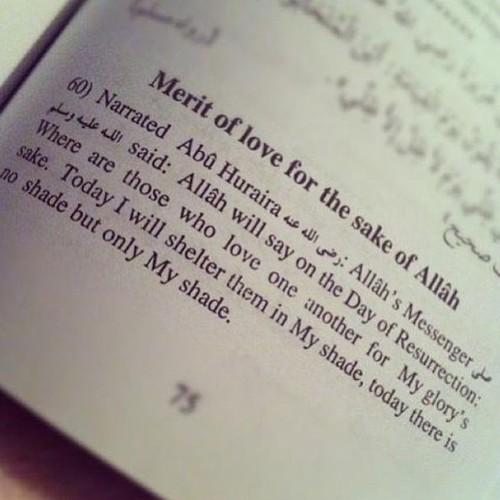
Love for the sake of Allah Abu Hurayra reported that the Messenger of Allah, may Allah bless him and grant him peace, said, "Allah Almighty will say on the Day of Rising, 'Where are those who loved one another for the sake of My majesty? Today, on the day when there is no shade but My shade, I will shade them.'" [Muslim] Abu Hurayra reported that the Prophet, may Allah bless him and grant him peace, said, "A man visited a brother of his in another village and Allah positioned an angel to wait for him on his way." He mentioned the hadith to his words, "Allah loves you just as you love him for His sake." [Muslim] Mu'adh said, "I heard the Messenger of Allah, may Allah bless him and grant him peace, say, 'Allah, the Mighty and Exalted, says, "Those who love one another for My majesty will have minbars of lights. The Prophets and martyrs will envy them."'" [at-Tirmidhi] Hadith Collection from Sunnipath
-
Cannot resist posting one of favourites! RAABI’AH BASRIYYA This great saintly woman was once seen walking the streets carrying a pail of water in one hand and a fire in the other. On being asked the reason she replied, “I wish I could burn the gardens of Jannat with this fire and put out the fire of Jahannam with this water. Then people will worship Allah subhaanahu wata’ala for His pleasure alone and not for entry into Jannat or for safety from the fire of Jahannam”.
-
A Despicable Man Posted by: TheMajlis “And if you decide to change one wife for another wife (i.e. divorce a wife to marry another woman), and you had already given one of them abundant wealth (by way of gifts), then do not take back from her anything. What! Do you repossess it by way of usurpation and flagrant transgression? And how indeed can you take it back after having mutually met (i.e. after having consummated the marriage), and after they (women) have obtained from you a sacred pledge (of Nikah)?” (Surah Nisaa’) A very common reaction of spiteful men of low moral calibre and defective intelligence, when the marriage ends, is to demand that his ex-wife returns all the expensive gifts which he had given her at a time of mutual enjoyment and pleasure. USURPATION The Qur’aan Majeed describes such repossession of gifts as usurpation. It is unjust, despicable and totally unbecoming of a honourable man to degenerate to the low ebb of reclaiming gifts from a woman who was his lawful wife and with whom he had enjoyed conjugal relations. VOMIT Rasulullah (sallallahu alayhi wasallam) said that a person who repossesses a gift is like a dog which laps up its own vomit. In many cases when the marriage collapses, the husband goaded on by his parents or bristling with malice, demands that his ex-wife returns all the expensive gifts he had given her in happier times. UNLAWFUL This attitude is abominable and totally at variance with Muslim moral character. Besides the morality of the issue, reclaiming gifts from a wife is not permissible nor valid. If by pressure, the man manages to take possession of the gifts, he does not become the owner. The gifts remain in the ownership of the woman who was once upon a time his wife. The excuse that the jewellery, etc. were given to the wife on loan is not valid after the marriage ends in divorce unless the man can prove with acceptable evidence that he had made such a declaration to the woman at the time when he gave her the assets. CUSTODY The husband’s or his parents’ custody of the items do not make him the owner thereof. It is normal for the wife to leave her expensive jewellery in her husband’s custody for safe-keeping. He holds it as an amaanat for her. As long as she had taken possession of the gifts, she remains the owner. When the heart-breaking event of divorce takes place, the husband should acquit himself honourably by softening the blow. He should not compound the tragedy for the sake of finding gratification for his spiteful and malicious attitude. The assets should be given to her without any problem or hassling. Many Sahaabah lauded their wives with substantial gifts on the occasion of divorce. Acrimony and malice did not feature in the dissolution of their marriages. Divorce at times becomes necessary. When the tragedy occurs, Allah Ta’ala should not be obliterated from the mind.
-
-
Assisting one's father with Zakaat Q. My father is battling and I know for a fact that he is always short every month as he is a pensioner and does not have any other source of income. Can I give him my Zakaat? (Query published as received) Answer A child cannot give his/her parents Zakaat and vice versa. You cannot assist your father with Zakaat funds. You can assist him with funds with the intention of optional Sadaqah if you wish or other family members (eg, his brothers, nephews etc) can assist him with Zakaat. A wife may not giver her Zakaat to her husband and vice versa. And Allah Knows Best Mufti Suhail Tarmahomed Fatwa Department Jamiatul Ulama (KZN) Council of Muslim Theologians
-
Q: A person gave zakaat to a muslim whom he regarded to be eligible for zakaat. However, after giving him the zakaat he discovered that he was unworthy of zakaat. Is the zakaat discharged? A: If a person discharged the zakaat to a muslim whom he regarded to be eligible for zakaat then the zakaat will be discharged. ( دفع بتحر ) لمن يظنه مصرفا ( فبان أنه عبده أو مكاتبه أو حربي ولو مستأمنا أعادها ) لما مر ( وإن بان غناه أو كونه ذميا أو أنه أبوه أو ابنه أو امرأته أو هاشمي لا ) يعيد لأنه أتى بما في وسعه حتى لو دفع بلا تحر لم يجز إن أخطأ (شامى 2/352) Answered by: Mufti Zakaria Makada Checked & Approved: Mufti Ebrahim Salejee (Isipingo Beach)
-
Q: Will the zakaat be fulfilled if it is given under the pretext of a gift or a loan? A: If the person discharging the zakaat has the intention of zakaat at the time he gifted the wealth or loaned it to the poor person, the zakaat will be discharged. However, in the case where he gave the zakaat as a loan it is impermissible for him to take back the wealth. If he takes it back he will be sinful. قوله ( نية ) أشار إلى أنه لا اعتبار للتسمية فلو سماها هبة أو قرضا تجزيه في الأصح ( شامى 2/268) Answered by: Mufti Zakaria Makada Checked & Approved: Mufti Ebrahim Salejee (Isipingo Beach)
-
THE STYLE OF RASULULLAH’S GARMENT
ummtaalib replied to ummtaalib's topic in Muhammad (Sallallaahu 'alayhi wasallam)
If gambling is involved in chess, it is categorically prohibited and without gambling being involved there is a difference of opinion in its prohibition Please see: Inter-Islam: Chess and Islam Askimam: Ruling on chess in Islam darul-Iftaa: Playing Chess -
Information on 15th Sha'baan - Night Of Barãt
ummtaalib replied to ummtaalib's topic in General Islamic Articles
This ruling applies to the men. Al-Bukhaari reported that the Prophet (peace and blessings of Allaah be upon him) said: "Whatever of the izaar (lower garment) is below the ankles is in the Fire." (al-Bukhaari, no. 5787) Detail Here -
THE STYLE OF RASULULLAH’S GARMENT By Mujlisul Ulama of South Africa When a modernist Muslim criticizes the dress style and appearance of Rasulullah (sallallahu alayhi wasallam) and the Sahaabah, we in this age in which kufr preponderates, are not surprised. Immersed in the kufr concepts and liberalism of the western kuffaar, it is just natural and logical for modernists to denigrate every teaching of the Sunnah which conflicts with the tastes and hues of western culture. In fact, even Ulama have become so terribly desensitized with the kufr of the modernists as a consequence of their mutual association and their dubious and baseless policies of ‘hikmat’ and diplomacy, that they (the Ulama) too have become chronic victims of the maladies of kufr and liberalism. So while we cannot be surprised when modernists criticize, mock and sneer at the dress styles and appearance of Rasulullah (sallallahu alayhi wasallam) and his Sahaabah, there is not only surprise but shock when molvis —products of Darul Ulooms - who purport to be followers of the Ulama of the Sunnah, resort to labyrinthal arguments in order to justify styles which are in conflict with not only the practical example of the Nabi, but in diametric opposition to his explicit statements of prohibition pertaining to certain dress styles. THE TROUSERS Every molvi is aware or should be aware that ALL the Books of Hadith contain many authentic ahadith clearly explaining the style of Rasulullah’s izaar. There is absolutely no difference of opinion among any of the innumerable authorities of the Shariah from the very inception of Islam that Rasulullah (sallallahu alayhi wasallam) and his Sahaabah always wore their izaar and trousers above their ankles. In addition to their practical example, Rasulullah (sallallahu alayhi wasallam) and the Sahaabah verbally propagated in explicit terms the prohibition of wearing the trousers below the ankles. This style is completely unrelated to age and time. There was no incumbency of the era to wear the trousers in this manner nor were there any physical or geographic restraints or factors which compelled the adoption of this style. on the contrary, the age and the people of the time demanded that the trousers be worn below the ankles in exactly the same way as modernists, kuffaar and Muslims ashamed of the Sunnah Culture are advocating today. THE REASON In order to accomodate the liberal fancies of the western kuffaar, molvis in this age of corruption, have hooked onto a legless and baseless argument to justify, propagate and even praise the kaafir style of wearing the trousers below the ankles—a style which is in clear opposition to the style and command of Rasulullah (sallallahu alayhi wasallam). The modernist molvis of the liberal cult of westernism are arguing that the reason for the prohibition to wear the trousers below the ankles was pride. Their argument goes that on account of pride, the style was prohibited. But if there is no pride then wearing the trousers below the ankles is permissible, in fact commendable by implication of their baseless and satanic arguments which they voice over their radio channels. Why is it haraam for a Muslim to wear a crucifix around his neck or arm? Why should it be haraam for a Muslim to keep a small idol of Bhagwan or Buddha in his pocket or display it in his home. Why should this be haraam if the Muslim concerned has no beliefs of shirk or kufr. He simply regards these items as ‘artifacts’ and symbols of ‘history’. He does not believe in these idols. He does not worship them. But we can claim without fear of contradiction that even the modernist molvis have as yet not descended to the level of corruption which will constrain them to say that keeping such idols is permissible if the reason is not shirk/worship. Although this is still the case presently, we know that there will soon come a time when keeping and admiring even these instruments of shirk and kufr will be justified and made legal by the presentation of the argument that the reason for the initial prohibition was the belief of shirk which had not yet been completely eradicated from the hearts of the new converts to Islam. CATEGORIC PROHIBITION When the Shariah categorically prohibits an act or practice, the prohibition will endure regardless of the reason for which it was initially prohibited. Reciting the qira’t jahran (aloud) in Zuhr and Asr was prohibited initially on account of a particular reason which soon after the prohibition no longer existed. But inspite of the disappearance of the reason for the prohibition, the hukm of Sirri (silent) recitation will endure until the day of Qiyaamah. Rasulullah (sallalahu alayhi wasallam) said that he who plays chess is like one who has dipped his fingers in the blood of a swine. Surely there was a cogent reason for this stern prohibition. Now, regardless of whether that reason exists in some cases or not, the prohibition of playing chess will remain until the day of Qiyaamah. In fact, the prohibition has been taken further by the Fuqaha (the Authorities of the Shariah). This prohibition has been extended to all similar games of the kuffaar. THE AHADITH We shall now present the relevant authentic Ahadith on the issue of the trousers below and above the ankles and then proceed to further refute and negate the utterly baseless and devious arguments tendered by modernists molvis to beguile the Ummah. (1) Abu Hurairah (Radhiyallahu anhu) narrates: Rasulullah (sallallahu alayhi wasallam) said: "Whatever of the garment is below the ankles will be in the Fire (of Jahannum).(Bukhaari) (2) Ibn Umar (Radhiyallahu anhu) narrates: "Verily the Nabi (sallallahu alayhi wasallam) said: Whoever hangs his garment in pride, Allah will not look at him (with mercy) on the day of Qiyaamah." (Bukhaari and Muslim) (3) Abu Saeed al-Kudri (Radhiyallahu anhu) narrates: "I heard Rasulullah (sallallahu alayhi wasallam) saying: The izaar of the Mu’min is halfway on the forlegs (i.e.midway between the knees and the ankles). There is no sin on him in that which is between it and the ankles. And, whatever is below this is in the Fire (of Jahannum). He (Rasulullah —sallallahu alayhi wasallam) repeated this statement) three times, And, he said: Allah will not look (with mercy) at the person who hangs his izaar in pride." (Abu Dawood and Ibn Maajah) (4) Ibn Umar (radhiyallahu anhu) narrates: "I passed by Rasulullah (sallallahu alayhi wasallam) while my trousers was hanging (i.e.below the ankles). He then exclaimed: O Abdullah! Raise your izaar. I then raised it (a bit). Then he (Rasulullah- sallallahu alayhi wasallam) said: Raise it more! I then raised it more. Thereafter I was always concious of it." Some people asked: Until where (did you raise it)? He (Ibn Umar) said: Until midway of the forleg." (Muslim) (5) Ubaid Bin Khaalid (radhiyallahu anhu) narrates: While I was walking in Madinah, (I heard) someone behind me say: "Raise your izaar! Verily it (raising the garment) is better for piety and preservation (of the garment)." I then looked behind and observed that it was Rasulullah (sallallahu alayhi wasallam). I then said: O Rasulullah! It is a simple (of inferior quality and price) garment. Rasulullah (sallallahu alayhi wasallam) commented: "What,is there not for you in me an example (to follow)?" When I looked (at Rasulullah’s garment), his izaar was midway on his forlegs." (Tirmizi) (6) Salmah Bin Akwa’ (radhiyallahu anhu) narrates: "Uthmaan (radhiyallahu anhu) would wear his trousers midway on his forlegs, and he would say: ‘So was the izaar of my Companion, i.e.Nabi -sallallahu alayhi wasallam)." (Tirmizi) (7) Huzaifah Bin Yamaan (radhiyallahu anhu) narrates: Rasulullah (sallallahu alayhi wasallam) took hold of the flesh of my forleg (or of his forleg) and said: ‘This is the location for the izaar. If you are not satisfied (with this position), then a bit lower. And if you are still not satisfied, then know that the izaar has no right in the ankles." (Tirmizi) COMMENT Commenting on these Hadith narration, Hadhrat Shaikh Muhammad Zakariyya (rahmatullah alayh) writes: "Severe warnings have been recorded for wearing the lungi, trousers, etc. below the ankles. That section (below the ankles) on which the garment hangs will be burnt in the Fire (of Jahannum). In view of this type (of severe) warnings (of punishment) in the ahadith, special attention should be paid to this matter. But, on the contrary in our age, the garments are specially (i.e.intentionally) worn below the ankles. To Allah does the complainer (register his complaint)." Inspite of the many unambiguous ahadith explicitly prohibiting the kuffaar style of wearing the trousers below the ankles, molvis in this age are devoting special time on their radio channels to negate what Rasulullah (sallallahu alayhi wasallam) has commanded. THE THRUST Any level-headed and unbiased Muslim in search of the truth will understand after a perusal of the aforementioned ahadith that wearing the trousers below the ankles is haraam. In Hadith No. 5, Ubaid Bin Khaalid (radhiyallahu anhu) was wearing his garment below his ankles. He was walking in the streets of Madinah when Rasulullah (sallallahu alayhi wasallam) ordered him to raise his izaar above the ankles. In this Hadith, Rasulullah (sallallahu alayhi wasallam) presented two reasons for wearing the trousers above the ankles.In this style (of the Sunnah) is greater piety in view of the fact that it firstly is in conflict with the style of the kuffaar. Secondly, when a Muslim conciously abstains from emulating the style of the kuffaar, he rises in rank of taqwa. Following the method of Rasulullah (sallallahu alayhi wasallam) is an incumbent requirement of Taqwa, hence he said that wearing the trousers above the ankles is ‘atqaa’ (more pious). It thus flows from this reasoning presented by Nabi-e-Kareem (sallallahu alayhi wasallam) that wearing the the garment below the ankles is not in conformity with taqwa. Whether we understand the relationship between this style and taqwa is of no significance. Since Rasulullah (sallallahu alayhi wasallam) has offered this explanation, it is the fardh duty of every Mu’min to blindly accept it. The second argument which Rasulullah (sallallahu alayhi wasallam) presented for his command to wear the garment above the ankles is that this style is ‘abqaa’ for the garment. In other words the garment will be better preserved against the dirt and filth of the road and in this way be better protected. The Mu’min’s trousers should not serve the function of the street-sweeper. It is significant that in this Hadith, Rasulullah (sallallahu alayhi wasallam) did not tender the argument of pride. Since he was aware that the Sahaabi was not wearing his garment below the ankles on account of pride, he did not mention pride on this occasion. However, when the Sahaabi did not understand the argument, Rasulullah (sallallahu alayhi wasallam) broached the subject from another angle. He asked: Is my example and way not sufficient? In otherwords, for the Mu’min the acts, practices and example of the Rasool are more than adequate. There is no need to search for reasons and wisdoms for the ahkaam (laws of the Deen). The example of Rasulullah (sallallahu alayhi wasallam) is compulsorily imposed on Muslims by the Qur’aan Majeed. There is no need to look elsewhere and further than this. It thus does not behove a Muslim, least of all a learned man, to dig out technicalities and by distortion present these in justification of the endeavour to negate the style and custom of Rasulullah (sallalahu alayhi wasallam). In Hadith No. 6 Hadhrat Uthmaan (Radhiyallahu anhu), the third Khalifah, long after the demise of Rasulullah (sallallahu alayhi wasallam) commented on the practice of wearing the trousers above the ankles. Everyone knows and accepts that he had no pride. If the order to wear the trousers above the ankles was based on pride, Hadhrat Uthmaan and all the Sahaabah would not have been so meticulous in observing this injunction. They would have worn their trousers below their ankles since they were bereft of pride. They had attained the loftiest heights in the reformation of the nafs. There were no better, no more pious and no humbler community on earth than the Sahaabah who were thoroughly purified of all spiritual maladies by Rasulullah (sallallahu alayhi wasallam). Yet, inspite of their high stage of humility, they adhered meticulously to the style of Rasulullah (sallallahu alayhi wasallam). Everyone who has studied a bit of the history of the Sahaabah, is aware that Hadhrat Ibn Umar (radhiyallahu anhu) was such a staunch and ardent follower of the minutest details of the Sunnah, that people believed that he would become insane. Pride was never the reason for him having worn his trousers below his ankles. When Rasulullah (sallallahu alayhi wasallam) saw this, he commanded him to raise his garment midway between the knees and the ankles. The issue of pride never featured in his wearing his trousers below his ankles nor in the argument of Rasulullah (sallallahu alayhi wasallam) on the occasion when he issued his instruction to this devotee of the Sunnah. PRIDE In some narrations the reason for wearing the trousers below the ankles is stated as pride. While this was the actual reason in those times for this prohibited style, it was not always the case with everyone who would wear his trousers below his ankles. Hence, we find Rasulullah (sallallahu alayhi wasallam) issuing stern warnings and threats of the punishment of the Fire for those who wear their trousers in the fashion of the proud people. So whether one wears the trousers below the ankles for the sake of pride or not, one is undoubtedly, imitating the style of the proud ones and the style of the kuffaar. Imitating the kuffaar by itself is a factor of prohibition. THE HIDDEN DISEASE Now the question to be asked is: Why would a molvi advocate a style which Rasulullah (sallallahu alayhi wasallam) had prohibited. He did not only present pride as the reason for the prohibition. So why is there so much concern to negate a Sunnah style? Leaving aside the technical questions and academic rulings, it can be simply understood that the permanent practice and style of Rasulullah (sallallahu alayhi wasallam) and his Sahaabah were to wear their garments above the ankles, not below their ankles. That wearing the trousers above the ankles is an irrefutable Sunnah practice, will be acknowledged by all Muslims, even the modernists and the liberal molvis. on the assumption that it is not haraam to wear the trousers below the ankles, then too, why should Muslims who claim to love Rasulullah (sallalahu alayhi wasallam) have a desire to scuttle this Sunnah practice and in its place follow the style of the kuffaar? Whose style is it to wear the trousers above the ankles? And, whose style is it to wear it below the ankles? What does the Imaan of a Mu’min demand? Follow the style of Rasulullah (sallalahu alayhi wasallam) or the style of the kuffaar? Why is there such a strong aversion in the ranks of the Muslims for the style of Rasulullah (sallallahu alayhi wasallam)? What goes on in the heart of a molvi who advocates a style abhorred by Rasulullah (sallallahu alayhi wasallam)? Surely there must be some hidden disease (mardh) lurking somewhere in such a heart. It is inconceivable that a Mu’min of healthy Imaan will ever stoop so low as to scrape the very bottom of the barrel of spiritual corruprion. Remember that to negate a preference of Rasulullah (sallallahu alayhi wasallam), to feel ashamed of the style of Rasulullah (sallallahu alayhi wasallam) and to present devious arguments to distort and deny what Rasulullah (sallallahu alayhi wasallam) had commanded, are worse than consuming liquor, worse than fornication and worse than all the major sins put together. Such attitude is kufr. HADHRAT ABU BAKR The solitary narration which the denigrators of Rasulullah’s practice are able to produce as ‘evidence’ is the Hadith in which it is mentioned that Rasulullah (sallallahu alayhi wasallam) allowed Hadhrat Abu Bakr (radhiyallahu anhu) to wear his garment below his ankles. To present this Hadith in substantiation of the claim, the aim of which is to negate the style of Rasulullah (sallalahu alayhi wasallam), is ludicrous and utterly baseless. The Hadith in question is very clear as for the reason of the permission granted to Hadhrat Abu Bakr (radhiyallahu anhu) who was highly perturbed by his inability to maintain his garment above his ankles. He therefore, discussed this matter with Nabi-e-Kareem (sallallahu alayhi wasallam). Hadhrat Abu Bakr (Radhiyallahu anhu) was a man with a big stomach. Inspite of all his efforts to keep his garment in place, he failed. His garment would repeatedly slide down over his ankles. The Hadith in question, explicitly mentions this fact. In view of this condition and his inability to retain his garment in position above his ankles, he was exempted from the prohibition. But he had a valid reason. What valid reason do the modernists and the liberal molvis have? There are always exceptions to general rules. But the exceptions do not cancel out the law or the rule. The rule remains in place. Furthermore, why do the scoffers of Rasulullah’s style cast a blind eye to all the ahadith of prohibition and cling onto this solitary narration which in no way negates the prohibition stated so emphatically in the other narrations? IMAAM SHAAFI Like a drowning man, the modernist molvi tries to cling to every floating straw that passes his way. Entirely bereft of proper Shar’i arguments to bolster his corrupt view and enmity for Rasulullah’s dress style, the molvi claims that according to Imaam Shaafi (Rahmatullah alayh) it is permissible to wear the trousers below the ankles. Let us for a moment assume that what the molvi tendered is correct. The question now is: Why does the Hanafi molvi resort to a view of Imaam Shaafi (Rahmatullah alayh), especially on an issue for which there is absolutely no need to adopt the view of another Math-hab? If it was a critical issue or an emergency or some urgent need, then in terms of the principles of the Hanafi Math-hab, a pious and experienced Mufti will have the right to issue a Fatwa on the basis of one of the other Math-habs among the Four Math-habs. But in this case of wearing the trousers, there is absolutely no such expediency. When a Hanafi molvi ignores the views and fatwas of the authorities of his own Math-hab and clings to an opinion of another Math-hab, it follows that there is no flexibility for his baseless view in his own Math-hab, hence he had to look elsewhere for aid. His act in itself is sufficient testimony for the claim that according to the Hanafi Fuqaha and Ulama and Auliya, wearing the trousers below the ankles is haraam. THE ACTUAL POSITION The liberal molvi claims that according to Imaam Shaafi (rahmatullah alayh) wearing the trousers below the ankles is permissible. His claim is baseless. Imaam Shaafi does not say that "it is permissible". According to the Shaafi Math-hab there are different degrees of prohibition for the style of wearing the trousers below the ankles. Explaining this, Imaam Nawawi (a Shaafi authority) states in his Sharhul Muslim "It is not permissible to hang the garment below the ankles if it is for pride. If it is for a reason other than pride, it is Makrooh. The Mustahab requirement is midway of the calfs (the forlegs) as it is stated in the Hadith of Ibn Umar. Midway of the forlegs is Mustahab. Below this limit until the ankles is permissible without it being Makrooh. What descends below the ankles is Mamnoo’ (prohibited). If it is for pride, then the prohibition is of the haraam category (i.e.Makrooh Tahrimi). And, if it is not for pride, the prohibition is of the tanzihi category (i.e.Makrooh Tanzihi)." Makrooh Tanzihi does not mean ‘permissible’. It remains a detestable act in the Shariah. In fact, persistence on a Makrooh Tanzihi act transforms it into Makrooh Tahrimi which is sinful and a punishable offence. It makes a man a faasiq. Clutching at straws is not Shar’i evidence for a claim. THE FACTORS From the aforegoing explanation it will be understood that there are several factors for the prohibition of wearing the garment below the ankles: (a) It is the style of the kuffaar. Whoever imitates the kuffaar becomes of them. (b) It is the way of the mutakabbireen (proud people). So whether one has pride or not, is immaterial. The fact that the mutakabbireen’s style is adopted in itself is a grave sin. © The opposite style (wearing above the ankles) is ‘atqaa’ and abqaa’ according to Rasulullah (sallallahu alayhi wasallam). (d) Wearing the garment above the ankles is part of the Uswah-e-Hasanah (Beautiful Life Pattern) of Rasulullah (sallallahu alayhi wasallam). The Qur’aan commands adoption of this Sunnah. (e) The trousers has no haqq (right) on the ankles according to the explicit pronouncement of Rasulullah (sallallahu alayhi wasallam). (f) What is below the ankles will be in the Fire of Jahannum. In view of all these factors of prohibition, the arguments of the modernist and liberal molvis have absolutely no validity. These molvis should also understand that in airing their liberal, modernist and baatil views, they do not have the support of a single one of our Akaabir Ulama. Our advice is that they should utilize their radio channels constructively to aid the Deen, not to breakdown Islam and its Culture, for then, there will be absolute justification for branding their organs of transmission as radio shaitaan and channel shaitaan. "The Majlis" Vol.15 No.1
-
Information on 15th Sha'baan - Night Of Barãt
ummtaalib replied to ummtaalib's topic in General Islamic Articles
Let us take stock of ourselves by the Following Reminder From Jamiatul Ulama (KZN) Council of Muslim Theologians Forgiveness on Laylatul Bara’ah The night of Bara'ah (emancipation), the 15th night of Sha'baan is indeed a significant and blessed night. On this night, Allah Ta'ala showers His servants with special and divine mercy. It is recorded in the Ahadith that all Muslims are forgiven on this night besides the following: 1. Idolaters 2. Those who harbour enmity against others 3. Those who consume alcohol 4. Those who disobey their parents 5. Those who commit murder 6. Those who sever family ties 7. Those who wear their trousers, kurtas, lungis, etc. below their ankles We should, at this time, take stock of ourselves. Are we of those that will be deprived of Allah’s mercy on this night due to our evil actions? If we find ourselves guilty of the above evil actions then we need to rectify ourselves. -
Information on 15th Sha'baan - Night Of Barãt
ummtaalib replied to ummtaalib's topic in General Islamic Articles
For the answer to your question, look at number 4 Here May Allah ta'ala give us the tawfeeq to clear our hearts of all enmity, envy, jealousy...! Aameen Ya Rabb and this is only possible through Your mercy! -
A Simple Format for ‘ibadah on Auspicious nights Our Beloved Nabi (sallallahu’alaihiwasallam) has mentioned: “Indeed your Lord has reserved certain special moments in time (in which he emits abundant/special mercy) Be sure to avail yourselves for these opportunities.” (Majma’uz Zawaaid) We are usually aware of the significant occasions that present themselves each year. The crucial thing is how do we “avail ourselves” and maximise our benefit from these blessed nights? Here under is a suggested format for “What to do on Blessed nights?” 1. Offer Esha & Fajr Salah in congregation. Rasululllah (sallallahu’alaihiwasallam) said: “One who performs Esha in congregation gets the reward of spending half the night in worship. And he who follows that up with the Fajr salah in congregation, will be as if he has stayed up all night in ‘ibaadah.” (Sahih Muslim & Sunan Abi Dawud) 2. Sleep in the state of wudhu Hafidh Ibn Hajar (rahimahullah) has mentioned a reliable narration that states: “The soul of one who sleeps with wudhu makes sajdah (prostrates) at the ‘Arsh of Allah” (Fathul Baari) Imagine our souls making sajdah at the throne of our Creator on a night like LaylatulQadr! 3. Abstain from sin It’s not logical to fill the bucket when it has a hole… One should specifically free the heart of any ill-feelings or malice towards fellow muslims. (See here for “how to clean the heart” of such ailments) 4. Clear your heart from ill-feelings towards fellow Muslims. The ‘Ulama state that those who harbour ill-feelings are deprived of Allah’s mercy and forgiveness on occasions like these. A Hadith in Sahih Ibn Hibban, there is mention of four people that will be deprived on this night: a) An Alcoholic. b) One who disobeys his parents. c) One who severe family ties d) One who harbours ill-feelings in his heart for others. 5. Salatut Tasbeeh This is very strongly recommended due to its huge reward. See here for a detailed article on it’s authenticity, and here for the format of Salatut Tasbeeh. 6. Tawbah Since the purpose of the turning to Allah on these nights is precisely to attain forgiveness from Allah, this act is a fundamental on such occasions. The procedure for Tawbah is: a. Perform two rak’aats of Salaah. (Optional) b. Stop the sin that one is repenting from. c. Regret the sin from the bottom of your heart. d. Make a determined pledge with Allah never to repeat that sin.Besides the two rak’aats of Salah,the remainder are all fundamental. Furthermore, if the sin involved usurping the right of the next person, one needs to ask him/her for forgiveness too. Without this we are not guaranteed forgiveness. If that person has passed away, we could make dua for him and repay the debt (if any) to his heirs. 7. Zhikr There are many forms of zhikrullah. I would suggest the following: A hundred times “Laa ilaah illallah” A hundred times repeating the name of “Allah” And a hundred times: “Subhaanallahi wabihamdihi subhanallahil ‘Azeem” The reason for the third one is the following: Rasulullah (sallallahu’alaihiwasallam) said: 1. “He who recites this one hundred times will have all his sins forgiven even if it be equal to the foam of the ocean” (Sahih Bukhari) 2. “These words are beloved to Allah Ta’ala, easy on the tongue and weighty on the scales (of deeds on Qiyamah)” (Sahih Bukhari) Furthermore, this is the form of Zhikr that the entire creation is engaged in. (Al-Quran, Surah:17 ayah:44) 8. Salawat on Rasulullah (sallallahu’alaihiwasallam) If it was not for our beloved Nabi (‘alaihiSalatu WaSalam) we would not have these Blessed occasions. Therefore we cannot afford moments like these to pass without remembering him. In Fact by doing so we ourselves benefit. One Hadith states: “He who sends salutations upon me once, Allah Ta’ala sends ten salutations upon him.” 9. Tilawat (Recital) of Quran This is considered the best form of Zhikr. One could recite even a quarter juz or just the masnoon Surahs that are to be recited every night. Like Surahs Waqi’ah, Mulk, Sajdah, Yaseen etc. 10. Dua “Du’a is the essence of Worship” and hence cannot be omitted when we engage in worship. More so on occasions when Almighty Allah accepts duas such as on the night of Qadr. One should spend a lengthy duration in begging from Allah, as we are all in need of it. In light of the current world crisis, do remember our oppressed brethren around the globe. On the night of Qadr the following Du’a should also be repeated as taught by Rasulullah (sallallahu’alaihiwasallam) to his beloved wife Sayyidah ‘Aishah (radiyallahu ‘anha): اللهم إِنَّكَ عَفُوٌّ تُحِبُّ العَفْوُ فَاعْفُ عَنِّيْ “Allahumma innaka ‘afuwwun tuhibbul ‘afwa fa’fu ‘Anni” O Allah! You are indeed Most Forgiving, so forgive me. Note 1: The above can all be achieved in about 1 hour. Salatut Tasbeeh: 20 mins Tawbah: can be incorporated in the du’a Zikr: 10 mins Salawaat: 5 mins Tilawat: 15 mins Du’a & Tawbah: 10 mins However if one is short on time for whatever reason, my suggestion would be to at least do the first four and the last one. That would be: a) Esha & Fajr with Jamat b) Sleep with Wudhu c) Abstain from sin d) clean the heart e) Dua Note 2: The night commences at Maghrib, not after Esha or after Taraweeh or at Sehri time. Therefore one can and should commence ‘ibadah from Maghrib, although it is indeed best to do so at the last part of the night. Note 3: These are mere suggestions intended to make it easy for people. One may engage in whatever form of ‘ibadah one is comfortable with. May Allah Ta’ala grant us all complete forgiveness and steadfastness on guidance. Ameen. Please do remember the writer in your supplication as well. Al-Miftah
- 1 reply
-
- 2
-

-
Great work MashaAllah. Jazaakillah for posting answer