
ummtaalib
-
Posts
8,467 -
Joined
-
Days Won
773
Content Type
Profiles
Forums
Events
Everything posted by ummtaalib
-
An Intelligent Mu'minah's Response to an Aunt's Rebuttal of a Mufti's Fatwa "Assalaamu Alaikum! Apa, kindly read below. I do not wish to enter into the debate with you, but just as you sent me something to read with which I disagree, I thought I should send you something as well. Given my privilege as a woman, I only degrade myself by trying to be something I'm not--and in all honesty--don't want to be: a man. As women, we will never reach true liberation until we stop trying to mimic men, and value the beauty in our own Allah-given distinctiveness. On March 18, 2005 Amina Wadud led the first female-led Jumuah (Friday) prayer. On that day women took a huge step towards being more like men. But, did we come closer to actualizing our Allah-given liberation? I don't think so. What we so often forget is that Allah has honoured the woman by giving her value in relation to Allah-not in relation to men. But as western feminism erases Allah from the scene, there is no standard left-but men. As a result the western feminist is forced to find her value in relation to a man. And in so doing she has accepted a faulty assumption. She has accepted that man is the standard, and thus a woman can never be a full human being until she becomes just like a man-the standard. When a man cut his hair short, she wanted to cut her hair short. When a man joined the army, she wanted to join the army. She wanted these things for no other reason than because the 'standard' had it. What she didn't recognize was that Allah dignifies both men and women in their distinctiveness--not their sameness. And on March 18, Muslim women made the very same mistake. For 1400 years there has been a consensus of the scholars that men are to lead prayer. As a Muslim woman, why does this matter? The one who leads prayer is not spiritually superior in any way. Something is not better just because a man does it. And leading prayer is not better, just because it's leading. Had it been the role of women or had it been more divine, why wouldn't the Prophet have asked Ayesha or Khadija, or Fatima-the greatest women of all time-to lead? These women were promised heaven-and yet they never lead prayer. But now for the first time in 1400 years, we look at a man leading prayer and we think, 'That's not fair.' We think so although Allah has given no special privilege to the one who leads. The imam is no higher in the eyes of Allah than the one who prays behind. On the other hand, only a woman can be a mother. And Allah has given special privilege to a mother. The Prophet taught us that heaven lies at the feet of mothers. But no matter what a man does he can never be a mother. So why is that not unfair? When asked who is most deserving of our kind treatment? The Prophet replied 'your mother' three times before saying 'your father' only once. Isn't that sexist? No matter what a man does he will never be able to have the status of a mother. And yet even when Allah honors us with something uniquely feminine, we are too busy trying to find our worth in reference to men, to value it-or even notice. We too have accepted men as the standard; so anything uniquely feminine is, by definition, inferior. Being sensitive is an insult, becoming a mother-a degradation. In the battle between stoic rationality (considered masculine) and selfless compassion (considered feminine), rationality reigns supreme. As soon as we accept that everything a man has and does is better, all that follows is just a knee jerk reaction: if men have it-we want it too. If men pray in the front rows, we assume this is better, so we want to pray in the front rows too. If men lead prayer, we assume the imam is closer to Allah, so we want to lead prayer too. Somewhere along the line we've accepted the notion that having a position of worldly leadership is some indication of one's position with Allah. A Muslim woman does not need to degrade herself in this way. She has Allah as a standard. She has Allah to give her value; she doesn't need a man. In fact, in our crusade to follow men, we, as women, never even stopped to examine the possibility that what we have is better for us. In some cases we even gave up what was higher only to be like men. Fifty years ago, society told us that men were superior because they left the home to work in factories. We were mothers. And yet, we were told that it was women's liberation to abandon the raising of another human being in order to work on a machine. We accepted that working in a factory was superior to raising the foundation of society-just because a man did it. Then after working, we were expected to be superhuman-the perfect mother, the perfect wife, the perfect homemaker-and have the perfect career. And while there is nothing wrong, by definition, with a woman having a career, we soon came to realize what we had sacrificed by blindly mimicking men. We watched as our children became strangers and soon recognized the privilege we'd given up. And so only now-given the choice-women in the West are choosing to stay home to raise their children. According to the United States Department of Agriculture, only 31 percent of mothers with babies, and 18 percent of mothers with two or more children, are working full-time. And of those working mothers, a survey conducted by Parenting Magazine in 2000, found that 93% of them say they would rather be home with their kids, but are compelled to work due to 'financial obligations'. These 'obligations' are imposed on women by the gender sameness of the modern West, and removed from women by the gender distinctiveness of Islam. It took women in the West almost a century of experimentation to realize a privilege given to Muslim women 1400 years ago. Given my privilege as a woman, I only degrade myself by trying to be something I'm not--and in all honesty--don't want to be: a man. As women, we will never reach true liberation until we stop trying to mimic men, and value the beauty in our own Allah-given distinctiveness. If given a choice between stoic justice and compassion, I choose compassion. And if given a choice between worldly leadership and heaven at my feet-I choose heaven. From The majlis
-
Unhealthy Rivalry: Feminism and More وَلَا تَتَمَنَّوْا مَا فَضَّلَ اللَّهُ بِهِ بَعْضَكُمْ عَلَىٰ بَعْضٍ ۚ لِّلرِّجَالِ نَصِيبٌ مِّمَّا اكْتَسَبُوا ۖ وَلِلنِّسَاءِ نَصِيبٌ مِّمَّا اكْتَسَبْنَ ۚ وَاسْأَلُوا اللَّهَ مِن فَضْلِهِ ۗ إِنَّ اللَّهَ كَانَ بِكُلِّ شَيْءٍ عَلِيمًا Do not covet something in which Allāh has made some of you superior to others. For men there is a share of what they earned, and for women, a share of what they earned. Pray to Allāh for His grace. Surely, Allāh is All-Aware of everything. (An-Nisā’, 4:32) This āyah was revealed in response to questions regarding disparity between men and women. Sayyidah Umm Salamah, the mother of believers, looking for an explanation, observed: “Men take part in battles and we do not. We do not take part in combat so we can become martyrs. Also our share in the inheritance is half theirs.” According to another report from ʿIkrimah some women said “We deeply desired that Allāh would let us participate in battles so we would get the same reward as men.” According to another report a woman was concerned that since women have half the share in inheritance and are given half the weight as witnesses in many cases, they would also get half the reward of men for all good deeds. Lest anyone influenced by feminist ideology jump into confusion here, women were not seeking equal rank in the family or tribal hierarchy; they were rather concerned about rewards in the Hereafter. They wanted to make sure they would get equal wages of piety for equal piety. And they were assured, here as well as at many other places in the Qur’ān, that the rewards for good or bad deeds are the same for men and women. While we are encouraged to compete with each other in performing good deeds, we should not get carried away with the idea of competition. Feminism is the result of taking competitiveness to extremes by seeking everything for women that applies to men. This is its foundation and this foundation is being demolished in no uncertain terms here. If men are superior in some respects (like physical strength) so be it. That is Allāh’s plan. If they are given the sole responsibility for earning a living for the family and therefore are given a bigger share in the inheritance in most circumstances, so be it. Their abilities are not the same. Their spheres are not the same. But within their sphere, ultimately everyone will get the rewards based on their own effort and ability. If they listen to this āyah, women will be content being women and will lead happy lives. But the message is not to be limited to its immediate context. It is general and applies to all unhealthy rivalry. We have not been created equal in our appearance, skin color, physical strength, talents, and abilities. We should not waste any time comparing ourselves with others and lamenting our disadvantages in any of these things. We submit to the Will of Allāh in everything that is beyond our control. But we try to do the best in areas where we have been given freedom of action. And we seek Allāh’s grace and mercy all the time. Most of the psychological problems in the world would go away if we followed this one gem of advice. Qur'an Reflections - Juz Five Albalagh
-
The Value of Women in Islam In the Quran Hadith, to quote just a few.... There are many more verses of the Qur'an and hadith of our Prophet sallallaahu 'alayhi wasallam which give women in Islam a value which no other religion has. Where women of other religions have had to fight for their rights, Islam has granted women their rights without having to ask or fight for. A Muslim woman does not need to degrade herself by wearing the mantle of feminism . She has Allah as a standard. She has Allah to give her value; she does not need a man as a standard, nor does she need to go out and demand to be valued!
-
Wealthy person Discharging Sadaqatul Fitr on behalf of his minor children Q: Is it necessary for a wealthy person to discharge the sadaqatul fitr on behalf of his minor children? A: It is necessary for a wealthy person to discharge the sadaqatul fitr on behalf of his minor children. فيخرجها عن نفسه وأولاده الصغار الفقراء (مراقي الفلاح مع حاشية الطحطاوى ص723, الدر المختار مع رد المحتار 2/361) Answered by: Mufti Zakaria Makada Checked & Approved: Mufti Ebrahim Salejee (Isipingo Beach)
-

Quotable Quotes - Shaykh Muhammad Saleem Dhorat
ummtaalib replied to ummtaalib's topic in Inspiring Quotes & Poems
Slaves of Allah ta'ala control their entertainment time. The TV, internet, football etc. do not control them. -
Quotable Quotes - Shaykh Muhammad Saleem Dhorat
ummtaalib replied to ummtaalib's topic in Inspiring Quotes & Poems
Those who were slaves of Allah ta'ala, for them the winds, the fire, the sun, moon and earth were slaves -
Valuing the Month of Ramadān By Shaykh Mawlānā Muhammad Saleem Dhorat hafizahullāh We have all been blessed with the month of Ramadān many times during the course of our lives. For some, the number will be a single figure, and for others double figures. However, for the majority of us, the month of Ramadān is just another month; it comes and goes like any other. In relation to valuing this great month, there are many questions we need to ask ourselves. We may be well acquainted with all the virtues of the month of Ramadān; but do we take advantage of these virtues? The most important way of measuring whether we value the month of Ramadān or not is to ask the question: Have we acquired the goal of Ramadān during any of the previous months of Ramadān, which is to acquire taqwā? If we have not yet achieved this goal, then we need to ask ourselves whether we have made it an objective in this coming Ramadān? Remember that in the famous hadīth of Kā‘b ibn ‘Ujrah radhiyallāhu ‘anhu, the Prophet sallallāhu ‘alayhi wasallam and Jibra’īl ‘alayhis salām cursed those who fail to attract the Forgiveness of Allāh ta‘ālā during the month of Ramadān. To help us truly value the month of Ramadān, we need to take lessons from the Ramadān of those who did value this blessed month. Let us take a glimpse at how our pious predecessors spent the month of Ramadān: • Aswad ibn Yazīd rahimahullāh would complete the Qur’ān every second night in Ramadān. (Siyar-A‘lām-An-Nubalā’) • Sa‘īd ibn Jubayr rahimahullāh would spend the time between Maghrib and ‘Ishā’ [which normally people spend in resting] in tilāwah and would recite the whole Qur’ān in one sitting. (The ‘Ishā’ salāh would be delayed.) (Ibid) • Hammād ibn Abī Sulaymān rahimahullāh would feed 500 people for iftār during Ramadān. (Ibid) • Qatādah rahimahullāh would complete the Qur’ān every third day during the first twenty days of Ramadān and every night in the last ten days. (Ibid) • Ibn Shihāb Zuhrī rahimahullāh would say, “Ramadān is nothing but for tilāwah of the Qur’ān and to feed people.” (Latā’if-ul-Ma‘ārif) • Imām Abū Hanīfah rahimahullāh and Imām Shāfi‘ī rahimahullāh would complete the Qur’ān twice daily in the month of Ramadān, with the latter completing the Qur’ān one more time during the night of ‘Īd and yet again during the day. • Imām Mālik rahimahullāh and Sufyān Thawrī rahimahullāh both would leave their everyday engagements and spend the whole time in the recitation of the Qur’ān. (Latā’if-ul-Ma‘ārif) • Imām Bukhārī rahimahullāh used to complete the Qur’ān 41 times in the Month of Ramadān; once every day, once during the whole month in the tarāwīh prayer, and ten juz daily in Tahajjud salāh. • Hājī Imdādullāh rahimahullāh never slept in the blessed month of Ramadān. After the Maghrib salāh, two huffāz led him in nafl salāh, reciting one juz each until ‘Ishā’ salāh. After ‘Ishā salāh, two huffāz would recite one after the other until half the night, and then another two huffāz would recite one after the other in Tahajjud salāh. In essence, the whole night was spent in worship. • Hadrat Mawlānā Rashīd Ahmad Gangohī rahimahullāh, even at the age of seventy, would spend all his time in worshipping Allāh ta‘ālā, fasting - despite the heat, and performing twenty raka‘āt nafl after the Maghrib salāh, reciting at least two juz in them. He would then also spend two and a half to three hours during the night in Tahajjud salāh, amongst his many other devotions during the day. • Shaykh-ul-Hind rahimahullāh would spend the whole night listening to the Qur’ān. It was common that he would stand in one place and the reciters would change over and take rest. • Qāri Fatah Muhammad Pānipattī rahimahullāh during his later life would spend the time after tarāwīh salāh until subh sādiq reciting ten juz of the Qur’ān, taking extra care in tajwīd. • Mawlānā Manzūr Nu‘mānī rahimahullāh states that Mawlānā Ilyās rahimahullāh daily average of tilāwah in Ramadān was 35 juz, with concentration and understanding of the text. Moreover, the women folk in his home, together with their daily practices of dhikr and tasbīhāt, at times, would complete a whole Qur’ān in one day. • It is stated about Hadrat Mawlānā Yahyā rahimahullāh that, during one Ramadān which he passed in mīrat, he would recite the Qur’ān once daily and would complete it by the time of iftār. • Shāh Abd-ur-Rahīm Raipūrī rahimahullāh used to spend the whole night reciting the Qur’ān, and in twenty four hours he would rarely sleep more than an hour. • Shaykh-ul-Hadīth, Mawlānā Muhammad Zakariyyā rahimahullāh himself completed one Qur’ān daily during the month of Ramadān, and he kept up this practice for more than forty years. Let us also value this blessed month and make the most of this great opportunity granted to us by Allāh ta‘ālā by making full use of its every moment and by using it to maximise our rewards, acquire taqwā and achieve salvation in the Hereafter. Āmīn. © Riyādul Jannah Islamic Da'wah Academy
-
PART TWO A SNAPSHOT OF THE AMAL (PRACTICE) OF THE SALAF-US-SALIHEEN We shall now provide a snapshot of the Taraweeh Amal (actual practice) of all the Salaf-us-Saliheen – a practice that was mass-transmitted from generation to generation before being recorded in detail in the authoritative books of Fiqh of all Madh-habs. The fact that every report of the Fuqaha-e-Mutaqaddimeen (the early Fuqaha during and in close proximity to the era of the Salaf-us-Saliheen) pertaining to the Taraweeh Amal (actual practice) of the Salaf-us-Saliheen conforms exactly to what Allamah Ibn Qudamah stated, leaves not the slightest doubt that the minimum base of 20 raka’ts was the unanimous practice of the Salaf-us-Saliheen. While reading the eye-witness accounts, testimonies, and ruling of the Salaf-us-Saliheen with regards to Taraweeh below, bear in mind that the specification or special emphasis on a particular number that is not explicitly found in the Sunnah causes a practice to become a reprehensible Bid’ah according to Ijma’ (consensus). To illustrate this concept of Bid’ah, if a Salafi mutation today were to introduce a “fast-track” or “instant” Taraweeh of 4 raka’ts in mosques around the world, or another deviant sect were to extend the 20 raka’ts Taraweeh practice of Ramadhan to other sacred months of the year, believing that Taraweeh is just another name for Tahajjud and thus permissible throughout the whole year, then such innovations would be classed as reprehensible Bid’ahs according to the Shariah. According to this principle of Bid’ah which the Salafis accept wholeheartedly, Imam Ahmad ibn Hanbal, Imam Shafi’i, and the Salaf-us-Saliheen who all condoned and adopted the widespread specification of 20 raka’ts for Taraweeh, as shall be demonstrated below, were all completely complicit in the perpetration of wholesale Bid’ah. Bear in mind that there existed literally hundreds of thousands of Ulama-e-Haqq besides the Four Imams during that blessed era, each one the staunchest upholder of the Haqq who would never have hesitated for a second in condemning most vociferously the slightest of deviations. Such Ulama bore not the slightest resemblance to the so-called “Ulama-e-Haqq” of today whose salient feature is cowardice and Kitmaanul Haqq (being silent regarding the truth). Yet not one authority who witnessed and transmitted the practice and ruling of Imam Ahmad Ibn Hanbal, Imam Shafi’i, Imam Malik, Imam Abu Hanifah, etc. have reported anything different to what Allamah Ibn Qudamah has stated with regards to the Amal (practice) of the Salaf-us-Saliheen. And not one record exists of a single objection from the droves of Ulama-e-Haqq of the Salaf-us-Saliheen and of subsequent generations regarding the Bid’ah specification of a number not found in the Sunnah. Perhaps the Salafis believe that Imam Shafi’i and other Imams of the Salaf-us-Saliheen were hallucinating when they explicitly testified to having witnessed the Salaf-us-Saliheen of Makkah, Madinah, Iraq, etc. to be praying 20 raka’ts? Or perhaps all the Salaf-us-Saliheen at some point in time conspired together in all the lands to displace the Ijma’ practice of the Sahabah (radhiyallahu anhum) and secretly institute a Bid’ah, while simultaneously managing to silence the hundreds of thousands of Ulama-e-Haqq who would have existed during that era and in subsequent eras? Or perhaps Taraweeh was an intensely dark, obscure and private matter that was surreptitiously enacted in all the mosques of the Ummah, including the Haramain (Makkah and Madinah), thus making it an extremely complex task for the Four Imams and other Fuqaha to surgically extract the number of raka’ts from the crowds of masses, including themselves, who all would have been participating fervently in this mysterious practice for hours on end, every evening during Ramadhan? Perhaps when Hazrat Umar (radhiyallahu anhum) re-enacted the Taraweeh prayers in congregation, based on the Sunnah of Rasulullah (sallallahu alayhi wasallam), and accepted by the Ijma’ of the Sahabah (radhiyallahu anhum), the subsequent generations of Salaf-us-Saliheen somehow lost count of the number of raka’ts they had witnessed first-hand and been taught to pray, and 8 raka’ts transformed instantly into 20 raka’ts? Or perhaps this issue serves as yet another example that exposes vividly the massive disparity that exists between the Maslak (way) of the Salaf-us-Saliheen and the Maslak of the Salafis, whose satanic “success” in this age in displacing so widely the exact Taraweeh practice of the Salaf-us-Saliheen demonstrates the lethal potential of the Salafi methodology to transform and mutate the Deen of the Ummah within a matter of a few years. THE AMAL (PRACTICE) OF THE SALAF-US-SALIHEEN OF MAKKAH, MADINAH, IRAQ AND THE WHOLE UMMAH Imam Shafi’i describes unambiguously in his famous Kitaab, ‘al-Umm’, the specified number of raka’ts prayed by the Salaf-us-Saliheen of Makkah and Madinah: “I saw [them] in Madinah standing up for prayer for 36 raka’ts. However, 20 raka’ts is more beloved to me since it was related on the authority of Umar, and in the same manner [i.e. for 20 raka’ts] they [i.e. the Salaf-us-Saliheen of his era] would stand up for prayer at Makkah and pray 3 raka’ts Witr.” Imam Abu Yusuf (d. 182), in his Kitab al-Athar, narrates via Imam Abu Hanifah and Hammad (ibn Abu Sulayman) from Hazrat Ibrahim al-Nakha’i (d. 96 AH), the great Tabi’i of Iraq – the other major centre of learning to which thousands of Sahabah (radhiyallahu anhum) had migrated and which had become the political capital of the Muslim empire during the era of the Khulafa-e-Rashideen: “The people [i.e. the Sahabah and Tabi’een] would pray 5 Tarweehaat [sets of 4 raka’ts] in Ramadhan.” In al-Mudawwanah, Ibn al-Qasim (d. 191 AH), the major student and primary source of the rulings of Imam Malik, relates Imam Malik’s statement in defence of the practice of 36 raka’ts (20 + 16) in Madinah: “This is what I found the people to be upon, and it is the age-old practice which the people (i.e. the Salaf-us-Saliheen) have not ceased to be upon.” Imam Tirmidhi (d. 279 AH), the student of Imam Bukhari, makes it clear explicitly in his Sunan that the minimum base of 20 raka’ts was the practice of the Salaf-us-Saliheen. The only ikhtilaaf he reports is the practice of the people of Madinah who would pray an extra 4 raka’ts in each period of rest: “The Ahlul Ilm (the Ulama of the Salaf-us-Saliheen) differed over the night prayer of Ramadan. Some were of the view that one is to pray 41 raka’ts [i.e. 20 raka’ts + 16 raka’ts Nafl + 5 witr] including Witr. This is the view of the people of Madinah, and this is what the Amal (practice) is upon according to them in Madinah. However, the majority of the Ahlul Ilm are upon what was reported from Ali, ‘Umar, and others from the Sahabah (radhiyallahu anhum) of Nabi (sallallahu alayhi wasallam), that it is twenty Rak’ah. This is the view of Sufyan Ath-Thawri, Ibn Al-Mubãrak and Ash-Shafi’i. Ash-Shafi’i said: “And like this I found them [i.e. the Salaf-us-Saliheen of his era] in our land in Makkah praying twenty Rak’ats.” Ahmad said: “There are various reports concerning this.” He did not judge according to any of them. Ishaq [ibn Rahawayh) said: “Rather, we prefer forty-one Rak’ah according to what has been reported from Ubayy bin Ka’b.” Ibn Al-Mubarak, Ahmad and Ishaq preferred that one perform the Salat with the Imam during the month of Ramadan, while Ash-Shafi’i preferred that one pray alone if he is a Qari.” Imam al-Tahawi (d. 321 AH) stated in his book, “Ikhtilaf al-Ulama”: “Our companions (i.e. the Imams of the Hanafi madh-hab) and Imam al-Shafi’i would pray 20 rakats other than witr. Malik said [that it is] 39 rakats including Witr – 36 rakats plus Witr – and he said that this was the age-old practice which the people have not ceased to be upon, [based] on the authority of Saa’ib ibn Yazeed (radhiyallahu anhu) that they would stand in Ramadan for 20 raka’ts, and that they would support themselves on staffs during the time of Umar ibn al-Khattab. Al-Hasan bin Hayy from Amr ibn Qays from Abul Husnaa [reported] that Ali ibn Talib (radhiyallahu anhu) ordered a man to lead them in Salaat for 20 raka’ts in the month of Ramadhan” Abul Qasim al-Khiraqi (d. 334 AH), the long-serving student of the eldest son of Imam Ahmad ibn Hanbal, states in his Mukhtasar, the earliest Hanbali Fiqh manual which was written solely for the purpose of recording the positions of Imam Ahmad ibn Hanbal: “The standing (of prayer) in the month of Ramadhan is 20 raka’ts” To be continued….
-
Fasting whilst on a Journey Q: Is it compulsory for a Musaafir to fast whilst on a journey? A: It is not compulsory for a Musaafir to fast whilst on a journey. Sharee’at has granted him a concession not to fast and to make up for the missed fast upon returning home after the month of Ramadhaan. However, if the Musaafir is able to fast during his journey then this is more rewarding. و يندب لمسافر الصوم إن لم يضره فإن شق عليه أو على رفيقه فالفطر أفضل (الدر المختار ج2 ص42) ومنها السفر الذي يبيح الفطر وهو ليس بعذر في اليوم الذي أنشأ السفر كذا في الغياثية (الفتاوى الهندية ج1 ص206) (وللمسافر الذي أنشا السفر قبل طلوع الفجر إذ لايباح له الفطر بإنشائه بعد ما أصبح صائما بخلاف ما لو حل له مرض بعده فله (الفطر) لقوله تعالى فمن كان منكم مريضا أو على سفر فعدة من أيام أخر … (وصومه) أي المسافر (أحب إن لم يضره) لقوله تعالى: ,أن تصوموا خير لكم (مراقي الفلاح ص686) Answered by: Mufti Zakaria Makada Checked & Approved: Mufti Ebrahim Salejee (Isipingo Beach)
-
Submission As Muslims the first thing we need to understand is that whatever Allah has commanded or prohibited, we submit whether we understand the logic behind it or not. His orders and prohibitions are full of mercy, wisdom and justice and we know this because being The Most-Merciful, The Wise and The Just are from among His qualities and part of our Aqeedah (Beliefs). It is Allah Who created both men and women and knowing His creation, He revealed laws and set limits for the good of His slaves, both male and female. Men & Women are not the same It is an established fact that men and women are different in their physical capabilities, emotional build up etc. and therefore their roles/assignments will be different. Muslim women who join the feminist movement fail to recognize that Allah dignifies both men and women in their distinctiveness, not their similarities. All human cultures make a clear cut distinction between ‘masculinity’ and ‘femininity’. The social role for men and women are different. Allah has honoured the woman by giving her value in relation to Allah ta'ala - not in relation to men.
-
What is Feminism? Origin And now we have "Islamic Feminism" Feminism in Islam? As Muslim Women, do we need to be "Feminists" demanding "Equal rights"? Following are some important points and beneficial articles Muslim women can inshaAllah benefit from....
-
8th Night Taraweeh Summary This Taraaweeh begins from the last quarter of the ninth para (beginning of Surah Anfaal) and concludes at the end of the tenth para (verse 93 of Surah Taubah). Allaah opens the Surah by discussing the distribution of the spoils of war. Allaah says, “The spoils of war are for Allaah and His messenger.” (i.e. Rasululllaah (sallAllaahu-alayhi-wa-sallam) would distribute one-fifth of the booty amongst those who were deserving). Thereafter Allaah invokes man saying, “So fear Allaah, correct your mutual relations and obey Allaah and His messenger if you are believers.” [verse 1]. Allaah then described the true Mu'mineen when He says, “The believers are those whose hearts tremble when Allaah is mentioned, whose faith (Imaan) increases when His verses are recited to them and they trust only in their Rabb. They are those who establish salaah and spend from what We have provided for them. These are the true believers! For them shall be ranks by their Rabb, forgiveness and bountiful sustenance.” [verses 2, 3, 4] Allaah makes mention of the assistance that He rendered to the Muslims during the Battle of Badr when He sent thousands of angels to fight with them. Allaah also cast fear into the hearts of the kuffaar despite their overwhelming numbers. Allaah then declares that there awaits a severe punishment for those who oppose Allaah and His Prophet (sallAllaahu-alayhi-wa-sallam). Thereafter, Allaah exhorts the Mu'mineen to fight in jihaad with fervour. Allaah says, “Oh you who believe, when you meet the disbelievers in battle, do not turn your backs to them.” [verse 15] Allaah says that the person who flees from the battlefield because of cowardice shall draw Allaah’s wrath upon himself. Towards the end of the para Allaah says, “Fight them till no anarchy (kufr) exists and all religion is for Allaah. So if they desist (from kufr and shirk), then indeed Allaah is Watchful over what they do. If they turn away then know that Allaah is your Protecting Friend. What a terrific Friend and what a terrific Helper!” (verses 39 and 40) End 9th Para - Start 10th Para The tenth para commences with mention of booty. Allaah declares, “Know that from whatever spoils of war that you acquire, a fifth thereof shall be for Allaah, His messenger, the relatives, the poor, the orphans and the travellers.” [verse 41] The remaining four-fifths will be distributed amongst the Mujaahideen (the Muslim soldiers who fought in the battle). Allaah then discusses certain details about the Battle of Badr. In this discussion Allaah addresses the Mu'mineen saying, “Obey Allaah and His messenger and do not fall into dispute with each other, for then you will become cowardly and your strength will be lost. Be patient, for verily Allaah is with the patient ones.” [verse 46] Allaah commands the Muslims further: “Prepare against them whatever forces of strength you can muster¼” [verse 60] In addition to amassing weapons and battle provisions, Muslims must always have conviction in Allaah’s assistance. Allaah then assures the Muslims: “Whatever you may spend in Allaah’s way will be given to you in full and you will not be oppressed.” [verse 60] Addressing Rasululllaah (sallAllaahu-alayhi-wa-sallam), Allaah says, “Oh Prophet (sallallaahu-alayhi-wa-sallam), exhort the believers to fight.” [verse 65]. Allaah informs the Muslims that if they are righteous, resolute and trust firmly in Allaah, they will be able to vanquish an army larger than themselves. Prisoners of war should not be captured merely with the intention of earning ransom money. Towards the end of the Surah, Muslims are urged to keep religious objectives in mind when migrating or when waging jihaad. Earning the booty must never be the objective. Allaah outlines a principle in inheritance at the end of Surah Anfaal when He says, “Those who are relatives are closer to each other in Allaah’s Book.” [verse 75] The next Surah is called Surah Taubah because it contains mention of the Taubah that Allaah accepted from those who failed to participate in the Battle of Tabook. It is also called Surah Baraa’ah because Allaah exonerates Himself and Rasululllaah (sallAllaahu-alayhi-wa-sallam) from the kuffaar (The Arabic word “Baraa’ah” means exoneration). This Surah makes mention of the Treaty of Hudaybiyyah which the Mushrikeen of Makkah eventually broke. Allaah declares, “Allaah and His messenger have exonerated themselves from those Mushrikeen with whom you have made a treaty.” Consequently, “The proclamation from Allaah and His messenger (was made) on the day of the greater hajj that verily Allaah and His messenger are exonerated from the Mushrikeen.” [verses 1 and 3] After this declaration, all Mushrikeen were banned from entering the Haram and from making Tawaaf naked. The Muslims are urged not to take even their closest relatives as friends if they are kuffaar. Allaah also advises Rasululllaah (sallAllaahu-alayhi-wa-sallam) not to accept the lame excuses of the Munafiqeen (hypocrites) when they are reluctant to fight in jihaad. Their excuses are all concocted and the oaths that they take along with the excuses are all false. Allaah assures Rasululllaah (sallAllaahu-alayhi-wa-sallam) that the oaths of the sinners and Munafiqeen are hollow and should be ignored because these people were never Muslims. Allaah warns Rasululllaah (sallAllaahu-alayhi-wa-sallam) that the Munafiqeen will desert him as soon as they get the opportunity. Allaah’s curse is on the Munafiqeen men and women because they are all birds of a feather. Allaah also forbade Rasululllaah (sallAllaahu-alayhi-wa-sallam) from performing the Janaazah (funeral) salaah for the Munafiqeen. This Surah also details the recipients of zakaah as: 1) The poor. 2) Slaves who are buying their freedom. 3) The destitute. 4) Those in debt. 5) The collectors of zakaah. 6) Those in “Allaah’s path”. 7) Those who need to be inclined to Islam. 8) Travellers. In brief, Surah Taubah contains the following subject matter: 1) Certain battles and related incidents. 2) The treaties with the Mushrikeen and the declaration of exoneration from all kuffaar and Mushrikeen. 3) Prohibition of fighting during the days of Hajj. 4) Restriction of entry into the Haram for non-Muslims. 5) The command for the Ahlul Kitaab to either accept Islam or pay the Jizya. 6) Reproaching those who were negligent in participating in jihaad. 7) Specifying the recipients of zakaah. 8) Identifying the Munafiqeen and the Mu'mineen. May Allaah grant us all the Taufeeq to practise upon the injunctions detailed in this Surah. Aameen.
-
7th Night Taraweeh Summary The summary of the 7th Taraaweeh commences from the second half of the eighth para (beginning of Surah A’raaf), and concludes three-quarters into the ninth para (up to the end of Surah A’raaf). Much of Surah A’raaf concerns the advent of the Hereafter. In this regard Allaah instructs man to “Follow what has been revealed to you from your Rabb and, leaving Him aside, do not follow other companions.” [verse 3] Allaah also says, “We shall definitely question those to whom messengers were sent and We will surely question the messengers.” [verse 6] People will be questioned about whether they followed the teachings of the Ambiya (A.S) and the Ambiya (A.S) will also be asked whether they fulfilled the task of propagation and about the attitude of their people. Every person will definitely have to pass the scales to have his/her deeds weighed. Allaah draws man’s attention to the fact that rejecting the truth like Qiyaamah and Risaalah (prophethood) is an act of Shaytaan. To illustrate this point, Allaah mentions the disobedience of Shaytaan when he refused to prostrate to Hadhrat Aadam (A.S) when Allaah commanded him to do so. Allaah warns man not to act in a similar manner. Allaah also mentions that He granted man many favours when He settled him on earth and also granted him honour by commanding the angels to prostrate before his father Hadhrat Aadam (A.S). However, despite all these boons, man is still ungrateful. Later in the Surah, Allaah cautions man not to transgress the limits that Allaah has set because “Allaah does not like those who transgress.” Allaah declares that He has forbidden all acts of immodesty, be they secret or public. He has also forbidden people from ascribing partners to Him and ascribing such statements to Allaah which they have no knowledge of. This is referred to in verse 33 where Allaah says, “and that you say against Allaah what you do not know.” In verse 40 Allaah says, “Indeed those who deny our verses and are arrogant thereto, the doors of the heavens will not be opened to them and they will not enter Jannah untill a camel enters through the eye of a needle.” It will therefore be impossible for them to enter Jannah. On the other hand, the righteous ones have been promised entry into Jannah. Therefore, the Mu'mineen should respond to Allaah’s call with hope and reverence because Allaah’s mercy is definitely close to the righteous ones. Thereafter Allaah relates the incidents of several Ambiya (A.S) and states how the nations of these Ambiya (A.S) refused to accept the truth, thereby inviting Allaah’s punishment to annihilate them. These incidents are intended to be lessons for people so that they accept the message of Rasululllaah (sallAllaahu-alayhi-wa-sallam). End of 8th Para - Start of 9th Para After narrating these incidents Allaah says, “When your Rabb extracted from the backs of the children of Aadam their progeny and called them to witness over themselves saying, ‘Am I not your Rabb?’ They replied, ‘Certainly! We attest thereto.’” [verse 172] Allaah then says that those people who are greedy and live only to fulfil their desires are like dogs who pant with their tongues hanging out. Allaah has made Jahannam for these people because “They have hearts with which they cannot understand, they have eyes with which they cannot see and they have ears with which they cannot hear. (In fact) They are like animals, but even more deviated.” [verse 179] Allaah tells Rasululllaah (sallAllaahu-alayhi-wa-sallam) that if the kuffaar call him a wizard or a madman, he should not heed their taunts and should tell them that he is a warner to them and a bearer of glad tidings to those who will accept his message. Allaah also explains to Rasululllaah (sallAllaahu-alayhi-wa-sallam) that he should bear the harassment of the kuffaar with tolerance so that any reaction of his should not obstruct the propogation of Islaam. In verse 199 Allaah enjoins Rasululllaah (sallAllaahu-alayhi-wa-sallam) saying, “Adopt forgiveness, enjoin what is right and ignore the ignorant.” In addition to this, Allaah also commands Rasululllaah (sallAllaahu-alayhi-wa-sallam) to engage in Dhikr morning and evening in the heart as well as verbally. We should pray to Allaah to grant us the ability to accept the prophethood of Rasululllaah (sallAllaahu-alayhi-wa-sallam) both verbally and practically. May He also grant us conviction in the Hereafter and make us amongst those who can sincerely ask from Him. Aameen.
-
Father discharging Sadaqatul Fitr from the wealth of Children Q: If the minor children possess the nisaab amount, can the father discharge their sadaqatul fitr from their wealth? A: The father can discharge the Sadaqatul fitr from their wealth. فيخرجها عن نفسه وأولاده الصغار الفقراء وإن كانوا أغنياء يخرجها من مالهم (مراقي الفلاح مع حاشية الطحطاوى ص723, الدر المختار مع رد المحتار 2/359) Answered by: Mufti Zakaria Makada Checked & Approved: Mufti Ebrahim Salejee (Isipingo Beach)
-
Quotable Quotes - Shaykh Muhammad Saleem Dhorat
ummtaalib replied to ummtaalib's topic in Inspiring Quotes & Poems
Ulama Deoband: we keep talking about them, why? Whatever we have gained we have gained through them. They were the epitome of a'maal (Deeds) according to the Qur'an and Sunnah and they sacrificed all to establish it. Since we have gained everything from them therefore we know only them. That does not mean we do not acknowledge others. For example I will make tazkirah (Mention) of my father the most, more than my grandfather or great grandfather. This does not mean I have no connection with my grandfather and grandfather but the connection with my father is the strongest. Shaykh Muhammad Saleem Dhorat (Hafizahullah) -
Evil Glances THE POISONED-ARROWS OF SHAYTĀN In this era of modern technology and scientific revolution, the temptations of Zinā (adultery) have reached such levels which are indescribable in mere words. Hakīmul Ummah, Maulānā Ashraf Ali al-Thānwi (r.a) once said: “Love affairs are the wrath of Allāh Ta’ālā. Just as a person will be restless in the fire of hell, so is he whilst in a love affair.” Rasūlullah (S.A.W) said:” Allāh Ta’ālā curses the one who casts evil glances and the one who present himself/herself to be looked upon.” That is, those who go around casting evil glances as well as those who invite others towards this evil by gallivanting immodestly. Rasūlullah (S.A.W) said: “Evil glance is one of the poisoned arrows of Shaytān, (whoever indulges in casting furtive evil glances) on him be Allāh’s curse. Whoever forsakes it for the fear of Allāh Ta’ālā will receive from Allāh Ta’ālā the sweetness of Īmān which he will find within his heart.” Allāh Ta’ālā is fully aware of those who cast evil glances. Allāh Ta’ālā states in the Glorious Qur’ān: “Indeed, Allāh Ta’ālā knows what they do.” (Sūrah al-Nūr) Allāmah Mahmūd Ālūsi Baghdādi (r.a) has elucidated this verse in his Tafsīr, Ruhul Ma’āni under four headings: 1. Allāh Ta’ālā is aware of how you turn your gaze around whilst casting evil glances 2. The one who casts evil glances uses all five of his senses. Allāh Ta’ālā is fully aware of all this. Allāh Ta’ālā is watching the use of his sense of sight, hearing, taste, touch and smell. 3. Allāh Ta’ālā is fully aware of the movements of all the limbs. Allāh Ta’ālā is watching how he uses his hands, legs and other limbs in order to fulfill his/her fantasy 4. Allāh Ta’ālā is aware of his final aim, which is adultery. ( If he does not repent sincerely and refrain, he will be punished severely) Sheikh Abdul Ghani (r.a) used to say that if you light a fire by a green tree, its leaves will be scorched. Then it is very difficult for the tree to become green again. Perhaps, if you apply fertilizer for a year and water it thoroughly, then only will it recover. Similarly, the illumination created by the Dhikr (remembrance) of Allāh Ta’ālā, righteous deeds and the company of the Ahlullah (pious friends of Allāh Ta’ālā) is scorched by evil glances and it takes a long time for the sweetness of Īmān and the illumination of Dhikrullah to come back. One must never trust the Nafs (lower self). The worst enemy of a true believer is his/her nafs. If your enemy presents some delicacies to you, will you accept it or will you be careful? You will be cautious, as it might be laced with poison. But the arch-enemy, the Nafs shows us a little bit of temporary pleasure through evil glances and we succumb to its demands immediately. Is that being careful? Is that being reasonable? Hereby are a few guidelines for those who sincerely want to be saved from the calamity of casting evil glances and love affairs. If Allāh Ta’ālā wills, even if someone has been suffering from this malady for a very long time, he/she will be cured. After constantly practising on these few guidelines, the carnal pleasure of this world will seem insignificant: 1. Salātul Tawbah ( to express one’s sincere repentance) 2. Salātul Hājah ( to seek Allāh’s help from this evil) 3. Recite Lā iIāha Illallāh a hundred times. With the words Lā iIāha ponder over the fact that the heart is becoming pure of everything else besides Allāh Ta’ālā and with the words Illallāh, ponder that the love of Allāh Ta’ālā is entering the heart. 4. Recite the Ismul-Dhāt, Allāh – Allāh, one hundred times. When you recite the word Allāh, with extreme devotion and love imagine that the heart is also uttering this beautiful name. 5. Make the Dhikr of Allāh – Allāh, one hundred times with the thought that the words Allāh – Allāh are coming out of every hair and pore of one’s body. After a few days, think that together with every hair, the earth, the sky, the trees, the oceans, stones, birds, animals and every atom of the creation are making Dhikr. 6. Meditate for a few minutes that Allāh Ta’ālā always sees you and make the following Duas: “O Allāh Ta’ālā! Let me be able to imagine that you are watching me at all times so that I do not commit any sin.” 7. Meditate about death and the grave 8. Meditate on the day of reckoning; that each one of us will have to answer for his/her deeds 9. Meditate on the fire and punishment of Hell 10. Meditate on the various favours and bounties of Allāh Ta’ālā 11. Remain in the state of Wudhu and lower the gaze when the need arises 12. Meditate that the attractiveness of beauty because of which one usually casts evil glances will one day perish 13. Most importantly, seek the company of a spiritual mentor and discuss your spiritual ailments with him 14. For every evil glance perform a minimum of twelve Rak’āt of Salāh and give out some charity and repent excessively. After casting evil glances, besides the punishment of the hereafter, one’s heart becomes uneasy. The heart will keep on fantasizing and eventually one will lose his/her peace of mind. The sin of casting evil glances is a sin of foolishness. Nothing is achieved but discomfort. To see dreams of happiness and contentment whilst displeasing Allāh Ta’ālā is extreme foolishness because Allāh Ta’ālā is the creator of happiness, joy and contentment. Whoever pleases Allāh Ta’ālā by tolerating the grief of abstaining from sins; Allāh Ta’ālā will bless this person with such contentment and joy that even the kings cannot dream of, and as for those who displeases Allāh Ta’ālā , Allāh Ta’ālā makes their life bitter and miserable. Allāh Ta’ālā states in the Qurān Shareef: “Whoever turns away from my remembrance will have a bitter life” Source

-
Fasting for one Commencing a Journey in Ramadhaan Q: A person intends travelling during the course of the day and at the time of Subh Sadiq (when the fast commences) he is still in his hometown? Is it permissible for him not to fast? A: It is compulsory for a person who is present in his hometown at the time of Subh Sadiq to fast. Since he only intends travelling during the course of the day the concession of not fasting does not apply to him. Hence, if he does not keep the fast he will be sinful. (Ahsanul Fataawa vol.4 pg. 447) ومنها السفر الذي يبيح الفطر وهو ليس بعذر في اليوم الذي أنشأ السفر كذا في الغياثية فلو سافر نهارا لايباح له الفطر في ذلك اليوم وإن أفطر لا كفارة عليه بخلاف ما لو أفطر ثم سافر كذا في محيط السرخسي (الفتاوى الهندية ج1 ص206) (وللمسافر الذي أنشا السفر قبل طلوع الفجر إذ لايباح له الفطر بإنشائه بعد ما أصبح صائما بخلاف ما لو حل له مرض بعده فله (الفطر) لقوله تعالى فمن كان منكم مريضا أو على سفر فعدة من أيام أخر … (وصومه) أي المسافر (أحب إن لم يضره) لقوله تعالى: ,أن تصوموا خير لكم (مراقي الفلاح ص686) Answered by: Mufti Zakaria Makada Checked & Approved: Mufti Ebrahim Salejee (Isipingo Beach
-
Eye drops and contact lenses while fasting Q. Whilst fasting, is it okay for me to use contact lenses? Can I also apply eye drops in my eyes whilst fasting? (Question published as received) A. The usage of contact lenses and eye drops in the eyes whilst fasting does not invalidate the fast. Accordingly, you may make use of contact lenses and eye drops in the eyes while fasting. (Al Bahrur-Ra’iq, 2/273) And Allah Knows Best Mufti Ismaeel Bassa Confirmation: Mufti Ebrahim Desai Fatwa Department Jamiatul Ulama (KZN) Council of Muslim Theologians
-
Discharging Sadaqatul Fitr before Ramadhaan Q: Is it permissible to discharge the sadaqatul fitr before the month of Ramadhaan? A: It is permissible; however discharging it in the month of Ramadhaan is more rewarding. (وصح أداؤها إذا قدمه على يوم الفطر أو أخره) اعتبارا بالزكاة والسبب موجود إذ هو الرأس ( بشرط دخول رمضان في الأول ) أي مسألة التقديم ( هو الصحيح ) وبه يفتى جوهرة و بحر عن الظهيرية لكن عامة المتون والشروح على صحة التقديم مطلقا وصححه غير واحد ورجحه في النهر ونقل عن الولوالجية أنه ظاهر الرواية قلت فكان هو المذهب (الدر المختار مع رد المحتار 2/367,فتاوى محمودية 14/392) Answered by: Mufti Zakaria Makada Checked & Approved: Mufti Ebrahim Salejee (Isipingo Beach)
-
Zakaat on Bad Debts Q: What is the shar’iee ruling regarding a debt that is owed to a person who has no hope of receiving the money? A: If the debtor blankly denies owing the creditor and there is no way to retrieve the money, then zakaat will not be waajib upon the debt. However, if he is unable to pay it due to financial constraints and wishes respite, then zakaat will be waajib on the debt. (فلا زكاة على مكاتب)…(ودين) كان (جحده المديون سنين) ولا بينة له عليه (ثم) صارت له بأن (أقر بعدها عند قوم) وقيده في مصرف الخانية بما إذا حلف عليه عند القاضي أما قبله فتجب لما مضى (وما أخذ مصادرة) أي ظلما (ثم وصل إليه بعد سنين) لعدم النمو والأصل فيه حديث علي لا زكاة في مال الضمار وهو ما لا يمكن الانتفاع به مع بقاء الملك (ولو كان الدين على مقر مليء أو) على (معسر أو مفلس) أي محكوم بإفلاسه (أو) على ( جاحد عليه بينة) وعن محمد لا زكاة وهو الصحيح ذكره ابن ملك وغيره لأن البينة قد لا تقبل (أو علم به قاض) سيجيء أن المفتى به عدم القضاء بعلم القاضي (فوصل إلى ملكه لزم زكاة ما مضى) وسنفصل الدين في زكاة المال (شامي 2/266) Answered by: Mufti Zakaria Makada Checked & Approved: Mufti Ebrahim Salejee (Isipingo Beach)
-
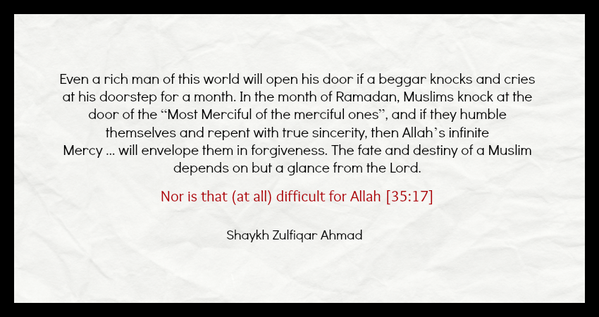
Quotable Quotes - Shaykh Zufiqar Naqshbandi
ummtaalib replied to ummtaalib's topic in Inspiring Quotes & Poems
(click on image to enlarge)
-
-
Virtues of Ramadaan # 3 Special gifts to the Ummah In this month, the Ummah of Rasulullah (sallallahu alayhi wasallam) are given these things specially: The smell from the mouth of a fasting person is more sweeter in the sight of Allah than the fragrant smell of musk. On their behalf the fish in the sea seek forgiveness until they break their fast. For them, Paradise is decorated everyday. For them, the evil minded Shaytaan is chained. On the last night of Ramadhaan they are forgiven. (Ahmad) During each day and night of this month, Allah Ta’ala sets free a great number of souls from Hell. And for every Muslim during each day and night, at least one prayer (Du’aa) is certainly accepted. (Bazzaaz)
-
Virtues of Ramadaan # 2 Sayyiduna Salmaan (radhiyallahu anhu) relates that Rasulullah (sallallahu alayhi wasallam) said, “Ramadhaan is a blessed month. In this month is a night better than a 1000 months. Fasting has been made compulsory and Taraaweeh Sunnah. Whosoever tries drawing nearer to Allah by performing any virtuous deed in this month, for him shall be such reward as if he had performed a ‘Fardh’ in any other time of the year. And whoever performs a ‘Fardh’ for him shall be the reward of seventy ‘Fardh’ in any other time of the year. This is indeed the month of patience, and the reward for patience is Paradise; it is the month of sympathy with one’s fellowmen; this is the month wherein a true believer’s Rizq is increased.” Bayhaqee
-
Virtues of Ramadaan # 1 Ameen of Nabi (sallallahu alayhi wasallam) Sayyiduna Ka’b Ibne ‘Ujrah (radhiyallahu anhu) relates that Rasulullah (sallallahu alayhi wasallam) said, “Come near the pulpit,” and we came near the pulpit. When he ascended the first step of the pulpit, he said, “Aameen.” When he ascended the second step, he said, “Aameen.” When he ascended the third step, he said, “Aameen.” When he descended, we said, “O the Nabi of Allah (sallallahu alayhi wasallam),we have heard from you today something which we never heard before.” He said, “When I ascended the first step, Jibra’eel appeared before me and said, ‘Woe to him who found the blessed month of Ramadhaan and let it pass by without gaining forgiveness.’ Upon that I said: Aameen. When I ascended the second step, he said, ‘Woe to him before whom your name is mentioned and he does not read durood (Salawaat) upon you.’ I replied: Aameen. When I ascended the third step he said, ‘Woe to him in whose presence his parents or either one of them attains old age, and (through failure to serve them ) he is not allowed to enter Paradise.’ I said: Aameen.” Source